
Checking the Apps Before the Show: How to Find a Comic's Real Fair Market Value
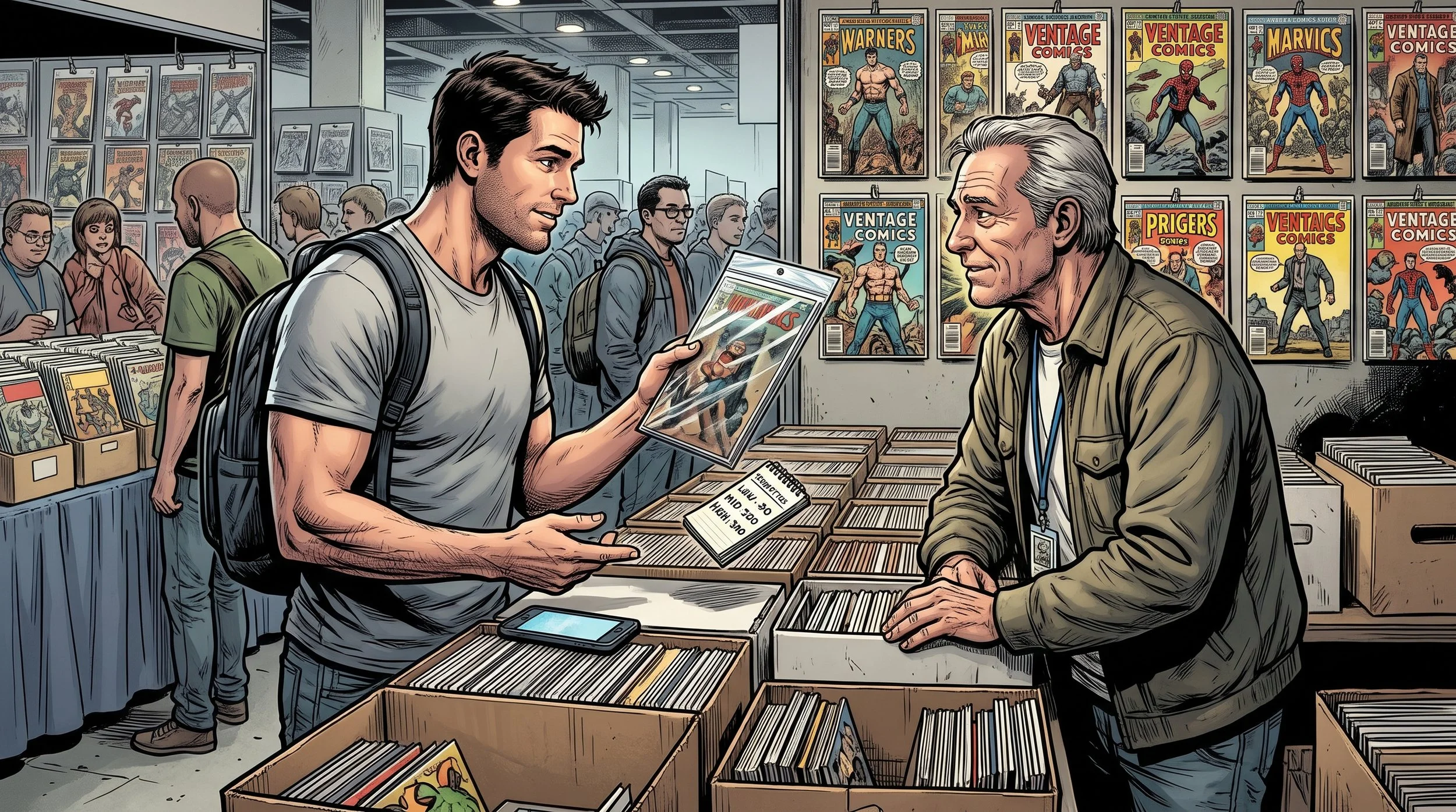
Before you walk up to a convention table, do five minutes of research.
Not vague research. Not “I saw one online for a lot of money” research.
You want a reasonable fair market value range for the exact comic in front of you. That means checking multiple apps, comparing actual sales, looking at supply, and making an honest adjustment for condition.
Then the conversation with the vendor becomes much simpler.
You are no longer asking, “What’s this worth?”
You are asking, “Would you take this amount?”
That is a negotiation. The first question is usually a quiz.
Start by identifying what you are looking at
Every number downstream depends on getting the book right at the beginning.
Write down:
Title
Issue number
Publication year
Publisher
Printing
Variant or regular cover
Newsstand or direct edition
Raw or graded
Apparent condition
Any signatures, restoration, or unusual markings
A first printing and a later printing may have different demand. A newsstand edition may trade differently from a direct edition. A regular cover and a popular variant are not interchangeable.
This is where Key Collector Comics belongs in the process.
Key Collector is useful for determining whether the issue is considered a key at all. It can also help explain why the book matters:
First appearance
First full appearance
Cameo appearance
First cover appearance
First team appearance
Origin
Important storyline
Notable variant
Debatable or incomplete first
That distinction matters. “First appearance” is not always one simple category. A cameo is not the same as a full appearance. A character appearing on a cover is not automatically the character’s first appearance inside the story.
Start here so you know what you are researching.
Do not start with the price.
Use more than one market tool
Once you have identified the exact book, move through the market data in a sensible order.
1. Key Collector Comics: identify the significance
Use Key Collector to establish the context.
You may discover that a book is:
A major key
A minor key
A first cover appearance
A character cameo
A later appearance with strong collector interest
A variant with a separate market
A book that is popular but not especially scarce
That context helps explain demand. It does not, by itself, establish a final purchase price.
A key issue can have strong demand and plentiful supply. A less famous book can have thin supply but limited demand. The market does not reward importance alone.
2. GoCollect: study graded sales and population
GoCollect is particularly useful for graded books. It gives you a way to review fair market value information by grade and examine sales trends.
It can also help you understand the relationship between grade and supply. If many copies exist in a particular grade, a vendor may have more competition when pricing that copy. If high-grade examples are less common, the premium may be stronger, but only if buyers are actually paying it.
This is where population information becomes useful.
Do not confuse rarity with value. A low population can explain a premium. It cannot create one by itself.
3. CovrPrice: get a second opinion across raw and graded copies
CovrPrice is useful because it includes both raw and graded market information when sufficient data is available.
That distinction matters at a convention. Most books on a dealer’s table are not graded. You need a raw comparison for a raw purchase.
CovrPrice also explains an important limitation: its raw condition information is based on how sellers describe their books. A seller calling a comic “near mint” does not make it near mint. Raw grades are opinions until you inspect the book.
Use the app as a second opinion, not as an oracle.
4. GPA/GPAnalysis: look at the longer graded history
For graded books, GPA/GPAnalysis provides historical sales data and analysis across multiple venues.
This is valuable when the most recent sale looks strange.
One sale can be unusually high because two determined bidders wanted the book at the same time. Another can be unusually low because the listing had poor photographs, a damaged case, weak timing, or an undisclosed defect.
The longer view helps you see whether that last sale is part of a pattern or just an anecdote.
5. eBay: use completed listings, not active listings
eBay is useful when you filter carefully.
An active listing is an opinion.
A completed sale is a fact.
That does not mean every completed sale is automatically a perfect comparison. You still need to check the issue, edition, grade, page quality, photos, and whether the listing included something unusual.
But an active listing only tells you what someone hopes to receive. Asking prices tend to cluster above reality. That is normal. Sellers are allowed to aim high. Buyers should not mistake the aim for the landing point.
Search for the exact title and issue. Then filter for sold or completed items. Compare several genuinely similar copies.
Do not quote an unsold listing to a vendor as proof of value. That is how convention conversations become unnecessarily awkward.
Check the grading company population reports
The major grading company population reports answer a different question:
How many copies exist in each grade?
For CGC books, use the CGC Population Report. Other grading companies maintain their own population information as well.
The census will not tell you what a book is worth. It tells you about the certified supply that has been counted.
Look at:
Total copies graded
Number of copies at each grade
Whether high-grade examples are common
Whether the book has a large population but thin demand
Whether the premium grade is genuinely scarce
Also remember what the census does not tell you. It does not count every raw copy in existence. It does not perfectly describe copies still sitting in collections. It does not guarantee that a low-population book will sell quickly.
Treat it as supply context.
Build a range, not one magic number
Your goal is not to find one perfect value.
Your goal is to establish three numbers:
Low: what you would pay for a quick, sensible purchase
Middle: your best estimate of current fair market value
High: what you might accept for an unusually nice copy or a particularly strong transaction
A single sale is an anecdote. Several comparable sales form a range.
If Key Collector identifies the book as a minor key, GoCollect shows a moderate graded market, CovrPrice shows similar raw sales, and eBay completed listings support that range, you have a defensible starting point.
If the sources disagree widely, slow down.
The disagreement may mean:
You have the wrong printing
You are comparing a variant to a regular cover
Raw and graded copies are being mixed
The data is thin
The market moved quickly
Condition descriptions are unreliable
Thin data deserves cautious language. When only a handful of sales exist, the range is soft. Do not present it as mathematical certainty.
Match condition, not just grade
A raw 6.0 and a graded 6.0 are not the same purchase.
A slab provides certification, protection, and a standardized opinion. A raw book gives you the chance to inspect it yourself, and the responsibility to do so carefully.
Two books with the same nominal grade can also have very different defects.
Look for:
Color-breaking spine ticks
Non-color-breaking bends
Creases
Detached staples
Staple rust
Tears
Missing pieces
Water or moisture damage
Trimmed edges
Writing or stamps
Page quality
Gloss loss
Some raw books have presentation problems that may respond to professional comic book pressing and careful cleaning. Non-color-breaking bends, light indentations, and certain waves can sometimes be improved.
That is part of comic book preservation, even if you never plan a CGC grading submission.
But be honest about the limits. Color breaks, rust, trimming, and moisture damage are not erased by wishful thinking. Pressing is not a time machine. Improving comic book grade is possible in some cases, not all cases.
Never pay as though a damaged book is already the best version of itself.
Adjust for the convention venue
An online sale and a convention sale are different transactions.
An online buyer may pay shipping. The seller may pay platform fees. The buyer may wait for delivery. The seller may handle packing, insurance, returns, and payment risk.
At a convention, you can inspect the book immediately. You may pay cash or complete the transaction without shipping. The vendor has also paid for travel, tables, staff, inventory movement, and convention overhead.
That does not mean you should accept any price.
It means you should negotiate fairly.
If you find a completed online sale for a certain amount and demand that the vendor match it exactly, you may be asking them to absorb costs that do not exist in your transaction. Use online sales as evidence, not as a weapon.
A respectful approach sounds like this:
> “I found a few comparable sales in this range. Based on the condition of this copy, would you take $X?”
That gives the vendor room to explain their position. Perhaps the copy has better pages. Perhaps it is a difficult variant. Perhaps you missed a color break. Perhaps the vendor’s cost basis is higher.
You can still say no.
You do not need to make the conversation personal.
Write down your target before you approach
Decide three numbers before you reach the table:
Target: the price that feels like a good buy
Walk-away: the highest price you are genuinely comfortable paying
Stretch: the amount you would pay only because the copy is unusually nice or the book matters to you personally
Put the numbers in your notes or on paper.
This prevents the table from setting your price for you.
It also protects you from the hot-key effect. When a book has a character you love, the market data can suddenly become “less important.” That is how a $90 decision becomes a $150 decision in the time it takes to say, “I’ve been looking for this one.”
If you love something, buy it, but always use caution.
Five mistakes that cost collectors money
Checking one app and treating it as gospel
Every tool has strengths and limitations. Use several.
Using an active listing as a sold price
An asking price is not a market result.
Comparing a slabbed book to a raw book
Certification, protection, and buyer confidence have value. Keep the formats separate.
Ignoring the census
Supply matters, especially when someone is asking for a premium based on scarcity.
Letting a hot key override your research
Popularity creates urgency. Urgency creates poor math.
Your pre-show checklist
Before you shop, record:
Exact title and issue
Printing, variant, or newsstand status
Key significance from Key Collector Comics
Raw and graded references from GoCollect and CovrPrice
Historical graded data from GPA/GPAnalysis when relevant
Several eBay completed listings
Population information from the relevant grading company
Low, middle, and high value range
Target price, walk-away price, and stretch price
Then inspect the actual copy.
The apps give you a range. The vendor defends their cost basis. Condition can move the number in either direction.
The fair price is the one both of you can live with.