
Is Slabbing a Thing of the Past? Only for Ultra-High-End Grails, 9.8s, and Boomers?
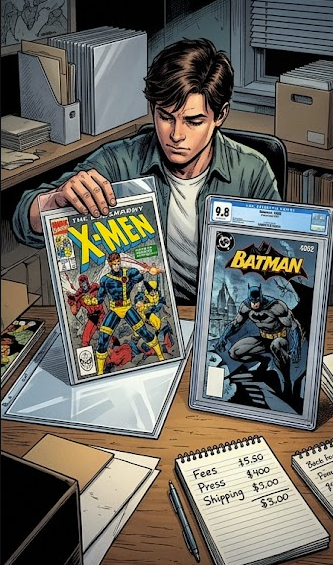
Slabbing still has a place in comic collecting. But is grading becoming a selective service for expensive keys and high-grade books, not a default step for every comic? The cost of a CGC grading submission, changing collector habits, and the appeal of raw books make that a fair question. The answer may depend less on age or trend than on the book, the math, and what you want from your collection.
What did slabbing actually bring to comic collecting?
Before asking whether slabbing has gone too far, give it credit for what it solved.
Third-party grading gave collectors a shared language for condition. A certified grade can make a book easier to compare, insure, store, and sell, especially when the buyer and seller are far apart. Encapsulation also adds a layer of physical protection and makes tampering more apparent, though no holder can eliminate every risk or guarantee authenticity on its own.
That structure improved price transparency and liquidity. A buyer considering a graded copy can compare it with sales of other copies carrying the same grade and label. The CGC Census adds population context: how many copies of an issue have been certified, and how those copies are distributed by grade.
Those benefits matter most when condition changes value significantly, or when confidence and convenience are worth paying for. A slab can serve the book. The trouble starts when it becomes an automatic step.
Is comic book slabbing mainly for Boomers?
It is tempting to say that older collectors grade and younger collectors stay raw. But that is a broad claim, not a proven rule. We should treat it as an open question, not a demographic fact.
There are observable signals worth considering. Raw books remain easy to find in collector communities and at shops and conventions. Younger collectors may be drawn to reading copies, cover variants, and building runs without paying the extra costs of certification. And a grading tier can be hard to justify when its full cost approaches the value of the comic itself.
At the same time, younger collectors buy slabs, and long-time collectors buy raw books. A generation does not collect with one mind. People choose based on budget, goals, trust, and how they enjoy handling their books.
The useful question isn’t “Which generation slabs?” It’s “What does a slab do for this book and for me?”
Does a CGC grading submission still make financial sense?
Run the full math, not just the grading fee. Add pressing if needed, shipping to and from the grader, insurance, any applicable handling or membership costs, and selling fees if you expect to sell. Then compare that total with the realistic difference between the book’s raw value and its likely graded value.
The higher the book’s value, the easier it can be to justify those costs. At the low end, fees can swallow the potential premium. A hopeful grade is not a financial plan.
Our general guidance is to consider professional pressing around the $200 level and up, and professional handling for keys over $500. Those are review points, not guarantees that pressing or grading will pay off. Grading makes financial sense only when the book’s realistic post-grade value justifies the full pipeline cost.
For current service options and fees, check the grading companies’ published schedules before you submit. CGC’s grading page and PSA’s comics and magazines page are useful starting points. Fees and turnaround estimates can change.
Is slabbing only worth it for 9.8s and ultra-high-end grails?
No. A 9.8 is not the only reason to grade, and a high-value book is not automatically a good submission. Certification can be useful for a key with significant condition sensitivity, a scarce book, or a comic you want protected and legible to distant buyers.
But there are also excellent reasons not to grade. You may want to read the book. You may prefer to inspect the paper and cover yourself. Or you may be collecting a run of under-the-radar keys that you personally value for a character, story, or first appearance, where the slab premium does not make sense for your budget.
A raw book is not a careless book. Archival Mylar, suitable backing boards, and stable storage help protect a collection without encapsulation. Professional comic book pressing and cleaning can improve presentation on some raw books with non-color-breaking defects. Done appropriately, those processes are intended to preserve the book in an unrestored state, not add material or promise a grade increase.
Collectors searching “how to clean comic books” or “remove spine ticks comics” should slow down before trying a new technique. Professional comic book dry cleaning and pressing involve risk. Do not experiment on an expensive key; test unfamiliar methods only on a dollar book you can afford to damage. Professionals avoid dry cleaning with drafting powder because it can leave residue, affect the surface, or abrade the cover. If a book matters to you, have it assessed before attempting treatment.
Has CGC and PSA killed the golden goose?
That’s a sharp question, but the evidence does not justify blaming either company for killing the hobby. CGC remains the industry leader and the grading service we assist collectors in submitting to. Certification has brought real structure to the market.
The fair question is whether grading fees, tier complexity, and turnaround economics have outrun the value of some books being submitted, and whether that pushes more average collectors toward raw books. That is a question about affordability and fit, not proof of a collapse.
Our view is that PSA’s comics strategy risked treating comic collectors too much like sports-card collectors. Comics have their own habits, history, and reasons for collecting. That is a critique of positioning, not a claim that PSA has harmed the hobby or that collectors should dismiss its services. Buyers can compare the labels, sales history, and features for themselves.
The best response is not to take anyone’s narrative, including ours, on faith. Look at books you actually collect.
How can you check whether raw or graded comics are selling better?
Use completed sales, not asking prices. Compare similar books, in similar condition, and account for the grading company and selling fees. For an under-the-radar key issue, compare raw and graded copies of that same issue rather than borrowing conclusions from a famous grail.
You can check completed sales on eBay, market data through GoCollect and CovrPrice, and graded sales history through GPA/GPAnalysis. Use Key Collector Comics for key-issue context and the CGC Census for certified population information.
Each source answers a different question. A census is not a count of every copy in existence, and a low population does not guarantee demand. Sales are snapshots, not promises.
Should you grade by default, or only for a reason?
A disciplined submission strategy beats sending every interesting book.
Use a 9.8 prescreen when the economics depend on reaching that threshold. A rejected book is still yours; inspect it again before deciding whether another attempt makes sense.
Batch by era to keep submissions organized and make the process more efficient.
Resubmit selectively. A book that misses a prescreen is not automatically a better candidate next time. Reassess its condition, likely grade, and costs first.
Keep the goal in view. A slab should serve the book and the collector, not the other way around.
The five golden rules of pressing and cleaning
Do no harm.
Do not perform an action on a comic book that it does not need.
Handle each comic book with care to avoid causing new damage during any movement.
Document your work with photos to ensure actions have a demonstrable effect and avoid repeating ineffective actions.
Treat every action as having inherent risk, acting strategically rather than on a whim.
For collectors unsure whether a book merits treatment or grading, a complimentary value analysis can help clarify the likely costs and options. The goal is an informed decision, not a guaranteed grade bump.
Is slabbing dying? Our balanced read
Probably not. But its center of gravity may be shifting: concentrated at the high end, optional in the middle, and skipped at the low end when fees outrun value. That is our read of the pattern, not a prediction or a verdict on any generation.
Raw collecting offers affordability, hands-on inspection, and the pleasure of opening a comic. Slabbing offers standardization, protection, and a widely understood condition record. Both are legitimate ways to collect.
Key takeaways
Slabbing brought standardization, liquidity, price transparency, and added protection to the hobby.
Whether younger collectors grade less is an open question, not an established demographic fact.
Judge a submission by its full cost and realistic outcome, not by the hoped-for grade.
Raw books still deserve good comic book preservation.
Compare sales and population data for the comics you collect before accepting a broad market narrative.
Grade when certification serves the book and your goals. Keep it raw when it doesn’t.
if you love something, buy it, but always use caution.