

Choosing a comic book presser can feel like a technical decision. You compare before-and-after photos, ask what defects they can improve, and look for signs of a steady hand.
That matters. But it is only about 10% of the decision.
The remaining 90% is about how you and your books will be treated.
This 90/10 framework is a way to organize your decision, not an industry statistic. The point is simple: pressing and cleaning are the technical service. What you are really choosing is a custodian: someone who will hold your comic, make decisions about it, and act on it while you cannot watch.
The 10%: Verify comic book pressing and cleaning competence
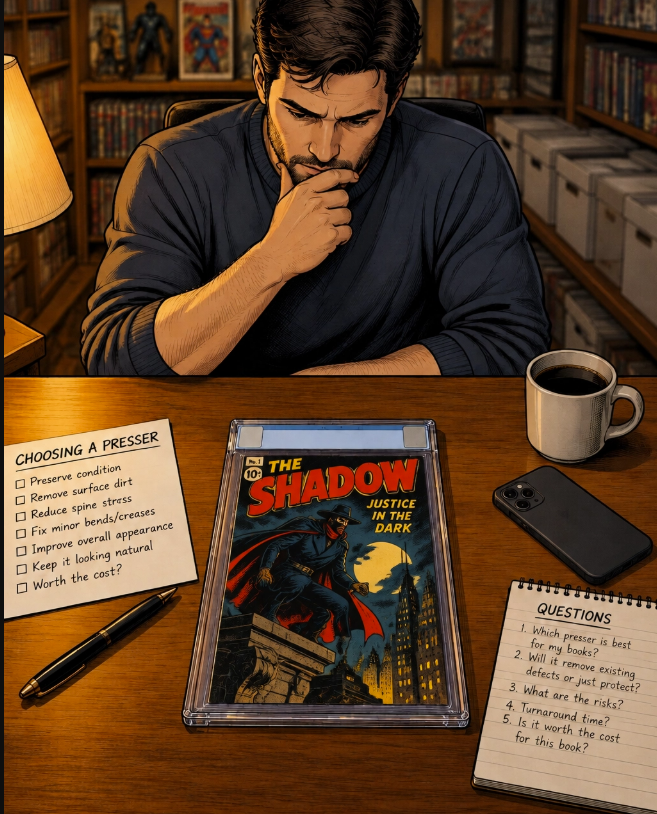
Start by checking whether the presser can do the work. Then move on. Don’t make a portfolio of dramatic before-and-after photos the whole decision.
Look for careful handling, clean results on appropriate non-color-breaking defects, and restraint. A professional should be able to explain what pressing may improve, and what it cannot. Color-breaking creases, missing pieces, and some stains will not disappear just because a book goes through a press. Even a successful press may not lead to a higher grade. As CGC explains, there is no guaranteed grade outcome.
For a quick competence check, ask to see examples, request references, and listen to how the presser talks about limitations. Before-and-after photos are useful when they show the same area under comparable lighting and the presser can explain what changed.
A competent professional should not promise miracles. They should describe the work, its limits, and its risks clearly.
As a practical guide, consider professional pressing for books worth around $200 or more, and seek professional eyes for key issues above $500. These are caution markers, not universal rules. The higher the value or personal importance of a book, the more careful you should be about who handles it.
The baseline matters. It just isn’t the whole job.
The 90%: Questions that protect your books and your trust
How well will they communicate?
A good answer: They explain when you will hear from them, how they handle delays, and whether you’ll receive photo updates during the work. You know whom to contact and don’t have to chase them for basic information.
A red flag: “Trust me.” Vague answers about the process. No photos, no clear updates, and no explanation of what happens next.
You are trusting someone with a book you may have spent years finding. Clear communication is part of that care.
How will your books be kept safe?
Ask where the books are stored, whether each customer’s books are kept identifiable and separate, and how intake is documented. Ask what insurance applies while the books are in the presser’s custody, during work, and in transit both ways. Ask about limits and exclusions. “We’re insured” is a starting point, not a complete answer.
A good answer: A specific intake process, clear records, careful storage, and a direct explanation of the insurance terms.
A red flag: No intake photos, unclear responsibility, or books mixed together without reliable identification.
For a closer look at why documentation and custody matter, read Trust, Verified: How Chain of Custody Protects Your Comic Books.
Will your comic come back the way you expect?
Agree on the return process before you ship. Ask how your book will be protected in storage and packed for its return. A careful return should include proper bagging and boarding, a rigid box with padding, and a packing list. Ask whether moisture protection, such as silica gel, is appropriate for the shipment.
A good answer: A specific explanation of how the presser identifies, protects, and returns each book.
A red flag: “We ship comics all the time,” without an answer about packing, tracking, or responsibility.
The final handoff is part of the service. A carefully pressed comic can still be put at risk by careless packing.
Will they make sound decisions about risk?
Every action has some risk. A responsible presser assesses what a book needs, whether the potential benefit justifies intervention, and when to stop. Ask how they evaluate fragile paper, weak staples, color-breaking defects, and other concerns before work begins.
A good answer: They can describe their assessment process, explain which actions they would take, and say when they would decline to proceed. The post Every Action Carries Risk: How a Professional Presser Weighs Every Move From Package to CGC Submission is a useful companion.
A red flag: Treating every book as a standard job, or presenting pressing as risk-free.
A presser should not just know how to act. They should know when to pause.
Will they give you realistic grade expectations?
Ask what grade range seems plausible, what defects may remain, and what the limits of a prescreen are. A prescreen can help assess whether a book may meet a target. It cannot guarantee a grade.
A good answer: “A 9.8 may be possible, but it is not promised.” They explain the known defects and distinguish a possibility from a likely result.
A red flag: A guaranteed grade or language that makes the best-case outcome sound certain.
Grade expectations are estimates. CGC makes its own grading decision, and the presser does not control it.
Will they give you honest value and return-on-investment expectations?
Ask for the math before you spend: the book’s current likely value, the possible result after cleaning and pressing, and the costs of pressing, grading, shipping, and selling. Use realistic comparisons, not the highest sale you can find.
A good answer: They show their assumptions, discuss uncertainty, and explain when the possible increase may not cover the total cost.
A red flag: “This will definitely be worth more after pressing.”
Improving comic book grade is not the same as improving your financial position. Hope is not a calculation.
Will they tell you when pressing isn’t the right choice?
This may be the most important question: “When would you tell me not to press this book?”
A presser who recommends work for every book may be prioritizing their own revenue over your collection. Some books have little to gain. Some defects will not respond. Some books may be too fragile to justify the risk.
A good answer: They can give examples of when they would recommend doing nothing, doing less, or choosing another path.
A red flag: They have no conditions under which they would decline work.
The best professionals sometimes talk themselves out of a job. That is not a failure to sell. It is sound judgment.
Are they an asset to collectors, or just selling confidence?
An asset to the comic book community leaves collectors better informed, even when the advice costs them a job. An extractor sells confidence to people who may not know enough to question it.
This is about standards and behavior, not a label to stick on a competitor. Look for a professional who helps you understand the decision rather than pressuring you toward it.
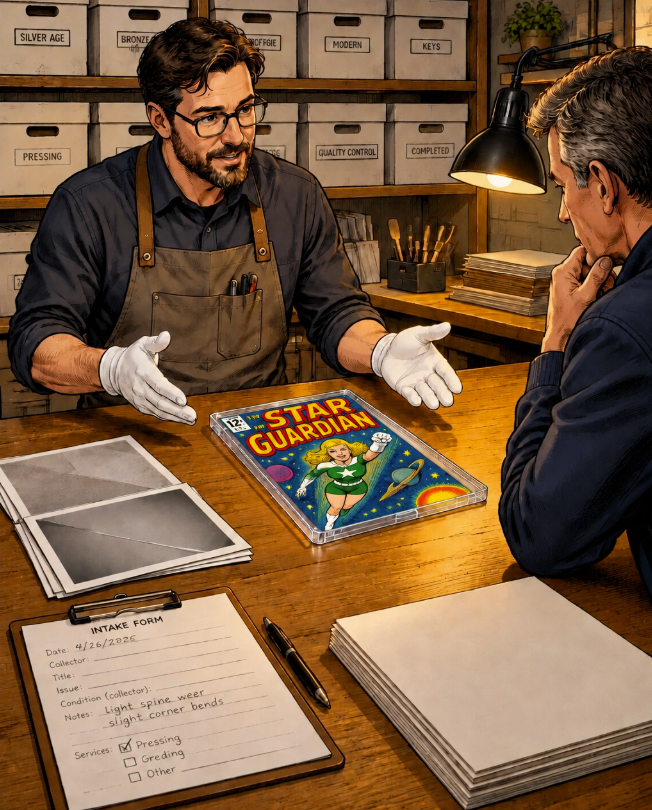
Questions to ask before you ship
Use this checklist in a conversation or email:
When will I receive updates, and will I get photo updates during the process?
How do you document books when they arrive, and how are they stored?
What insurance applies while the books are with you and in transit both ways? What are the limits and exclusions?
How will you photograph and assess my books before and after work?
How do you decide whether a defect or book is too risky to treat?
What grade range do you think is realistic, and what defects could keep the book from reaching it?
What are your estimated value and return expectations after accounting for the full cost?
When would you tell me not to press a particular book?
How will my books be packed, tracked, and returned?
Strong answers are specific and process-oriented. The presser is willing to explain, show documentation, and say no.
What doing it right looks like
At Pressing Issues, the 90% starts before work: every book receives a complimentary value analysis to help determine whether pressing makes sense at all. Photo updates are standard, the unrestored standard is maintained, and value-focused appraisals are intended to set realistic expectations, not promise a grade or return. The goal is to pair clear communication and a stated turnaround with a careful decision about each individual comic.
That is an example of the larger principle: the service should fit the book, not the other way around.
What I have learned: You are hiring judgment
Collectors rarely worry only about whether a press can flatten a bend. They worry about what happens after their book leaves their hands: whether someone will notice a fragile area, communicate a problem, protect the comic, and tell the truth about what pressing can accomplish.
That is why the technical work is only the first filter. You are not just hiring a press. You are hiring judgment.
The press can be replicated. The treatment cannot.
Key takeaways
Treat pressing skill as the baseline. Check it, then evaluate the whole service.
Ask about communication, custody, insurance, documentation, and return packing before shipping.
Look for realistic grade and value expectations, not promises.
A trustworthy presser will explain risks and sometimes recommend no work.
Choose the person who treats your comic and your decision with respect.
If you love something, buy it, but always use caution.