
Gen X, Millennials, and Gen Z Collect Comics Differently : Here's What Each Generation Can Learn
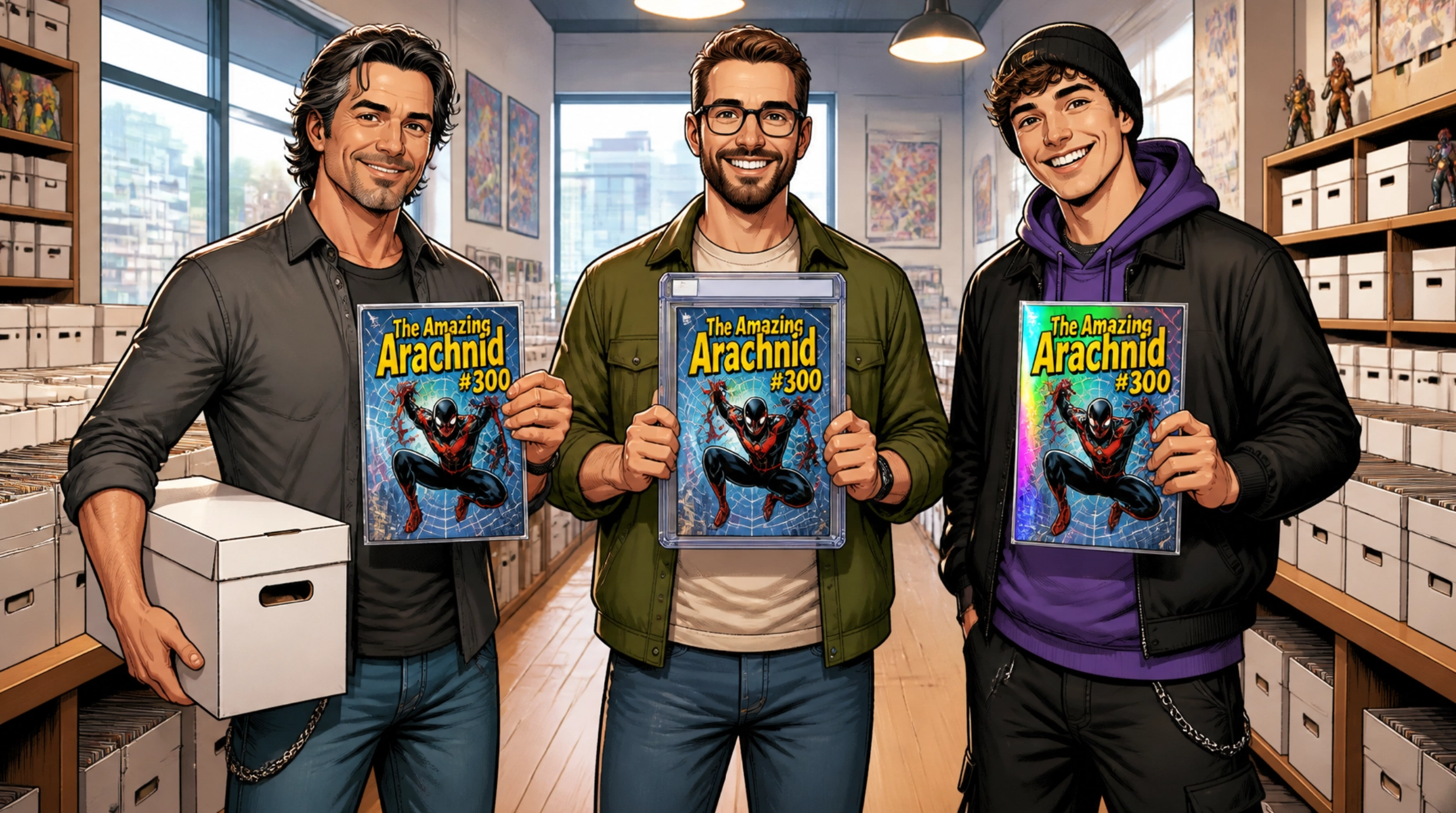
Comic book collecting is not one hobby anymore.
It is several hobbies sharing the same characters, publishers, conventions, and market.
A Gen X collector may begin with a childhood memory of Batman, X-Men, or a comic pulled from a newsstand spinner. A Millennial collector may begin by studying the 1990s speculator boom, graded market data, and auction results. A Gen Z collector may discover a new series through TikTok, YouTube, a creator recommendation, or a Wednesday trip to the local comic shop.
None of these approaches is automatically better.
They are products of different entry points, technologies, and financial realities.
For this comparison, Swagglehaus, also known as Mickey Finnegan, represents a Gen X collecting voice. David Wilson of Collectors Comics and ComicBookInvestments represents a Millennial market-minded voice. Nate Nielsen, known online as speedsultan, represents a Gen Z community-focused voice.
That does not mean any of them speaks for an entire generation. It means their public content offers useful examples of three different ways to approach comic book collecting.
The three collecting mindsets

The simplest way to understand the difference is to identify what each collector uses as a starting point.
Gen X often starts with memory and historical significance.
Millennials often start with market data and condition.
Gen Z often starts with community, creators, and current releases.
These are tendencies, not rules.
A collector can be all three at once.
Gen X: the nostalgia anchor
Mickey Finnegan’s Swagglehaus content reflects a collector who connects comics to history, personal memory, and long-term significance. His collecting voice is informed by the late-1980s and 1990s experience, including the cultural impact of Tim Burton’s Batman and the process of discovering older books through back-issue shops and historical context.
His weekly TRENDING COMICS videos use current market information, but the larger message is practical: understand why a comic matters, collect within your means, and do not confuse temporary excitement with lasting importance.
That is a valuable Gen X lesson.
Nostalgia can point you toward the right book. It can help you understand why a character or creator has endured. It can also make you overpay.
Possibility can make us see what we want to see.
A collector chasing an under-the-radar X-Men key such as Uncanny X-Men #221, the first appearance of Mister Sinister, should separate personal attachment from market assumptions. The book may be historically important. That does not mean every copy is worth submitting, pressing, or buying at any price.
Gen X collectors also tend to understand the appeal of the complete run. A run of Uncanny X-Men may matter more than one expensive issue because it tells a larger story. The long box is not just storage. It is an archive.
Millennials: the market system
David Wilson’s public work through Collectors Comics and the ComicBookInvestments channel reflects a more analytical approach.
David and his brother Thomas built their comic business through dealing, eBay, auctions, and marketplace experience. Their platforms emphasize transaction history, buyer and seller trust, supply, demand, and the practical realities of moving inventory.
That is a useful Millennial lesson.
The market is not a feeling.
When you evaluate comic book market value, you need real sales. Asking prices are not proof. A seller can list a comic for $5,000. That does not mean anyone will pay $5,000.
Use several sources:
GoCollect for graded sales and price trends.
CovrPrice for raw and graded market data.
GPA for historical graded sales.
Heritage Auctions for auction archives and higher-value material.
eBay sold listings for a broad range of completed transactions.
Key Collector Comics for identifying key issues and first appearances.
The Millennial collector is also more likely to think in terms of inventory quality. Is the book raw or graded? Is the grade supported by the defects? Is the copy scarce in that condition? Is the demand strong enough to justify the cost of acquisition and grading?
That approach is especially useful for modern variants, blue-chip keys, and graded comic books.
But data has limits.
A price chart cannot tell you why you love a comic. A census report cannot tell you whether a book belongs in your collection.
The CGC Census shows how many books CGC has graded. It does not show every copy in existence. It does not measure total demand. Treat census numbers as evidence, not a final verdict.
Gen Z: the community experience
Nate Nielsen’s speedsultan content shows another entry point into the hobby.
His public videos include New Comic Book Day routines, store pickups, pull lists, collection updates, convention experiences, and day-in-the-life content. In his Q&A material, he explains that he is often a reader first with new releases: if he is not excited to read an ongoing series, he may drop it, even if the book could potentially increase in value.
That is a strong Gen Z lesson.
A comic does not have to be an investment before it earns a place in your life.
Modern collectors may discover books through YouTube, TikTok, Instagram, podcasts, and creator-driven recommendations. The local comic shop is still important, but it is no longer the only doorway.
The Gen Z collector is also more comfortable making the hobby visible. A pull list becomes content. A room tour becomes a conversation. A store pickup becomes a recommendation. A new variant becomes part of a community discussion before it ever becomes a long-term collectible.
This is particularly visible in modern buying habits:
Ratio variants such as 1:25 and 1:50 incentives.
Selective artist variants.
New number ones and first appearances.
Modern releases from Marvel, DC, and Image.
A choice between reading the book and preserving it in high grade.
Trades, omnibuses, digital reading, and single issues existing together.
The risk is obvious.
Modern supply can be enormous. Hype moves quickly. A 1:50 variant may be difficult to find at release and still fail to maintain demand later.
The correct question is not, “Is this scarce?”
Ask, “Do people still want it?”
How the generations find value
The answer is not to choose one column.
The answer is to use the strongest part of each.
What each generation can learn from the others
What Gen X can learn
Use modern data tools.
Historical importance matters, but current prices still depend on condition, supply, demand, and buyer behavior. Check completed sales before assuming a book is undervalued.
An under-the-radar issue such as Uncanny X-Men #244, Jubilee’s first appearance, may be meaningful to you. Research the actual spread between raw copies, mid-grade slabs, and high-grade examples before making a submission decision.
What Millennials can learn
Leave room for enjoyment.
Not every comic needs a profit thesis. Some books are worth owning because they remind you who you were, what you read, or who introduced you to the hobby.
A market downturn does not make a personal favorite worthless.
What Gen Z can learn
Patience beats the algorithm.
A trending video can create demand overnight. It can also create a buying rush that disappears just as quickly. Read the issue. Inspect the production quality. Check print runs and completed sales. Then decide.
You do not need every variant.
You need a system.
Why all three generations are good for comics
Gen X nostalgia creates the historical foundation. It keeps older runs, creators, and key issues in the conversation. That nostalgia often fuels Millennial buying decisions: a collector may learn about an important book through an older fan, then use auction data to determine which copy makes financial sense.
Millennial analysis creates structure. It helps collectors distinguish market value from asking price and rarity from census noise. Dealers, auction platforms, and pricing databases make the hobby more transparent.
Gen Z community energy creates new demand. It brings current readers into comic shops, exposes independent creators to wider audiences, and makes collecting feel active instead of isolated.
The generations feed each other.
That is healthy.
Where pressing and cleaning fit
Preparation work serves every collecting style.
You may have a Gen X-era raw key with spine stress. You may have a Millennial collection of graded books that needs better selection before the next submission. You may have a modern variant with a non-color-breaking bend from shipping.
Comic book pressing and comic book cleaning can improve certain defects without changing a comic’s unrestored status. But pressing cannot repair color-breaking creases, missing paper, tears, or detached staples.
Slow down and inspect closely.
At Pressing Issues, a complimentary value analysis helps determine whether a book is worth preparing for grading. The calculation is simple:
Expected post-submission value – pressing, cleaning, grading, shipping, insurance, and selling costs = projected result
If the math does not work, keep the book raw.
That is not a failure. It is discipline.
What I have learned
What I have learned is that collectors usually do not disagree about comics as much as they disagree about the purpose of collecting.
One person wants a complete run. Another wants the highest possible grade. Another wants to read every issue on New Comic Book Day and share the experience with friends.
All three are legitimate.
If you love something, buy it, but always use caution.
Enjoy the memory. Check the data. Join the community. Then make the decision with your eyes open.
Key Takeaways
Gen X collecting often emphasizes nostalgia, history, runs, and long-term significance.
Millennial collecting often emphasizes market data, graded comic books, supply, demand, and resale math.
Gen Z collecting often emphasizes reading, community, creators, modern releases, and social discovery.
No generation has the complete answer.
Use GoCollect, CovrPrice, GPA, Heritage Auctions, eBay, Key Collector Comics, and the CGC Census as research tools.
Do not mistake hype, scarcity, or asking prices for guaranteed value.
Pressing and cleaning can help collectors of every generation when the defects are appropriate and the math works.
The best comic book community combines history, analysis, and enthusiasm.
If you love something, buy it, but always use caution.