
How to Choose Which Comics to Send for Pressing
Every collector knows the feeling.
You pull a stack of books from a long box, lay them out under the light, and start asking the same nervous question over and over:
“Is this one worth pressing?”
It sounds simple, but it rarely feels simple. One book has a small spine tick. Another has a light bend near the corner. Another might be a key issue, but the fair market value only makes sense if it can move up a grade. Suddenly, what started as an exciting submission turns into a little cloud of doubt.
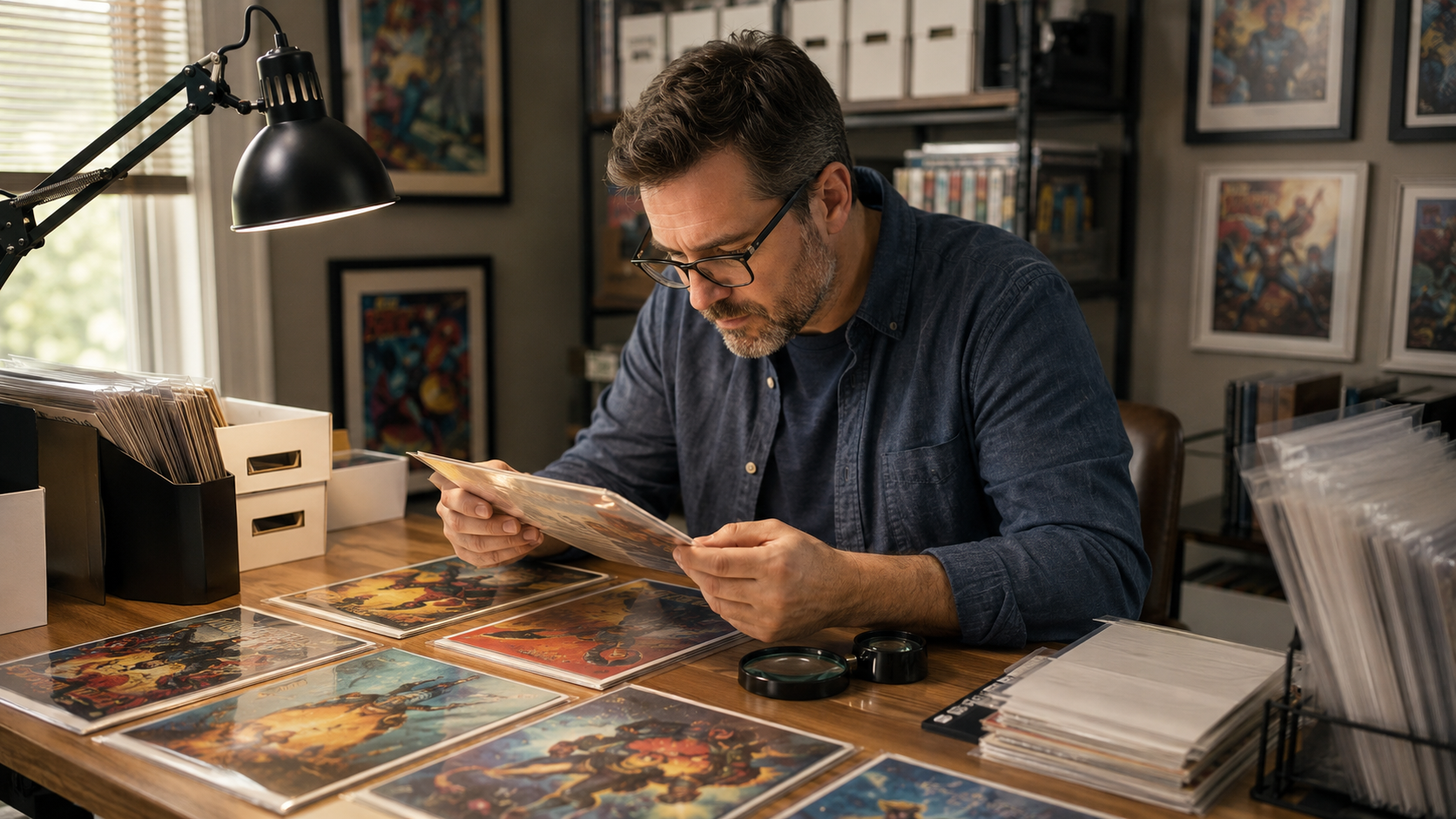
Nervous about which comics to press? Learn how to inspect defects, estimate grade potential, check fair market value, and choose the right books for pressing.
At Pressing Issues, we work with collectors who feel this exact uncertainty all the time. The good news is that you do not need to guess blindly. You can slow the process down, inspect your books clearly, compare likely grade movement against fair market value, and make a more confident decision before spending money on pressing, cleaning, grading, shipping, and insurance.
This guide walks you through a practical process for deciding which comics are worth sending for pressing.
Why collectors get nervous before sending books for pressing
Collectors are nervous because the decision carries real stakes.
A good pressing candidate can improve visually, grade higher, and increase in value. A poor pressing candidate may look a little better, but still come back with the same limiting defects. In some cases, pressing a book with the wrong kind of damage can even make the collector feel like they paid for hope instead of results.
That is the emotional trap: pressing feels like possibility.
And possibility can make us see what we want to see.
The best way out of that trap is not cynicism. It is process. Before submitting a book, ask three basic questions:
What defects does the comic actually have?
Are those defects pressable?
Does the possible grade improvement justify the total cost?
If the answer to all three is yes, the book may be a strong pressing candidate. If one answer is unclear, that is where a professional assessment can save you from a disappointing submission.
Step 1: Start with the book, not the value
It is tempting to begin with price. Collectors often look up the fair market value first, see a big number in a higher grade, and then start imagining the book into that grade.
That is backwards.
Start with the physical comic. The book itself tells you what is possible.
Remove the comic carefully from its bag and board. Wash and dry your hands first, or use whatever handling method you trust most. Work on a clean, flat surface. Use a bright light source, ideally angled across the cover rather than shining straight down.
Flat overhead light hides defects. Angled light reveals them.
Look slowly across the front cover, back cover, spine, corners, edges, and center of the book. You are looking for texture changes: tiny dents, ripples, bends, waviness, thumb impressions, stacking bends, light spine roll, and non-color-breaking creases.
These are the kinds of defects that may respond well to pressing.
Step 2: Separate pressable defects from permanent defects
This is the most important part of the process.
A pressable defect is usually a defect in shape, not a defect in material.
Pressing can often help with:
Non-color-breaking bends
Light corner bends
Minor spine roll
Cover rippling
Light waviness from storage
Small dents or impressions
Some spine ticks where the ink has not broken
Pressable bends caused by stacking or shipping
Pressing cannot fix defects where the paper, ink, or structure has been permanently damaged.
Pressing will not remove:
Color-breaking creases
Tears
Missing pieces
Chipping
Detached staples
Rusted staples
Stains
Foxing
Sun fading
Tape or tape residue
Heavy water damage
Ink loss
Blunted corners with broken fibers
The easiest test is the color-break test.
Hold the book under angled light and look closely at each crease or tick. If the defect bends the surface but the ink remains intact, it may be pressable. If the defect shows a white, gray, or broken line where the ink has split, pressing will not erase it.
A press may improve the presentation of the book overall, but that color break will still be there when the grader sees it.
Step 3: Make a simple defect list
Before thinking about grading, write down what you actually see.
For each comic, make a quick note:
Title / issue:
Estimated current grade:
Pressable defects:
Non-pressable defects:
Possible post-press grade:
Fair market value at current grade:
Fair market value at possible grade:
Decision:
This does not need to be complicated. Even a few handwritten notes can prevent wishful thinking.
For example:
Amazing Spider-Man #___
Current estimate: 7.0
Pressable defects: light spine roll, back cover bend
Non-pressable defects: two color-breaking spine ticks, small corner chip
Possible post-press grade: 7.5–8.0
Decision: Maybe, depending on FMV spread
That small note creates clarity. The book may improve, but the corner chip and color-breaking ticks are still grade-limiting defects. Now you are evaluating the actual book, not the fantasy version of the book.
Step 4: Estimate the current grade honestly
This is where many collectors get into trouble.
Most of us grade our own books too generously, especially when the book is valuable or personally meaningful. A comic we love can start looking like a 9.4 simply because we want it to be one.
Try to estimate the current grade as if you were buying the book from someone else.
Ask yourself:
Would I be happy receiving this as a 9.2?
Would I complain if this were sold to me as an 8.5?
Are there obvious color breaks?
Are the corners sharp?
Is the spine clean?
Is the back cover being ignored because I want the front cover to carry the grade?
Would a grader see this defect immediately?
The back cover matters. The interior matters. The staples matter. The edges matter.
A comic is not graded by its best feature. It is graded by the total accumulation of defects.
Step 5: Estimate the realistic post-press grade
Once you have a current grade estimate, ask what pressing can realistically improve.
If the book is mostly limited by pressable defects, a grade bump may be possible.
If the book is mostly limited by color breaks, tears, chips, stains, or rounded corners, pressing may improve the look but not dramatically change the grade.
A helpful way to think about it:
A 9.2 with one small non-color-breaking bend might have real 9.6 or 9.8 potential.
An 8.0 with light rippling and a few non-color-breaking bends might have 8.5 or 9.0 potential.
A 6.0 with color-breaking spine wear, a corner crease, and a small tear may still be a 6.0 after pressing, even if it presents better.
A 4.0 with heavy waviness and spine roll may improve visually, but if the book also has staining, paper loss, or major color breaks, the ceiling remains limited.
The question is not “Can this book look better?”
The question is “Can this book look better in a way that changes the grade?”
Step 6: Check fair market value before deciding
Now you can look at value.
Fair market value matters because pressing is part of a larger cost equation. If you are planning to grade the comic, you are not only paying for pressing. You may also be paying for cleaning, grading, shipping, insurance, handling, and time.
Look up recent sold prices, not just asking prices.
Asking prices show what sellers hope to get. Sold prices show what buyers are actually paying.
Check values in the current estimated grade and the realistic post-press grade. For graded books, compare the same grading company when possible. A CGC 9.4, CBCS 9.4, and raw “NM” copy may not all sell for the same amount.
For each book, ask:
What is this worth in its current condition?
What might it be worth if it improves by half a grade?
What might it be worth if it improves by a full grade?
Does that increase exceed the total cost of pressing, cleaning, grading, shipping, and insurance?
Is the book liquid enough that the value matters?
Am I pressing for resale, grading, preservation, or personal satisfaction?
That last question matters.
Not every pressing decision has to be purely financial. Sometimes a collector wants a personal favorite to look its best. That is perfectly valid. But it is important to know when you are making a value decision and when you are making a personal collection decision.
Step 7: Sort books into three piles
Once you have inspected the defects and checked the values, sort the books into three groups.
Pile 1: Strong pressing candidates
These are books with clear pressable defects and meaningful value upside.
Examples:
Key issues with non-color-breaking bends
High-grade modern books with one or two correctable defects
Bronze, Copper, or Modern keys where a grade bump changes value significantly
Books with light spine roll or stacking bends
Books that look structurally strong but need presentation improvement before grading
These are the books most likely to justify the investment.
Pile 2: Maybe candidates
These books could benefit from pressing, but the value math or defect profile is unclear.
Examples:
Books with both pressable and non-pressable defects
Books where the grade bump may be too small to justify grading
Mid-grade keys where presentation will improve but grade movement is uncertain
Books with sentimental value but limited market value
Books where you are unsure whether the main defect breaks color
This is the pile where professional evaluation helps most.
Pile 3: Skip or hold candidates
These are books where pressing probably does not make sense right now.
Examples:
Low-value reader copies
Books dominated by color-breaking defects
Books with staining, tears, chips, or water damage
Books where grading costs exceed likely value gain
Books that already present well and have no meaningful pressable defects
Skipping a book is not failure. It is good collecting discipline.
Sometimes the smartest pressing decision is not to press.
Common mistake: submitting the whole stack
Collectors often want to send the whole stack because it feels efficient. But not every book in a stack deserves the same treatment.
A strong submission is curated.
If ten books are on the table, maybe three are obvious pressing candidates, four need closer review, and three should stay raw. That is normal.
Pressing every book because “they might all improve” can quickly turn into wasted money. A better approach is to let the defects and value guide the submission.
At Pressing Issues, this is one reason we believe in complimentary value analysis. Collectors deserve to understand the potential benefit before work begins. The goal is not to press every comic. The goal is to press the right comics.
Common mistake: chasing 9.8 on the wrong book
The 9.8 chase is real.
For modern comics, the difference between 9.6 and 9.8 can be enormous. But the closer a book gets to 9.8, the less room there is for any defect at all.
A press can help unlock 9.8 potential if the book is already extremely sharp and held back by a minor pressable flaw. But pressing cannot turn a book with multiple color-breaking spine ticks, corner wear, or manufacturing issues into a 9.8.
The book has to have 9.8 potential already.
Pressing does not create a perfect book. It reveals the best version of the book that is already there.
Common mistake: ignoring cleaning
Pressing and cleaning are related, but they are not the same service.
If a book has surface dirt, grime, pencil marks, light soiling, or other removable contamination, cleaning may be part of the correct preparation process. In many cases, cleaning should happen before pressing.
Pressing a dirty book can set contamination deeper into the paper or cover surface. That is why a good evaluation looks at both structure and surface.
Ask:
Is the defect a bend?
Is it dirt?
Is it staining?
Is it removable?
Is it permanent?
Should this be cleaned before it is pressed?
The right sequence matters.
A simple decision formula
Here is the basic formula collectors can use:
Press the book if:
The main defects are pressable
The possible grade bump is realistic
The fair market value increase exceeds the total cost
The book is worth the risk and handling
You trust the person doing the work
Skip the book if:
The main defects are permanent
The value increase is too small
The book is low value and already presents fine
You are relying on hope instead of visible defects
The cost of grading and pressing exceeds the likely upside
When in doubt, slow down. The book will still be there tomorrow.
What I have learned from years of looking at collector submissions
The best pressing decisions usually come from patience.
The collectors who do well are not always the ones with the biggest keys or the most expensive collections. They are the ones who learn to look carefully. They inspect under good light. They separate pressable defects from permanent defects. They check fair market value before committing money. And when they are not sure, they ask for another set of eyes.
I have seen collectors pass on books that were not good candidates, saving themselves grading fees and frustration. I have also seen overlooked books turn into excellent submissions because one small non-color-breaking bend was holding back an otherwise beautiful copy.
That is the sweet spot.
Not magic. Not hype. Just a careful eye, an honest assessment, and the right work performed on the right book.
At Pressing Issues, that is the heart of the process: collector to collector, book by book, crease by crease.
— Charles
Professional pressing and value analysis for your collection
Pressing Issues helps collectors decide which comics are worth pressing, cleaning, grading, or holding raw. Every comic begins with a complimentary value analysis so you can understand the potential upside before moving forward.
Whether you have one key issue, a small CGC submission, or a full collection that needs sorting, we inspect each book carefully and give honest recommendations based on condition, pressable defects, and fair market value.
If you are nervous about choosing which comics to send, that is exactly where we can help.
Submit your comics for a complimentary value analysis and let’s find the books with the strongest potential.
FAQ
How do I know if my comic is worth pressing?
A comic is worth pressing when it has pressable defects, such as non-color-breaking bends, rippling, dents, or light spine roll, and the likely grade improvement creates enough value to justify the cost.
What defects can comic pressing fix?
Comic pressing can often improve non-color-breaking bends, light creases, spine roll, cover rippling, dents, and waviness. It cannot fix color-breaking creases, tears, missing pieces, stains, fading, or structural damage.
Should I check fair market value before pressing a comic?
Yes. Always compare the comic’s value in its current estimated grade against the value it might reach after pressing. The potential value increase should exceed the total cost of pressing, cleaning, grading, shipping, and insurance.
Is pressing worth it for low-value comics?
Usually not from a financial standpoint. Pressing low-value books may make sense for personal collection reasons, but if the goal is resale or grading profit, the math often does not work.
Should I press every comic before CGC grading?
No. Only comics with pressable defects and realistic grade upside should be pressed before grading. Some books are already as strong as they are likely to get, while others have permanent defects that pressing cannot fix.
Can Pressing Issues help me decide which books to send?
Yes. Pressing Issues provides a complimentary value analysis for each comic, helping collectors understand the likely benefit of pressing and cleaning before committing to service.