
The comic book pressing community is the best community in comics.
I say that plainly because I have seen what it looks like in practice. A presser answers a beginner’s question. Someone shares why a particular approach did not work. An experienced hand explains why a defect should be left alone. People who could keep their knowledge to themselves choose to help.
Collectors bring passion. Dealers bring deep knowledge. Creators inspire us. The pressing community sits at a particular intersection: technically demanding, hands-on, and built on knowledge passed from one person to another. Nobody learned this in school. We learned from books, from mistakes, from patient mentors, and from each other.
That willingness to share is what makes this corner of comics special.
We share what we learn
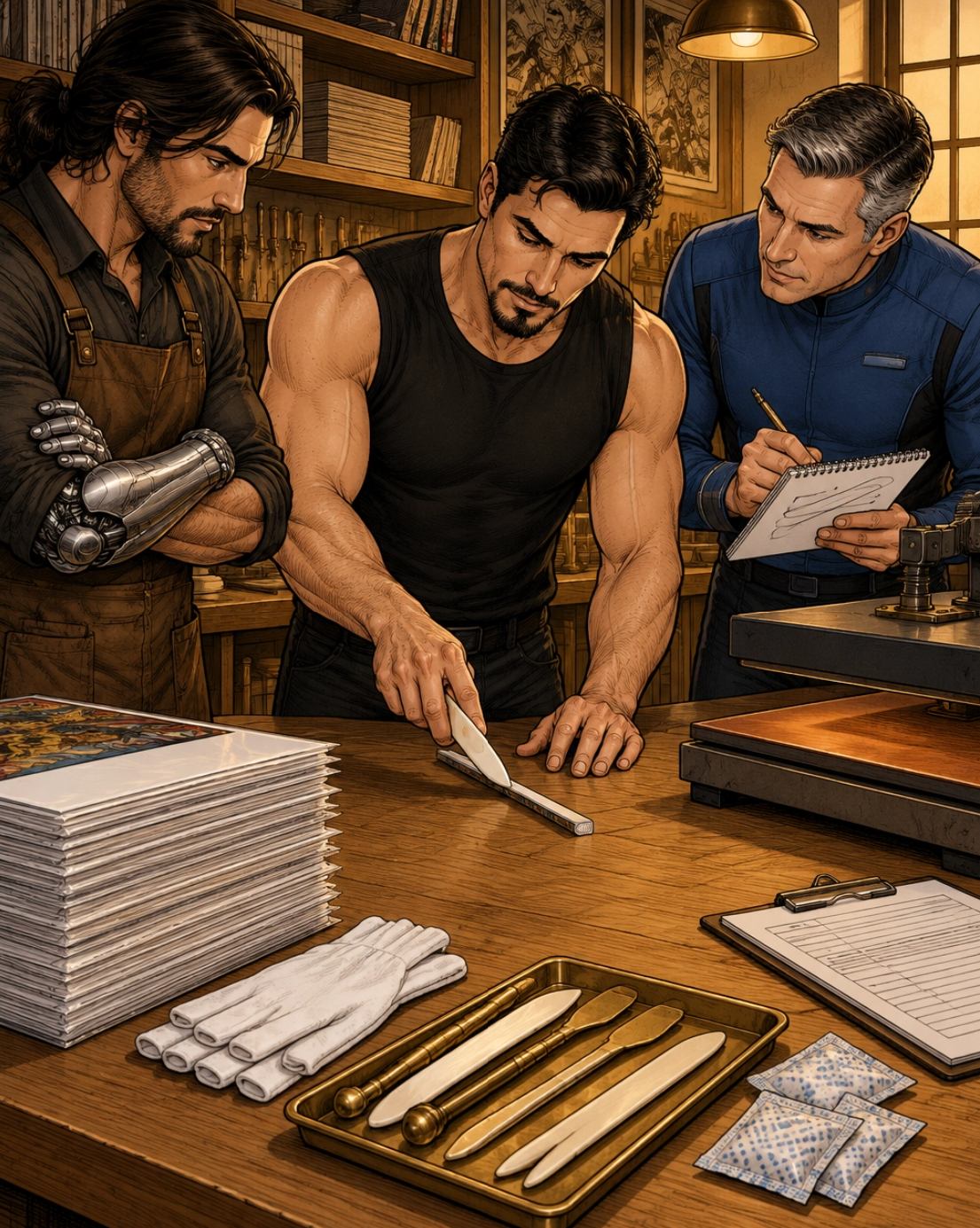
In a competitive trade, people often guard their methods. In comic book pressing, I have seen the opposite. Many practitioners are willing to talk about the work, not just the satisfying results, but the judgment behind them.
That includes broad lessons about heat and moisture, how different paper stocks behave, how age can affect a book’s response to pressure, and how to tell whether a defect is worth addressing at all. It also includes the most important lesson: sometimes the best action is no action.
Good advice is not a recipe to follow blindly. Every book is different. The same-looking defect can behave differently depending on the paper, the ink, the book’s condition, and its history. A conversation can help you understand what to look for, but it cannot remove the risk from an intervention.
If you are learning, practice on inexpensive dollar books. Do not experiment on a valuable comic. A cheap book can still be damaged, but it is a far better place to learn than a book you cannot replace.
The pressers worth learning from share their failures, too. They will talk about a book that went wrong as freely as the one that came back looking better. That honesty matters. It reminds us that experience does not make anyone infallible. It makes you more aware of what can go wrong, and more careful about deciding what to do next.
Nobody does this for the money
Nobody does this for the money. Not really.
Comic book pressing is physical work. It takes time, a dedicated space, equipment, practice, and patience. The outcome depends on the book in front of you. There is no button that makes every crease disappear or guarantees a particular grade.
We do it because we love comics. We love working with our hands. We love helping a book look its best while respecting its limits.
There is a particular satisfaction in seeing a comic come off the bench looking better than when it arrived. There is another in hearing from a collector who has opened the return package and is happy to have the book back in their collection. Those moments are the reward.
That is also why a responsible conversation should be honest about the limits. Pressing may support comic book preservation, and it may improve a book’s appearance. It does not guarantee an improving comic book grade. A non-color-breaking bend may respond; a color-breaking crease will not simply vanish. Hope is not a reliable process.
When your focus is the book, not a number, you have less reason to promise an outcome you cannot control.
Advisors and helpers, not just vendors
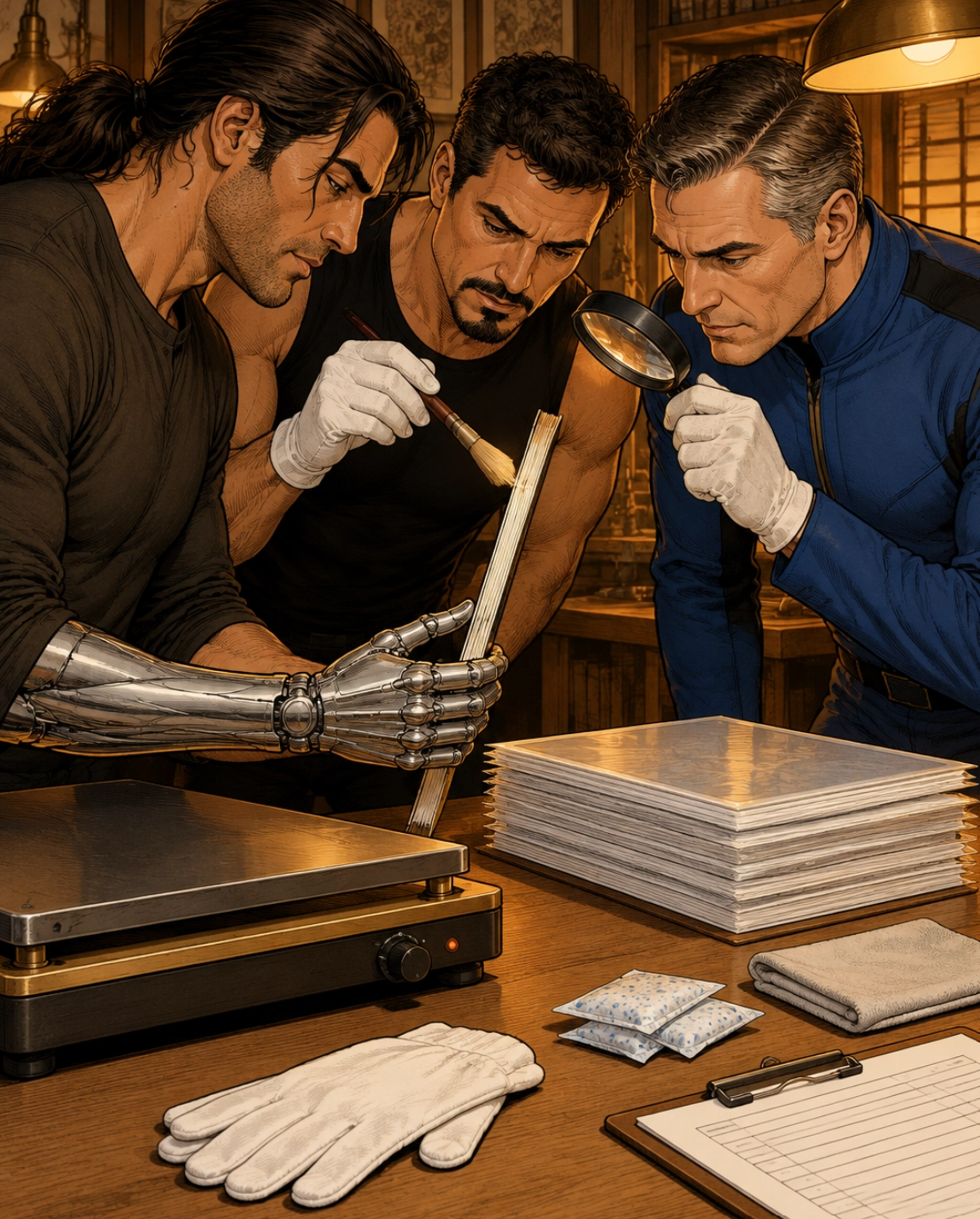
A presser can help you understand what your book needs. Sometimes that means recommending work. Sometimes it means advising you not to spend the money.
We should be willing to tell a collector:
The book does not need pressing.
The defect is permanent.
The potential benefit does not justify the cost or risk.
Your money may be better spent on a cleaner copy.
The question you are asking is reasonable, even if you are new to the hobby.
A presser who will talk you out of a job is offering something valuable: judgment. That does not mean every business behaves well, or that you should trust someone simply because they work in the trade. Ask questions. Look for clear answers. A strong community is a standard to live up to, not a guarantee about every individual.
Being a resource also means being reachable. Collectors should not have to pretend they know everything before asking for help. The person who gets thoughtful advice today may be the person helping another collector five years from now. That is how knowledge travels.
What makes this community different?

Three things stand out to me.
First, reputation travels. This is a community where people notice who answers questions, who treats books carefully, and who is honest about what a job can accomplish.
Second, the work is technical. Confidence alone cannot make someone competent. The comic either responds to appropriate treatment or it does not. The difference becomes clear over time.
Third, many of us arrived as collectors. We understand what it feels like to care about a book. To remember where you found it, what it means to your collection, or how long you searched for it. That perspective does not make anyone perfect, but it helps keep the collector’s interests in view.
That generosity does not mean the wider comics world is unfriendly. It means this part of it has a culture I am proud to be part of.
If you are just starting out
Ask questions. Be humble. Say when you are new. Practice on dollar books, and do not learn a new technique on an expensive comic.
Most people are glad to help someone who is honest about what they know and what they do not. What damages trust is pretending to have experience you lack, or learning on a collector’s book without permission.
Keep our Five Golden Rules of Comic Book Pressing and Cleaning close:
Do no harm.
Do not perform an action a comic book does not need.
Handle each comic carefully so you do not create new damage.
Document your work with photos so you can assess the effect and avoid repeating what did not work.
Treat every action as a risk. Act strategically, not on a whim.
If you are choosing someone to handle your books, our guide to choosing a comic book presser offers questions to help you make that decision. And if you want to hear about three practitioners we respect, see our post on three comic book pressers we recommend.
A word about Pressing Issues
We are one shop in a community of shops. We have learned from people in this trade, and we have answered questions from people who may one day be better at this than we are.
That is the culture at its best. It is not about keeping score. It is about helping collectors make informed decisions and helping more books stay in good hands.
Key takeaways
The pressing community is built on shared knowledge, practical advice, and care for comics.
Good advice includes limits, failures, and knowing when not to act.
Beginners should ask questions and practice only on inexpensive books, not valuable comics.
Pressing is preservation work, not a promise of a higher grade.
A strong community is something we keep building through honesty and helpfulness.
A trade that shares its knowledge is a trade that can survive. The books outlive all of us. The point is to help more of them survive in good hands.
If you love something, buy it, but always use caution.