
Does the CGC Census Really Prove a Comic Is Rare?

A low CGC census number can feel like proof.
You search the issue. You see three copies in a particular grade. Your pulse rises. The seller calls the book “extremely rare.”
Slow down.
The CGC Census is useful. It can show how many comics CGC has graded and how those books are distributed by grade. But it does not count every surviving copy. It does not prove absolute rarity. And it does not tell you what a book is worth by itself.
The census measures CGC-graded population.
That is not the same thing as true scarcity.
What the CGC Census Actually Tells You
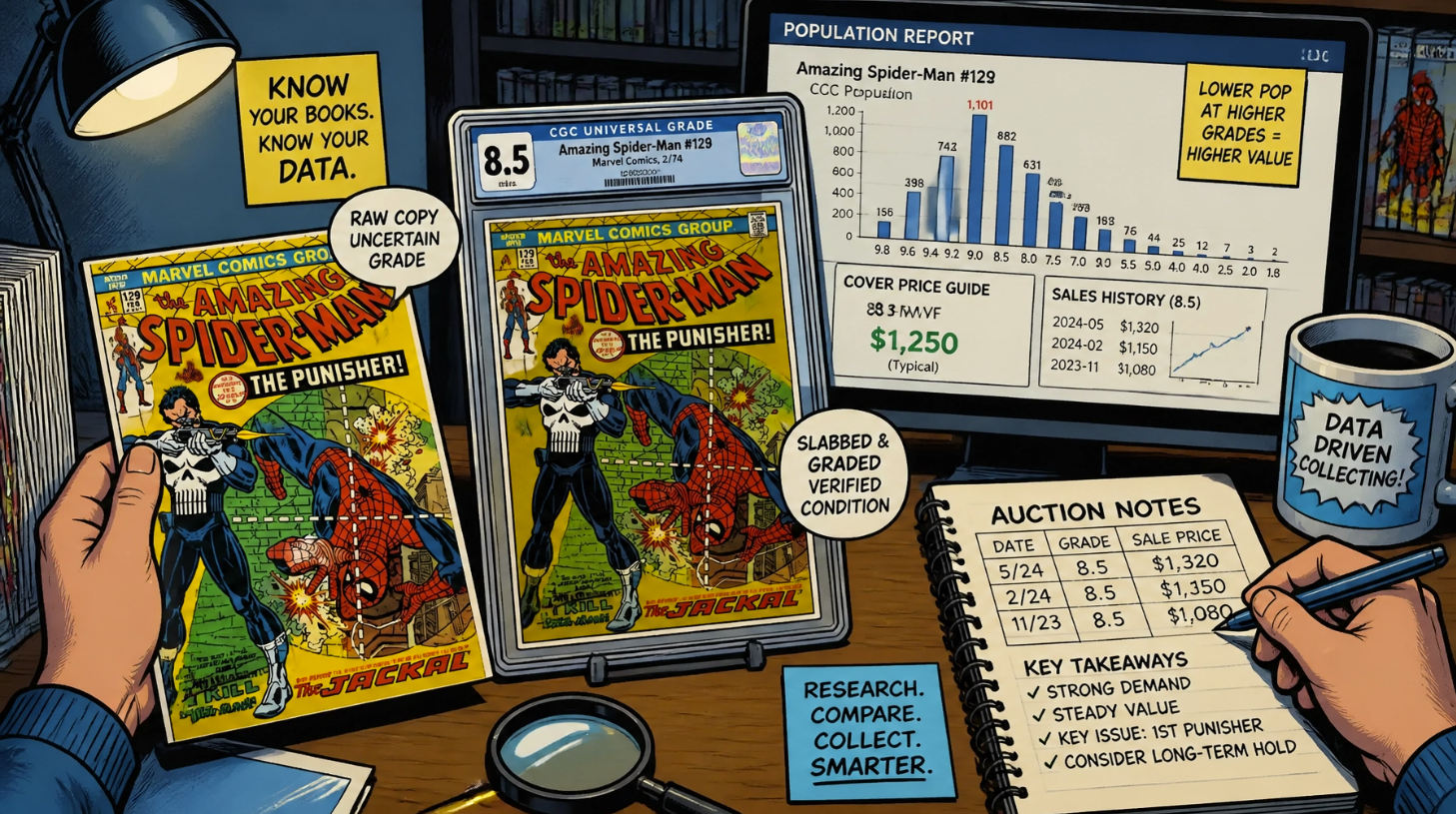
The CGC Population Report is a running record of comics certified by CGC. You can search by publisher, title, issue, and grade.
For example, the report may show:
1,000 total copies graded
500 copies graded 9.8
350 copies graded 9.6
100 copies graded 9.4
50 copies spread across lower grades
That information matters. It gives you a picture of the graded market.
But the number is limited to one grading company’s records. It does not include every copy in existence.
CGC itself explains that the census reflects collectibles previously graded by CGC. It should not be treated as a complete measure of value or rarity.
That distinction is the foundation for using the census correctly.
Five Reasons a Low Census Count Can Mislead You
1. Ungraded copies are invisible
Most comics are raw.
They sit in long boxes, collections, dealer inventories, closets, and private vaults. Many will never be submitted for grading. Some are too inexpensive to justify the submission cost. Others are owned by collectors who have no interest in selling or slabbing them.
Those copies do not appear in the CGC Census.
A book with five CGC copies may have five surviving copies. Or it may have hundreds of raw copies that nobody has submitted.
You cannot tell from the census alone.
This is especially important for older books with low collector demand. If grading, shipping, and insurance cost more than the comic is worth, owners have little reason to submit it.
Low submission volume can look like scarcity.
It may only reflect low interest.
2. Other grading companies are not included
CGC is not the only grading company in the market. Books certified by CBCS, PGX, and other companies are not counted in the CGC report.
That means a low CGC count may not represent the total number of graded copies. It represents the number graded by CGC.
This distinction becomes important when comparing older census numbers with current market activity. A collector may see only a handful of CGC copies while several more certified copies are being offered through dealers, auctions, or private sales under other labels.
The census is company-specific data.
Treat it that way.
3. Duplicate submissions can inflate the count
A collector may submit a comic, receive a grade, remove the book from its holder, press it, and submit it again. The goal may be a higher grade, a new label, a signature designation, or a correction.
The same physical book can therefore appear in the grading history more than once.
Reholdering creates another complication. A reholdered comic is still one physical copy, even though the certification record may change. Modern grading databases attempt to track these records, but the census is not a perfect, independently verified inventory of unique books.
Do not assume that every census entry equals a separate physical comic.
The safest view is that the census is a count of grading activity. It is not a warehouse audit.
4. Private collections create survivorship bias
The books most likely to be submitted are not a random sample of all surviving comics.
They are often:
High-grade copies
Important keys
Books with strong character demand
Comics with meaningful price upside
Copies being prepared for sale
Books owned by collectors who already use grading services
This creates survivorship bias.
The census shows the books that survived, attracted attention, and justified submission. It underrepresents lower-grade copies and books that owners simply chose to keep raw.
A modern variant with a census of 20 may not be rare. It may be new, lightly collected, or not yet widely submitted. A 1960s issue with thousands of graded copies may still have very few high-grade examples because time, handling, and paper quality have eliminated many of the best copies.
The question is not just, “How many are on the census?”
Ask, “Why are these the copies that were submitted?”
5. Census counts by grade tell a different story
Total population and high-grade population are not interchangeable.
Suppose a book has 5,000 CGC copies, but only six are graded 9.8. That may be meaningful high-grade scarcity.
Now suppose another book has 12 CGC copies total, including four 9.8s. The second book has a lower total census, but the first book may be much harder to find in its top grade.
This is why you should study the distribution:
Total CGC population
Number in the target grade
Number one grade below
Historical changes in the population
Recent sales in the target grade
A low total count can be noise. A large total population with a very thin top-grade population is often more useful information.
Population Is Not the Same as Market Rarity
Here is the formula I use:
Market rarity = available supply at a grade + real buyer demand + liquidity
The CGC Census gives you only part of the supply picture.
It does not tell you:
How many raw copies exist
How many books are held privately
How many copies are graded by other companies
How many census entries represent resubmissions
How many owners would actually sell
It also does not tell you whether buyers care.
Scarcity without demand is not automatically valuable.
A rare comic nobody wants may remain inexpensive. A heavily produced comic with an important first appearance, a popular character, and strong collector competition may sell for much more than its census number suggests.
The market decides through completed transactions.
Not through adjectives.
Use Sales Data Before Paying a Rarity Premium
Before paying extra because a book has a low census count, check actual sales.
Useful research tools include:
GoCollect for market tracking and comic value research
CovrPrice for raw and graded sales data across multiple marketplaces
GPA for CGC sales analysis, certification data, and historical trends
Heritage Auctions for major auction results and high-end market evidence
eBay for completed sales, current listings, and real-world liquidity
Key Collector Comics for key issue context and collector consensus
ComicBook.com for entertainment news that may affect character and media demand
Look for completed sales, not optimistic asking prices.
A listing at $2,000 proves only that someone wants $2,000. A completed sale proves that a buyer actually paid it.
You should also compare multiple grades. If a CGC 9.6 sells regularly but a CGC 9.8 has not sold in eighteen months, the 9.8 may be technically scarce but practically illiquid.
That matters.
An asset is not fully valuable to you if you cannot sell it without accepting a steep discount.
A Practical Pressing and Preservation Check
The census can help you decide whether a submission deserves further analysis. It cannot tell you whether your specific raw copy is a good candidate for pressing.
That requires physical inspection.
Use angled light. Look at the cover surface. Watch how shadows move across bends and dents. Run your eyes along the spine. Check whether a crease breaks the ink or only distorts the paper.
Pressing candidate diagram
Pressing can improve certain non-color-breaking defects. It cannot erase every defect. It cannot reverse missing paper, brittle pages, severe tears, or significant color loss.
That is why Pressing Issues begins with inspection and value analysis. Our complimentary value analysis helps you compare the likely benefit against pressing, grading, shipping, and selling costs. Professional pressing and cleaning can improve presentation while keeping the book in an unrestored state when the process is appropriate for the book.
But there are no guarantees.
The back cover matters. Interior pages matter. Paper quality matters.
The Conservative Financial Math
Use a simple formula before submitting:
Expected sale value − purchase price − pressing − grading − shipping − selling fees = possible return
Consider a hypothetical example:
Purchase price: $150
Pressing and cleaning: $40
Grading and handling: $50
Shipping and insurance: $25
Selling fees: $35
Total cost: $300
If the likely graded sale is $325, you do not have a strong investment. You have a narrow margin with risk.
The grade may come back lower than expected. The market may soften. The book may take months to sell. A new wave of submissions may increase the census and reduce the premium.
Hope is not a calculation.
What I Have Learned
I have learned that possibility can make us see what we want to see.
A low census number creates a story. We imagine hidden demand. We imagine a discovery. We imagine that the next buyer will pay whatever it takes.
Sometimes that happens.
Often, the physical book and the market data tell a quieter story.
The disciplined process is simple:
Confirm the exact issue, printing, and variant.
Check the CGC population by grade.
Look for raw copies and other grading-company copies.
Review completed sales.
Check how often the book actually trades.
Inspect the specific copy under good light.
Calculate the complete cost.
Decide whether you want the comic even if the grade disappoints.
If you love something, buy it, but always use caution.
That is not pessimism. It is how you protect the enjoyment of collecting from an avoidable financial mistake.
Key Takeaways
The CGC Census measures CGC-graded population, not every surviving comic.
Raw copies, private collections, and books graded elsewhere are excluded.
Resubmissions and reholdering can complicate the count of unique physical copies.
Census numbers by grade are more useful than a single total number.
A low census count may reflect low submission interest instead of true rarity.
Scarcity does not create value without demand.
Completed sales and liquidity matter more than asking prices.
Pressing can help certain non-color-breaking defects, but it cannot fix every condition problem.
Use the census as one tool in a larger decision system.
FAQ
Is a comic with a low CGC census rare?
Not necessarily. It may be scarce within the CGC-graded population, but raw copies, private collections, other grading companies, and duplicate submissions make absolute rarity difficult to prove.
Does a high CGC census mean a comic has no value?
No. A comic can have a large graded population and still be valuable because of character demand, historical importance, condition rarity, or strong liquidity.
Should I submit a low-census comic to CGC?
Only after checking the book’s condition, recent sales, total submission costs, and likely buyer demand. A low census number alone is not enough.
Can pressing increase a comic’s value?
Pressing may improve certain non-color-breaking defects and potentially improve eye appeal or grade. Results depend on the specific book, and no grade increase should be guaranteed.
What is the best way to research comic rarity?
Combine the CGC Census with sales data from GoCollect, CovrPrice, GPA, Heritage Auctions, and eBay. Then compare that information with collector consensus and the physical condition of your copy.