
Raw vs. Slabbed Comics: Which Is Better for Your Collection in 2026?
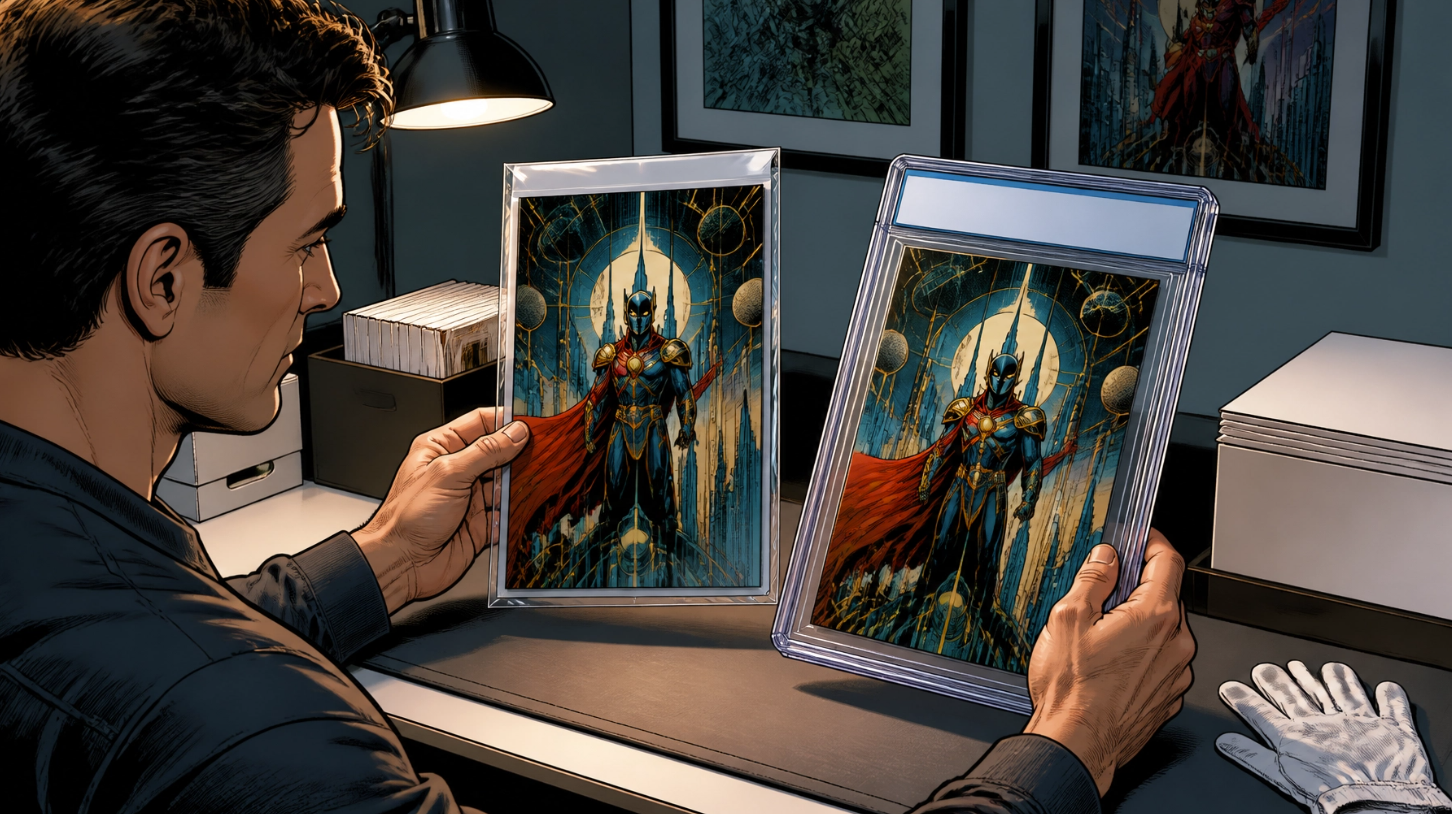
A slab is not automatically better.
That is the first truth.
A graded comic can offer stronger buyer confidence, easier online sales, and rigid physical protection. A raw comic can cost less, remain flexible, and make more sense for reading, displaying, or building a complete run.
The right choice depends on five things:
The comic’s market value.
Its realistic condition.
Its demand.
Your collecting goals.
The math after every fee.
If you love something, buy it, but always use caution.
Raw and slabbed comics: what is the actual difference?

A raw comic is unencapsulated. It may be stored in a bag and board, Mylar, or a short box. Its condition is estimated by the seller or collector.
A slabbed comic has been evaluated, graded, and sealed in a rigid holder by a third-party grading company such as CGC. The label identifies the issue, grade, and whether the book received a universal, qualified, or signature designation.
The slab does not improve the paper by itself.
It documents the condition. It protects the book from many handling risks. It also gives buyers a common language.
A CGC 9.6 means something very different from “near mint” in a seller’s description.
Raw vs. slabbed comics at a glance
The best option changes from book to book.
The 2026 cost question: what does grading really cost?
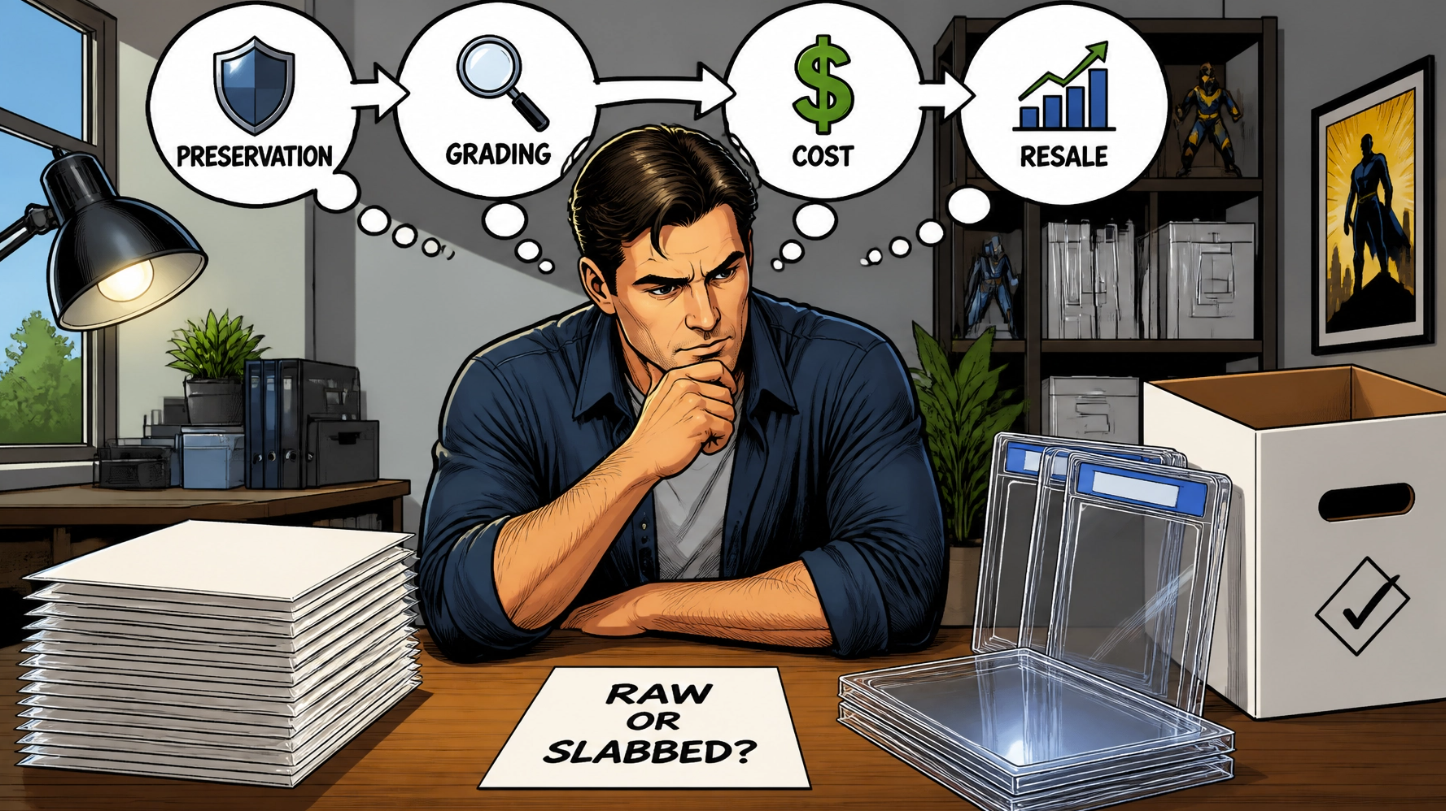
CGC’s current direct-submission fee page lists a Modern comic grading fee of $30, with a $27 Modern Bulk tier for qualifying submissions of at least 25 books. The listed Vintage fee is $45, while High Value submissions are listed at $105. Unlimited Value submissions are charged at 4% of fair market value, with a $135 minimum.
Those are not your total costs.
You also need to account for:
The online handling fee.
Return shipping.
Shipping to CGC.
Insurance.
Packing materials.
Optional imaging.
Pressing and cleaning.
Membership costs, if applicable.
Marketplace fees when you eventually sell.
The time your money is unavailable during turnaround.
A single modern book can easily move from a $30 grading decision to a much larger all-in expense once shipping, insurance, and pressing are included.
CGC also uses declared value and maximum value limits to determine the correct service tier. Declared value is not a wishful number. It should be a reasonable estimate of the comic’s fair market value. If CGC determines that the book belongs in a higher tier, the additional fee becomes your responsibility.
Current turnaround times are estimates, not guarantees. A book can be physically safe while still being unavailable to you for weeks or months.
Slow down before submitting.
When a slab improves buyer confidence
Slabs are most useful when condition creates uncertainty.
A buyer who purchases a raw $20 comic may accept some risk. A buyer considering a $2,000 key issue will usually ask more questions:
What defects are present?
Has the book been restored?
Is the seller’s grade accurate?
Are the photographs complete?
Could the book have hidden damage?
A slab reduces some of that uncertainty.
This is especially important when selling online through eBay’s comic book marketplace, where the buyer may never see the book in person before purchasing.
Slabs also make price comparisons easier. You can compare a CGC 8.0 with other CGC 8.0 sales. Raw books are harder to compare because “very fine,” “near mint,” and “looks like a 9.4” are not consistent standards.
That does not make every raw seller unreliable.
It means raw transactions require more trust.
Liquidity depends on the comic
A slab can increase liquidity, but only when the market wants that slab.
A high-grade copy of a major key issue often sells more easily in a recognized holder. Auction houses, online buyers, and serious collectors can understand the offering immediately.
For high-value material, Heritage Auctions’ comic archives and completed eBay sales can help you compare actual realized prices.
Raw comics can be more liquid in other situations:
Common modern issues.
Complete runs.
Reading copies.
Mid-grade books with modest value.
Books sold at conventions or local shops.
Comics where buyers want to inspect the interior themselves.
A slab may make a $25 book look official, but that does not mean buyers will pay enough to recover the submission cost.
Use real sales data, not asking prices
Before deciding, compare raw and slabbed sales separately.
Useful resources include:
GoCollect’s comic price guide, which tracks graded sales and fair market values by grade.
CovrPrice, which reports raw and slabbed sales data from multiple marketplaces.
GPA for CGC Comics, which provides graded sales analysis and links to census information.
Key Collector Comics, which helps identify first appearances, major keys, and historically significant issues.
Heritage Auctions, especially for higher-value books and auction archives.
Look for at least three comparable sales.
Ignore the one extraordinary result unless you understand why it happened.
A listed price is not a market value. A completed sale is evidence.
The CGC Census: useful, but easy to misunderstand
The CGC Census and Population Report shows how many copies CGC has graded in each grade.
It does not show every copy in existence.
It does not include raw comics. It does not fully include books graded by other companies. It can also be affected by cracked slabs and resubmissions.
A low census may suggest that a high-grade copy is less common. It does not automatically prove that the book is rare or valuable.
Demand still matters.
A low-census comic with no active buyer base may remain inexpensive. A heavily collected key with hundreds of high-grade copies may still be highly liquid.
Use the census as one piece of the decision. Not the whole decision.
Five practical examples
1. A key issue with pressable defects
Imagine a raw copy of Amazing Spider-Man #129 with light spine ticks, a non-color-breaking bend, and good color.
This is a logical pressing candidate because:
It is a recognized key.
Buyer demand is established.
The defects may improve.
A higher grade could create a meaningful premium.
A slab could make the book easier to sell online.
Pressing is not a guarantee. The current grade, expected grade, and complete cost still matter.
2. A mid-grade Silver Age non-key
A mid-grade issue from a long Silver Age run may have value, but not enough value to justify grading.
If it is worth $100 raw and a slabbed copy sells for $140, a $60 or $80 submission may destroy the upside.
Keep it raw unless preservation or personal preference is the priority.
3. A high-grade modern
A high-grade modern comic can be an excellent grading candidate when the issue has strong demand and the 9.8 premium is real.
But check the supply first. If the CovrPrice data shows many 9.8 copies and weakening prices, another slab may not stand out.
High grade is not the same as high demand.
4. A signed comic
Signed comics require a separate decision.
The signature’s authenticity, ink type, placement, provenance, and condition all matter. A signature can add value, but it can also limit the buyer pool if authentication is unclear.
Pressing a signed book requires additional caution. Heat and pressure can affect some inks, especially paint pens or signatures on glossy covers.
Read our guide to preserving signed comics safely before sending one anywhere.
5. A book with color-breaking damage
A heavy color-breaking crease, tear, missing piece, or detached staple is not a pressing problem.
Pressing may flatten the paper around the damage. It will not restore the missing color or replace the missing material.
That book may still deserve a slab if it is a major key and authentication matters. But grade improvement should not be your reason.
Pressing candidate diagram: criteria and outcomes
The back cover matters.
Inspect the book under bright, angled light. Look for texture changes, color breaks, spine stress, waviness, and edge damage. Do not let the front cover alone decide the submission.
Pressing Issues provides a complimentary value analysis before work begins. The goal is simple: identify what can be improved, what cannot, and whether the financial math is defensible.
What I have learned
What I have learned is that collectors rarely lose money because they cared too much about a book.
They lose money because possibility made them stop inspecting.
A raw comic can look like a future 9.8 from across the room. Under angled light, the cover may reveal a color-breaking crease, a torn spine, or a damaged back cover. A slab can make a book feel safer, but it cannot remove physical limitations.
Cautious patience protects collections.
If you are considering pressing, our comic book pressing and cleaning service evaluates each book individually. We keep the process focused on preservation, realistic outcomes, and unrestored status.
FAQ: should you keep your comic raw?
Is a slab always worth more than a raw comic?
No. A slab may sell for more, but grading and shipping costs can absorb the difference. Compare completed sales and calculate your net outcome.
Should every key issue be graded?
No. A key in low grade or with significant damage may not justify grading unless authentication, preservation, or buyer confidence is important to you.
Is raw better for personal collections?
Often, yes. Raw books are easier to read, inspect, press later, and store efficiently. Slabs are better when you prioritize rigid protection and documented condition.
Should you press before grading?
Only when the book has defects that pressing may correct and the expected value increase justifies the cost. Color-breaking defects are not pressable.
What is the simplest grading formula?
Use this:
Expected slabbed sale price – all submission and selling costs = projected net
Then compare that net with the realistic raw sale price today.
If the difference is small, keep the book raw.
Key Takeaways
A slab is a tool, not an automatic upgrade.
Grade major keys when buyer confidence and market demand support the cost.
Keep common moderns, complete runs, and many mid-grade books raw.
Count grading, pressing, shipping, insurance, declared value, and selling fees.
Use GoCollect, CovrPrice, GPA, Heritage, and completed eBay sales for research.
Treat the CGC Census as graded-population data, not proof of total rarity.
Inspect under angled light before deciding.
Press non-color-breaking defects only.
Preserve signed comics with extra caution.
If you love something, buy it, but always use caution.