
Graded Comic Book Resale Workflow: Maximize Your Value

Reselling graded comics comes down to six core steps: evaluate your books, decide whether to press and clean, submit for grading, price against real completed sales, list on the right platform, and ship with care. Done right, this graded comic book resale workflow protects your investment at every stage and gives buyers the confidence to pay top dollar. Done carelessly, it eats into margins through avoidable fees, poor pricing, and shipping damage. Here at Pressing Issues, we work with collectors and sellers daily, and the difference between a profitable submission and an expensive mistake almost always traces back to preparation.
The core workflow at a glance:
Evaluate: Identify key issues, assess raw condition honestly, and research completed sales
Prepare: Clean and press comics with pressable defects before submission
Submit: Choose CGC or CBCS, select the right service tier, and ship with tracking and insurance
Price: Anchor to actual sold listings, not asking prices
List: Choose the platform that matches your book's value and your timeline
Ship: Package slabs in archival materials inside a rigid, well-padded box
Turnaround from submission to sale can range from a few weeks to several months depending on the grading tier you choose and how long your listing takes to sell. Plan accordingly, especially if capital is tied up in inventory.
How graded comics differ from raw comics in resale value
A raw comic is any unslabbed book you sell in its current condition, with the buyer trusting your grade assessment. A graded comic has been evaluated by a third-party service, encapsulated in a tamper-evident holder, and assigned a numeric grade on a 10-point scale. That distinction shapes everything about how buyers perceive, price, and purchase your book.
CGC remains the industry standard for resale, with the broadest market recognition and the strongest buyer confidence. CBCS is a respected alternative, particularly valued for signature authentication. PGX carries far less market trust and many buyers discount slabs from that service entirely.
Graded comics typically command higher prices because they remove uncertainty. A buyer purchasing a raw book has to trust the seller's condition description. A buyer purchasing a CGC 9.6 knows exactly what they are getting and can compare it directly to every other CGC 9.6 of the same issue. That comparability is what drives the premium on graded copies.
Key differences between graded and raw comics:
Authentication: Graded books are verified for restoration, trimming, and alterations; raw books are not
Condition certainty: A numeric grade removes buyer doubt and reduces negotiation friction
Price comparability: Slabbed copies can be benchmarked directly against prior sales of the same grade
Liquidity: Graded key issues often sell faster online because listings require less buyer education
Exceptions: Common modern issues, reader copies, and low-value books rarely justify grading costs
Raw comics still sell well, especially through local dealers and to buyers who want to read or re-grade the book themselves. The right choice depends on the book's value, condition, and your selling goals.
When does grading a comic before resale actually make sense?
Grading is not an automatic value booster. It is a tool best used when it addresses authentication or buyer confidence with clear cost justification. The question to ask before every submission is whether the expected graded sale price, after all costs, beats what you could net by selling the book raw today.
A practical rule: only grade comics if the expected graded market value exceeds the raw value plus all grading costs by at least 50%. That buffer accounts for grade uncertainty, marketplace fees, and the time your money sits tied up during turnaround.
True submission costs go well beyond the base grading fee. They include inbound and return shipping, insurance both ways, pressing if you choose it, signature services if relevant, packing materials, and the opportunity cost of inventory locked up for weeks or months. A book that looks profitable at the headline fee level can look marginal once every line is added.
Comics that typically benefit from grading:
Key issues and first appearances with strong collector demand
High-grade copies where a 9.6 or 9.8 commands a meaningful premium over lower grades
Golden Age and Silver Age books where authentication matters to buyers
Signed copies where signature verification adds value
Books where restoration concerns might otherwise suppress buyer confidence
Comics where grading rarely pays:
Common modern issues with raw values under $100
Books in mid-grade condition where the slabbed premium is thin
Overprinted titles with low collector follow-through
Any book where the 50% rule does not clear after honest cost accounting
Pro Tip: Before submitting, run two scenarios: one at your expected grade and one at a grade lower. If the graded net still beats the raw sale in the downside case, the submission is defensible. If it does not, wait or sell raw.
Pros and cons of selling graded versus raw comics
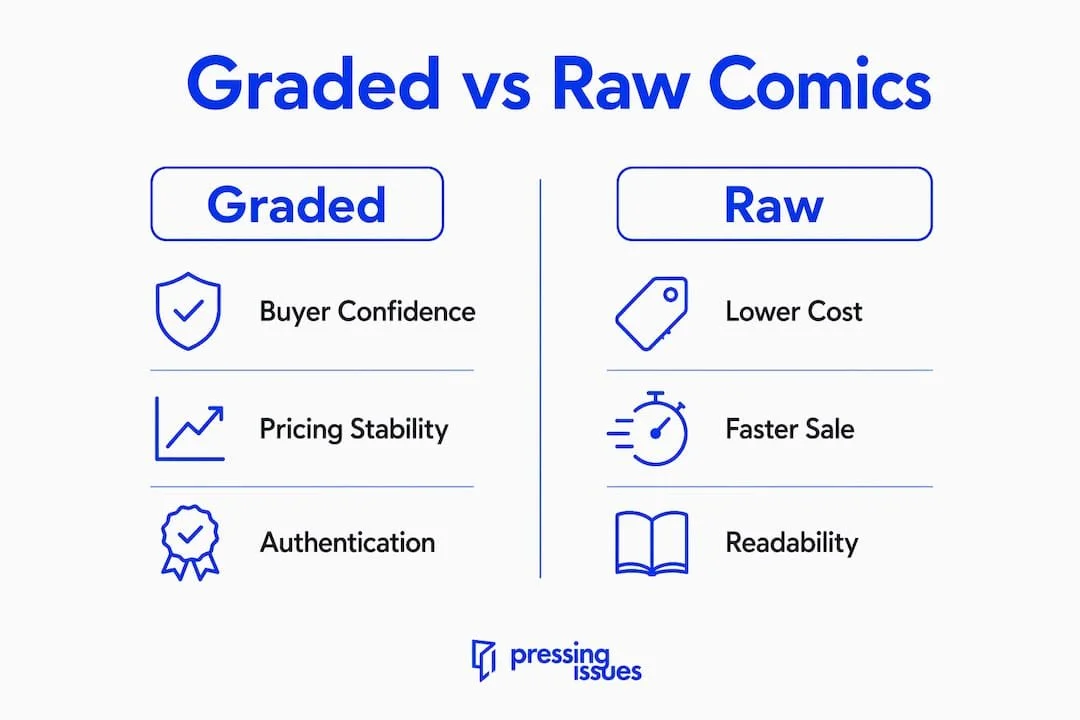
Neither approach is universally better. The right method depends on the book, your timeline, and how much upfront cost you can absorb before the sale.
Raw comics can be sold without grading but may require more buyer education and typically yield lower prices. Grading adds certification and comparability, which matters most for books where condition drives a significant portion of the value.
Considerations for choosing your method:
If the book is a recognized key issue in high grade, grading almost always pays
If you need cash quickly, raw sales through a local dealer are faster, though dealer buy offers typically range from 40%–60% of retail for bulk collections and 70%–80% for single high-demand keys
If the buyer pool for your book strongly prefers one grading company's holder, that preference should drive your submission choice
If the book has potential restoration concerns, grading provides documentation that protects both parties
How to maximize your ROI when reselling graded comics
Profitable resale starts with honest pricing. A comic listed for $500 is not worth $500 unless it actually sold at that price. Auction results provide the empirical evidence you need. Use completed sales on eBay, GPA Analysis, or Heritage Auctions archives rather than active listings, which reflect seller hope rather than buyer reality.
Most new sellers confuse list prices with market value, and that mistake compounds when they also undercount their costs. Factor in every expense: grading fees, inbound and return shipping, insurance, pressing, marketplace fees, payment processing, and packing materials for the buyer shipment. Your net is what remains after all of those come out, not the gross sale price.
Selling venue shapes net outcome significantly. Local dealers offer quick, low-friction sales but lower payouts. Auction houses can achieve strong prices for high-value keys but involve seller fees and timelines of weeks to months. Online marketplaces vary in fees and audience depth. Match the venue to the book: a $3,000 CGC 9.8 key issue belongs in an auction or a dedicated collectibles platform, not a bulk lot listing.
ROI tips for graded comic resale:
Use a grading worksheet tracking probable grade, raw value, graded value at two grade levels, all-in costs, and net outcome before submitting
Batch submissions reduce per-book costs, but avoid padding a batch with low-upside books just to spread shipping expenses
Time listings around demand spikes: media announcements, anniversary issues, and convention season can lift prices on relevant keys
Use a 90-day window of completed sales for pricing; older benchmarks may not reflect current demand
Pull at least three to five comparable sales before setting your price, and ignore single outlier results
The opportunity cost of money tied up during grading turnaround is a real expense; factor it into your decision before submitting
How cleaning and pressing can improve your comic's grade and resale price
Before a comic ever reaches a grading company, its condition is already set. Pressing and cleaning give you one legitimate opportunity to improve that condition, and the difference between a 9.4 and a 9.6 on a key issue can represent a meaningful jump in sale price. This is where Pressing Issues comes in.
Professional pressing can remove non-color-breaking defects such as bends, finger waves, and light spine stress, potentially lifting the grade. Results are never guaranteed, and poor work can damage a book. That is why the quality of the pressing service matters as much as the decision to press.
Cleaning addresses surface dirt, oxidation, and other contaminants that affect eye appeal and can suppress a grade. A well-cleaned book presents better under grader scrutiny and to buyers viewing listing photos. Combined with pressing, cleaning is often the highest-return preparation step you can take before a grading submission.
What to know before pressing and cleaning:
Not every defect is pressable. Color-breaking creases, tears, and missing pieces cannot be corrected by pressing
Pressing adds cost and time to your submission timeline; run the ROI estimate both with and without it before deciding
Choosing which comics to press requires honest defect assessment; a book with only non-pressable flaws gains nothing from the process
The sweet spots for grade upgrades through pressing tend to be books sitting just below a grade threshold with pressable defects as the primary issue
Always photograph the book in detail before sending it anywhere, and document every visible defect for your records
Pressing Issues serves collectors and sellers in Seattle and Portland with professional pressing and cleaning before CGC or CBCS submission. We evaluate each book individually, tell you honestly whether pressing is likely to help, and handle your comics with the care they deserve. Our clients send us books they care about, and we treat every one accordingly.
Step-by-step: the full resale workflow for graded comics
1. Evaluate and select your books
Pull your collection and identify candidates: key issues, first appearances, high-grade copies, and books with strong recent sales history. Check comic book appraisal resources and completed sales data to establish raw market value before committing to any submission costs.
2. Assess condition honestly
Grade each book conservatively. Most sellers naturally overgrade their copies, especially books with sentimental value. Write down every visible defect before anyone else sees the book. If you are uncertain between two grades, price and plan around the lower one.
3. Decide on pressing and cleaning
For books with pressable defects sitting near a grade threshold, pressing is often worth the added cost and time. For books with only non-pressable flaws, skip it. Run the ROI estimate both ways and let the numbers decide.
4. Submit for grading
Choose CGC for the broadest market recognition and strongest resale. Choose CBCS when signature authentication or detailed defect documentation matters more to your buyer. Select the service tier based on each book's declared value. Bag and board in acid-free materials, package between rigid cardboard in a sturdy box, and ship with tracking and insurance. Keep your submission ID and tracking number.
5. Verify the returned slab
When slabs arrive, verify each certification number on the grader's official lookup tool. Confirm the label matches the book, grade, and any notes. Photograph the slab before listing.
6. Price against completed sales
Pull three to five recent completed sales for the same issue and grade. Build a low, middle, and high estimate. Price near the middle for a standard listing; price toward the high end if your copy has exceptional eye appeal. Subtract all selling costs to confirm your net before you commit to a price.
7. List on the right platform
Match the venue to the book's value and your timeline. High-value keys perform well in auction formats and on dedicated collectibles platforms. Mid-range slabs move well through fixed-price online listings. Understanding CGC submission strategy also helps you write accurate, confident listing descriptions that reduce buyer questions.
8. How to authenticate a graded comic before resale
Every CGC and CBCS slab carries a unique certification number. Verify it on the grader's official website before listing and again before shipping. A legitimate slab will match the book, grade, and label color exactly. Tampered or counterfeit slabs show inconsistencies in the holder seam, font, or hologram. If anything looks off, do not list the book until you have confirmed authenticity directly with the grading company.
9. Package and ship graded comics safely
Store and ship graded comics upright in archival boxes with backing boards and sleeves. For shipping, wrap each slab in bubble wrap, place it snugly between rigid cardboard or foam inserts inside a sturdy outer box, and fill any void space so the slab cannot shift. Ship with tracking and insurance matching the declared value. Never use a padded envelope for a graded book.
10. Common pitfalls to avoid
Pricing from active listings instead of completed sales
Underestimating total submission costs, especially return shipping and insurance
Submitting low-value books that cannot clear the 50% rule
Choosing the wrong grading tier for a book's declared value
Skipping pressing on a book that would clearly benefit from it
Failing to verify slab authenticity before listing
Using inadequate packaging and losing a sale to shipping damage
Ignoring the grade impact on value when setting your price, especially at the high end of the scale where small grade differences produce large price swings
Ready to prepare your comics for grading?
Pressing Issues handles professional comic pressing and cleaning in Seattle and Portland, preparing your books for CGC or CBCS submission with the care and expertise your collection deserves. Whether you have one key issue or a full submission batch, we evaluate every book honestly and tell you exactly what pressing can and cannot do for it. Visit our comic pressing services page to learn more and get started.
Key Takeaways
A disciplined graded comic book resale workflow, built on honest condition assessment, full cost accounting, and completed-sales pricing, consistently outperforms guesswork at every stage.
PointDetailsGrade only when the math worksThe 50% rule: graded value must exceed raw value plus all costs by at least 50% before submitting.Count every costTrue submission costs include fees, shipping both ways, insurance, pressing, and opportunity cost during turnaround.Price from completed salesA listed price is not market value; only sold listings reflect what buyers actually pay.Press before you submitCleaning and pressing can lift grades on books with pressable defects, improving net sale price.Match venue to book valueHigh-value keys belong in auctions or dedicated platforms; common slabs sell better in fixed-price listings.