
What Is Foxing on Comics? A Collector's Guide
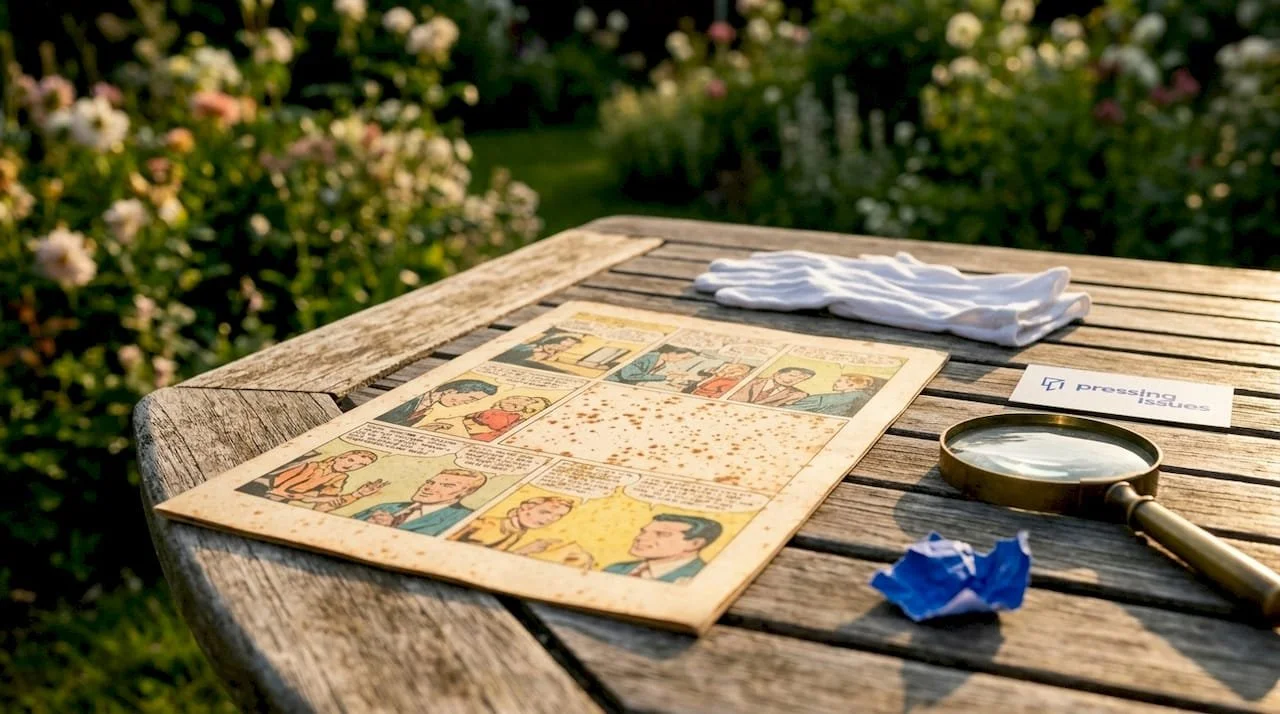
Foxing on comics is defined as localized reddish-brown or rusty spots caused by fungal growth and metal-catalyzed oxidation within paper fibers. These spots are not surface dirt. They form inside the paper itself, triggered by humidity, heat, and the natural impurities found in older newsprint and pulp stock. For collectors, foxing is more than a cosmetic flaw. It signals active biological and chemical damage that continues to spread unless the root causes are corrected. Understanding what foxing is and how it behaves is the first step toward protecting the comics you care about most.
What causes foxing on comic books?
Foxing results from two distinct but often simultaneous processes: fungal growth and metal ion oxidation. Both are activated by the same environmental conditions, which is why they frequently appear together on the same book.
Fungal spores exist naturally in the air and settle on paper surfaces over time. When humidity rises above 65%, those spores activate and begin metabolizing the organic compounds in paper fibers. The byproduct is the characteristic brown discoloration collectors recognize as foxing. Temperature fluctuations compound the problem. A swing of just 9°F (5°C) between day and night creates micro-condensation on paper surfaces, feeding both fungal activity and metal ion migration simultaneously.
Metal impurities, particularly iron and copper compounds, are introduced during paper manufacturing. When moisture reaches these particles, oxidation begins. The result is a rust-like spot that expands outward from the contamination point. Older comics printed on high-acid newsprint carry more of these impurities, which is why Golden Age and early Silver Age books are especially vulnerable.
Foxing is distinct from general yellowing or tanning. General yellowing is a uniform acid-driven process affecting the whole page. Foxing is localized, spotted, and represents an active ongoing reaction rather than passive aging. Water stains spread in irregular tide-mark patterns. Mold grows in fuzzy surface colonies. Foxing spots are embedded in the fiber and cannot be wiped away.
Pro Tip: Check the edges and margins of your comics first. Foxing almost always appears at the perimeter before migrating toward the interior, giving you an early warning window to act.
Here is a quick breakdown of how foxing differs from similar damage:
Foxing: Clustered rusty-red or brown spots, embedded in paper, cannot be wiped off
Mold: Fuzzy surface growth, often white or gray, may have a musty odor
Water stains: Irregular tide-mark edges, often with a wrinkled or warped surface
General yellowing: Uniform color shift across the full page, not spotted
Dirt or smudges: Surface-level, removable with gentle handling or cleaning
How does foxing affect comic book value and condition?

Heavy foxing is a major grade-capping defect that directly reduces a comic's market value. Grading services treat significant foxing as a structural and aesthetic defect, not a minor flaw. A book that might otherwise grade at 8.0 or higher can be capped well below that threshold when foxing covers key areas of the cover or interior pages.
The financial impact is real. Collectors often assume foxing is purely cosmetic, but that misperception costs money. A foxed copy of a key issue trades at a steep discount compared to a clean copy of the same grade. The gap widens further for high-demand books where condition-sensitive buyers dominate the market.
Beyond grading, foxing compromises the structural integrity of paper fibers over time. The fungal and oxidative processes that create spots also weaken the cellulose chains within the paper. A heavily foxed page becomes brittle, prone to tearing, and more susceptible to further damage from handling. This is not a slow cosmetic fade. It is active degradation.
Rarity does not cancel out foxing damage. A rare book in foxed condition is still a foxed book. Serious collectors and grading services apply the same standards regardless of scarcity. The only exception is when a book is so rare that any surviving copy commands value, but even then, a clean copy will always command more.
What are the best practices for preventing foxing?
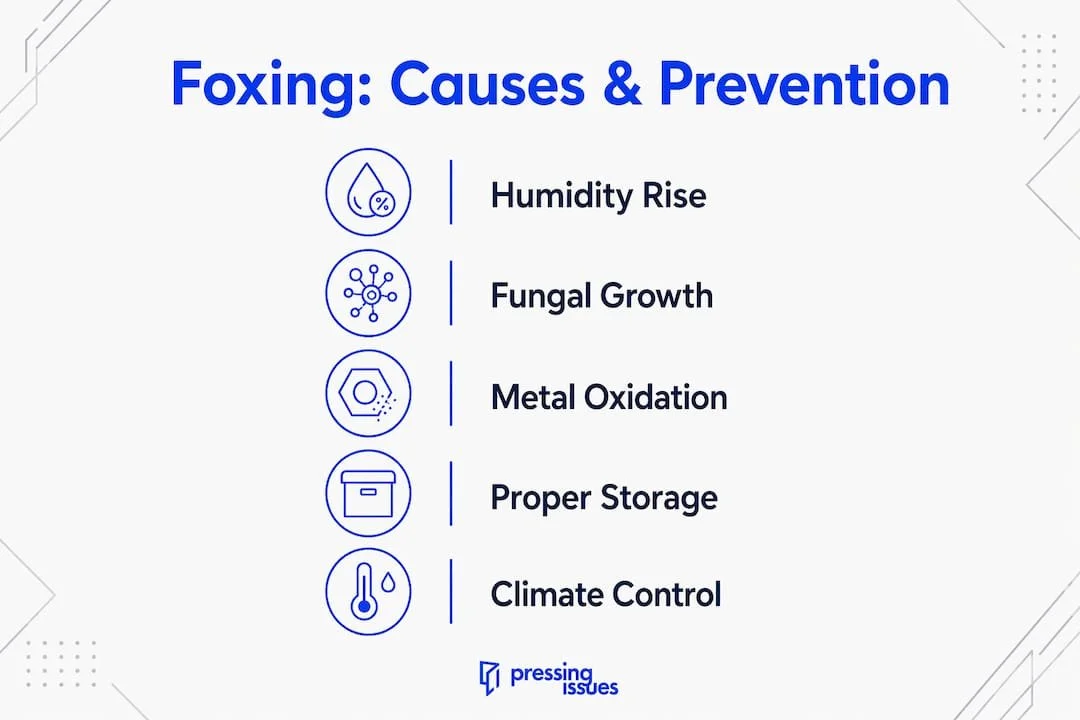
Prevention is the most effective strategy available to collectors. Damaged paper fibers cannot be perfectly restored, which means stopping foxing before it starts is always better than treating it after the fact.
The foundation of prevention is climate control. The target environment for comic storage is a stable temperature of 64–68°F (18–20°C) and relative humidity between 40–50%. Staying below 65% humidity prevents fungal activation. Avoiding temperature swings prevents the micro-condensation that feeds both fungal and oxidative processes. A dedicated storage room with a dehumidifier and a digital hygrometer is not excessive for a serious collection. It is the minimum standard.
Storage materials matter as much as climate. The right materials create a physical barrier between your comics and environmental threats:
Use Mylar or polyester bags. These are chemically inert and do not off-gas acids. Standard polypropylene bags degrade over time and can transfer harmful compounds to your comics.
Use calcium carbonate-buffered backing boards. Many acid-free boards sold at retail are only superficially treated and lose buffering capacity within a few years. True archival boards are buffered throughout and last 50 or more years.
Store comics vertically in acid-free boxes. Horizontal stacking creates pressure and traps moisture between books.
Keep comics away from exterior walls. Exterior walls experience the greatest temperature fluctuation, creating exactly the micro-condensation conditions that accelerate foxing.
Inspect your collection every six months. Early detection of foxing spots allows you to isolate affected books before spores spread to neighboring comics.
For collectors who want a deeper look at archival storage options, the combination of Mylar bags, lignin-free boards, and climate control represents the current best-practice standard.
Pro Tip:A digital hygrometer costs less than $20 and gives you real-time humidity readings in your storage area. Place one inside your storage box or cabinet, not just in the room.
The best protection uses a multi-layer approach. Layered storage barriers combined with proper climate control minimize both moisture exposure and acidic gas buildup simultaneously.
Can foxing be removed from comics?
Foxing can be reduced through professional treatment, but it cannot be fully erased. Professional removal uses reversible enzyme baths or controlled light bleaching applied by trained conservators. These methods target the biological and chemical compounds causing the discoloration without destroying the surrounding paper or ink. The process is expensive and is financially justified mainly for high-value collectibles where the cost of treatment is proportional to the potential grade improvement.
DIY removal attempts are where collectors cause the most damage. Common household approaches include:
Bleach or chlorine solutions: These lighten spots temporarily but leave chemical residues that cause bullseye staining and paper brittleness over time.
Hydrogen peroxide: Peroxide oxidizes paper fibers aggressively. The short-term lightening effect is followed by accelerated yellowing and brittleness within months.
Eraser or abrasive cleaning: Physically abrading foxed spots damages the paper surface and removes ink, causing permanent print loss.
Household cleaners: Most leave harmful residues that worsen staining and compromise paper structure.
The core problem with DIY methods is that they address the visible symptom without stopping the underlying reaction. If the environmental conditions that caused foxing remain unchanged, spots will return even after treatment.
Pro Tip:Before spending money on any treatment, improve your storage environment first. If humidity and temperature are not corrected, treated spots will re-develop within months.
For most comics, chemical removal risks outweigh the benefits. Redirecting that budget toward better storage materials and climate control delivers more lasting protection for your entire collection, not just one book.
How to identify foxing on your comics
Foxing appears as small, clustered spots ranging from pale tan to deep reddish-brown. The spots are typically round or irregular, concentrated in groups rather than spread uniformly. They appear most often on page edges, margins, and lighter-colored areas of the cover where the contrast makes them visible.
Proper identification prevents misguided treatment attempts. The key diagnostic test is simple: try to wipe the spot off with a dry cloth. Foxing does not wipe away. Dirt and surface smudges do. If the spot is embedded in the paper and has a slightly raised or textured feel, it is almost certainly foxing or mold. Check for a musty odor to distinguish mold from foxing. Foxing has no smell.
When documenting foxing for appraisal or professional evaluation, photograph the affected areas under natural light and at a slight angle. Angled lighting reveals the texture of spots that flat-on photography can miss. Include a ruler or coin in the frame for scale. This documentation helps a professional conservator or comic cleaning service assess treatment feasibility before you commit to any restoration work.
Key Takeaways
Foxing is an active chemical and biological process that continues to spread unless environmental triggers are removed, making prevention the only fully reliable strategy for collectors.
What I've learned from years of watching foxing destroy collections
The collectors who lose the most to foxing are not the ones who ignored their books entirely. They are the ones who stored their comics carefully by most standards, but made one or two small compromises. A basement storage room that gets humid in the summer. Backing boards bought in bulk from a discount retailer. A box pushed against an exterior wall. These small decisions compound over years into serious damage.
What surprises most collectors when they bring books to us at Pressing Issues is how far foxing has progressed on comics they thought were fine. Foxing is slow enough that you can miss it during casual handling, but persistent enough that by the time spots are obvious, the reaction has been running for years. The paper around those spots is already weaker than it looks.
My honest recommendation is this: spend your preservation budget on climate control and archival materials before you spend a dollar on treatment. A dehumidifier and a box of genuine Mylar bags will protect your entire collection. Professional treatment, even done well, addresses one book at a time and cannot undo fiber damage that has already occurred. Prevention scales. Treatment does not.
For collectors considering comic book encapsulation, encapsulation after professional cleaning and pressing locks in a stable microenvironment that dramatically slows future foxing. That combination, clean storage plus encapsulation, is the closest thing to a permanent solution available right now.
— Charles
Protecting your collection with professional care
Foxing does not have to be the end of the story for a comic you love. At Pressing Issues, we work with collectors in Seattle and Portland to assess, clean, and press comics affected by foxing and other condition issues.

Our team evaluates each book individually before recommending any treatment. We apply professional-grade comic cleaning services that are safe for paper and ink, and we are honest about what treatment can and cannot achieve. If a book is better served by improved storage than by cleaning, we will tell you that. Reach out to Pressing Issues before attempting any DIY restoration. One conversation can save a book you cannot replace.
FAQ
What does foxing look like on a comic book?
Foxing appears as small, clustered reddish-brown or rusty spots embedded in the paper. They are most common along page edges and margins and cannot be wiped off with a dry cloth.
What humidity level causes foxing on comics?
Humidity above 65% triggers fungal activation and accelerates foxing. The safe storage range is 40–50% relative humidity at a stable temperature of 64–68°F.
Can foxing spread from one comic to another?
Yes. Fungal spores that cause foxing can transfer to neighboring books in the same box or bag. Isolating a foxed comic from the rest of your collection is a critical first step.
Is foxing the same as yellowing on comic pages?
No. General yellowing is a uniform acid-driven process affecting the whole page. Foxing is localized, spotted, and represents an active biological or chemical reaction rather than passive aging.
Should I try to remove foxing at home?
DIY removal using bleach, peroxide, or household cleaners causes irreversible paper damage and future staining. For valuable books, consult a professional conservator before attempting any treatment.