
It’s Okay to Collect Comics Without Reading Them

There it is again.
The stack of unread comics.
Maybe it is a short box filled with new issues. Maybe it is a run of back issues you bought because the covers were perfect. Maybe it is a group of under-the-radar X-Men keys, such as Uncanny X-Men #168, #169, or #193, sitting safely bagged and boarded while you keep buying more.
Then someone asks:
> “Have you read all of those?”
The question sounds harmless. It may not be. Sometimes it lands like a challenge.
You start wondering whether your collection is legitimate. Whether you are allowed to own a comic you have not read. Whether every issue must become part of a reading list before it earns a place on your shelf.
Slow down.
A comic collection does not need to be a homework assignment.
Reading comics is one way to enjoy them. It is not the only legitimate reason to own them.
Collecting and reading are related, but separate
Some collectors read everything they buy.
Some collectors read only a few books.
Some collect almost entirely for the covers, history, condition, or hunt.
Most collectors move between those positions depending on the book.
All of them are valid.
Owning a comic is not a contract to consume it. You do not owe every book your time simply because you purchased it. A physical comic can be a story, an illustration, a cultural artifact, a memory, or an asset. Sometimes it is all five.
The pressure to read everything can quietly change the hobby. A relaxing search through a long box becomes an obligation. A stack of exciting discoveries becomes a backlog. The collection starts to feel like a task you are failing to complete.
That is not the point.
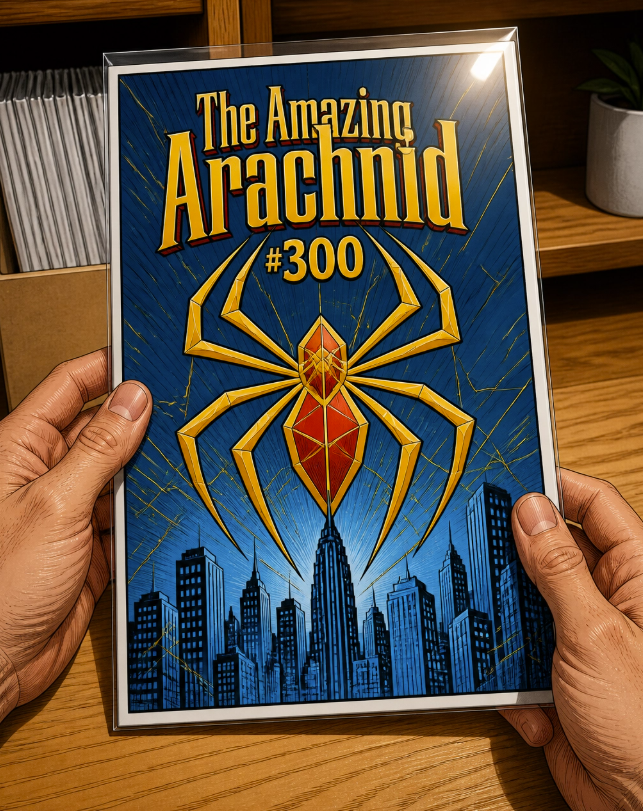
Why people collect comics beyond reading
1. The artwork matters
A comic cover is a complete visual object.
You can appreciate composition, color, lettering, character design, and printing without reading the story inside. A strong cover can communicate mood immediately. It can make you stop under harsh convention-center lighting and pull a book from a dealer’s box.
You may never read that issue. You may still love the image.
That is enough.
2. Covers can function as wall art
Many collectors display comics because they enjoy looking at them.
A cover can mark an era, celebrate a favorite character, or create a visual theme across a room. You might build a display around artists, costumes, villains, first appearances, or a particular publishing period.
The comic does not become less meaningful because you appreciate the cover before the interior.
3. Comics are history
Key comic books are pieces of publishing and cultural history.
An issue may document the first appearance of a character, the beginning of a major storyline, or a change in how superheroes were portrayed. An under-the-radar X-Men issue can matter because it introduced an important idea or supporting character, not because it contains the loudest battle.
For example, Uncanny X-Men #168 is associated with the first appearance of Madelyne Pryor. #169 introduces the Morlocks and Callisto. #193 is recognized for Firestar’s first comic-book appearance. These books are collected as artifacts of a larger continuity.
You can own them because they occupy an important place in that history.
You do not have to read them first.
4. The physical object has its own appeal
There is pleasure in the object itself.
The smooth or slightly textured cover stock. The smell of older newsprint. The sound of a bag opening. The sharp edge of a cleanly stored issue. The difference between a glossy modern cover and a softly aged Bronze Age page.
Comic book collecting is tactile. It involves paper and ink, staples, spine stress, corner sharpness, and surface texture. Reading is not the only way to engage with those qualities.
5. Preservation can be the goal
Some collectors see themselves as caretakers.
They are preserving a book for a future collector, family member, museum, or simply their future self. They may never read the physical copy because they read a collected edition, digital version, or library copy instead.
That is not wasteful. It can be a practical preservation choice.
You may want to keep a valuable key sealed in a graded comic book holder. You may want to own a high-grade copy while using a lower-grade reader copy for the story. You may want to preserve a fragile newsprint issue because opening it repeatedly would create unnecessary handling risk.
The story and the artifact do not have to be the same copy.
6. Completing a run feels satisfying
Collectors often want the complete run.
That may mean every issue of a series, every cover by a particular artist, or every important book from an era. Completion creates order. It turns scattered purchases into a coherent collection.
You may not read every issue in a 100-book run. You can still enjoy seeing the sequence together.
The visual rhythm of the spines and covers can be the reward.
7. The hunt is part of the hobby
Finding the book is sometimes the best part.
You search dealer inventories, convention boxes, online listings, estate sales, and local shops. You compare copies. You negotiate. You remember where you found each issue.
The hunt creates its own memories.
That is especially true when you are looking for less obvious X-Men keys instead of only the blue-chip books everyone already knows. Finding a clean copy of a quieter character or story key can feel more personal than buying the most famous issue in the room.
8. Community matters
Collectors share enthusiasm.
You can discuss a cover, an artist, a print variation, a character’s importance, or a book’s place in comic history without having read every page. You can enjoy the conversation while admitting, “I own it, but I have not read it yet.”
That honesty is healthy.
You do not need to pass a reading test before participating in the hobby.
The honest middle ground
There is no correct ratio of reading to collecting.
Some people read every issue before buying another. Some read trade paperbacks but collect single issues. Some buy graded comics and never open them. Others collect raw books specifically because they want the option to read them later.
Most collectors are somewhere in the middle.
The important question is not:
> “Have I read everything?”
Ask this instead:
> “Do I understand why I own this?”
If the answer is art, nostalgia, history, preservation, completion, community, or investment, that reason is real.
When you should be honest with yourself
There is one important distinction.
If you are buying books because you genuinely love them, but never reading them, that is fine.
If you are buying books speculatively and telling yourself it is purely about personal passion, examine that honestly. You may be making an investment decision. That is not automatically bad. It simply means you should use investment discipline.
Separate your budgets:
Reading budget: books you want to experience as stories.
Collection budget: books you want to own as objects.
Speculation budget: books you can afford to hold or lose value on.
Preservation budget: bags, boards, storage, pressing, cleaning, and grading.
This system removes confusion.
It also protects you from wishful thinking. Possibility can make us see what we want to see. A rumored adaptation does not guarantee demand. A low census does not automatically mean rarity. A book that looks like a future 9.8 from across the room may show color-breaking damage under angled light.
Inspect closely.
If you do not read the books, preservation matters more
When the comic is primarily an object, its condition becomes part of the experience.
Start with basic comic book storage:
Use properly sized polypropylene, polyethylene, or Mylar bags.
Use acid-free backing boards.
Keep books away from direct sunlight.
Avoid attics, damp basements, heat sources, and unstable humidity.
Store boxes upright and do not overpack them.
Keep valuable issues off the floor.
Photograph important books before moving or submitting them.
The back cover matters.
Look at the book under bright, angled light. Feel for raised texture, dents, bends, and waviness. Check the spine and edges. Do not assume a clean front cover tells the whole story.
For books with non-color-breaking bends, spine stress, surface dirt, or other correctable defects, professional comic book pressing and cleaning may improve presentation. It is not a guarantee of a higher grade. It cannot repair missing paper, restore broken color, or erase every limitation.
The goal is careful preservation while keeping the book in an unrestored state under grading standards.
Before work begins, a complimentary value analysis can help you decide whether the process makes financial sense. A book may deserve professional care because you love it, even when the market math does not support the expense. Those are separate decisions.
Pressing candidate diagram: criteria and likely outcomes
The formula is simple:
Expected benefit – treatment cost = decision
The benefit may be financial. It may also be emotional. Just label it correctly.
What I have learned
What I have learned is that collectors often feel guilty about the wrong thing.
They feel guilty for not reading enough when they should be asking whether the collection still brings them joy.
A collection can be quiet. It can sit in a box for years. It can represent a period of your life, a favorite artist, a character you loved as a child, or a hunt you never thought you would complete.
You are allowed to own the book before you understand every page inside it.
You are also allowed to change your mind. Read it later. Sell it. Upgrade it. Keep it sealed. Buy a reader copy. Move from reading to collecting or from collecting back to reading.
The hobby is not a test of purity.
FAQ
Is it okay to collect comics without reading them?
Yes. Collecting and reading are related but separate hobbies. Your reason for owning a comic does not have to be literary.
Is collecting comics only for investment?
No. Comic book market value is one part of the hobby. Art, nostalgia, history, preservation, completion, and community matter too.
Should I read a comic before grading it?
Not necessarily. If your goal is preservation or documented condition, grading may make sense without opening the book. If you want to read the story, use a reader copy when possible.
How can I research a comic’s value?
Use several sources, not one.
GoCollect for graded price and trend information.
CovrPrice for raw and graded sales data.
GPA / GPAnalysis for CGC-focused historical sales.
Heritage Auctions for auction archives.
eBay sold listings for recent market activity.
Key Collector Comics for key-issue context.
The CGC Census for graded population data.
For broader industry news and character coverage, ComicBook.com can provide useful context. None of these tools should replace close inspection or realistic financial math.
Key takeaways
A comic collection does not need to be a reading list.
Reading is optional, not a moral requirement.
Covers, paper, history, preservation, completion, and the hunt are valid reasons to collect.
Separate your reading, collecting, speculation, and preservation budgets.
Use appropriate comic book storage to protect the object you value.
Pressing and cleaning may help with specific defects, but neither guarantees a grade increase.
Research market value with completed sales and multiple sources.
If you love something, buy it: but always use caution.
The hobby belongs to you.
If you love a comic, that is enough reason to own it. And if you never read it, the collection is still real.