
Alternate Universes Are Fun: An Ultimate Universe Cautionary tale on the eve of the Midnight Universe
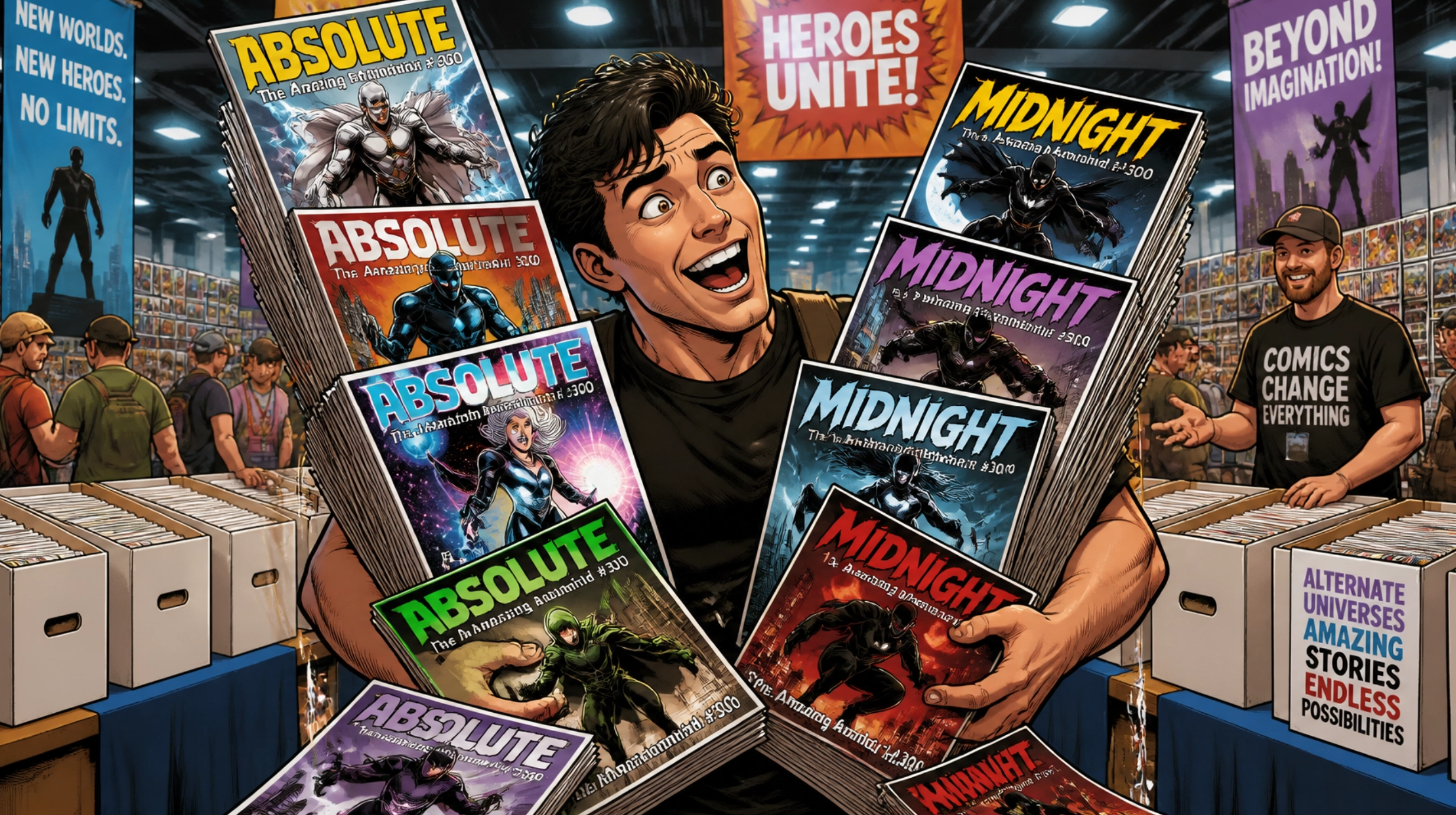
Get those Ashcans and first appearances!
Alternate-universe comics are good for the hobby. DC’s Absolute universe and now Marvel’s Midnight Universe are here with New versions of your favorite heroes re-imagined!
They give you new entry points. They let creators rebuild familiar heroes without decades of continuity pressing down on every page. They give longtime readers a reason to feel discovery again.
That is the fun.
The danger starts when a new universe becomes a financial story before it becomes a reading experience.
We have seen this cycle before. More than once.
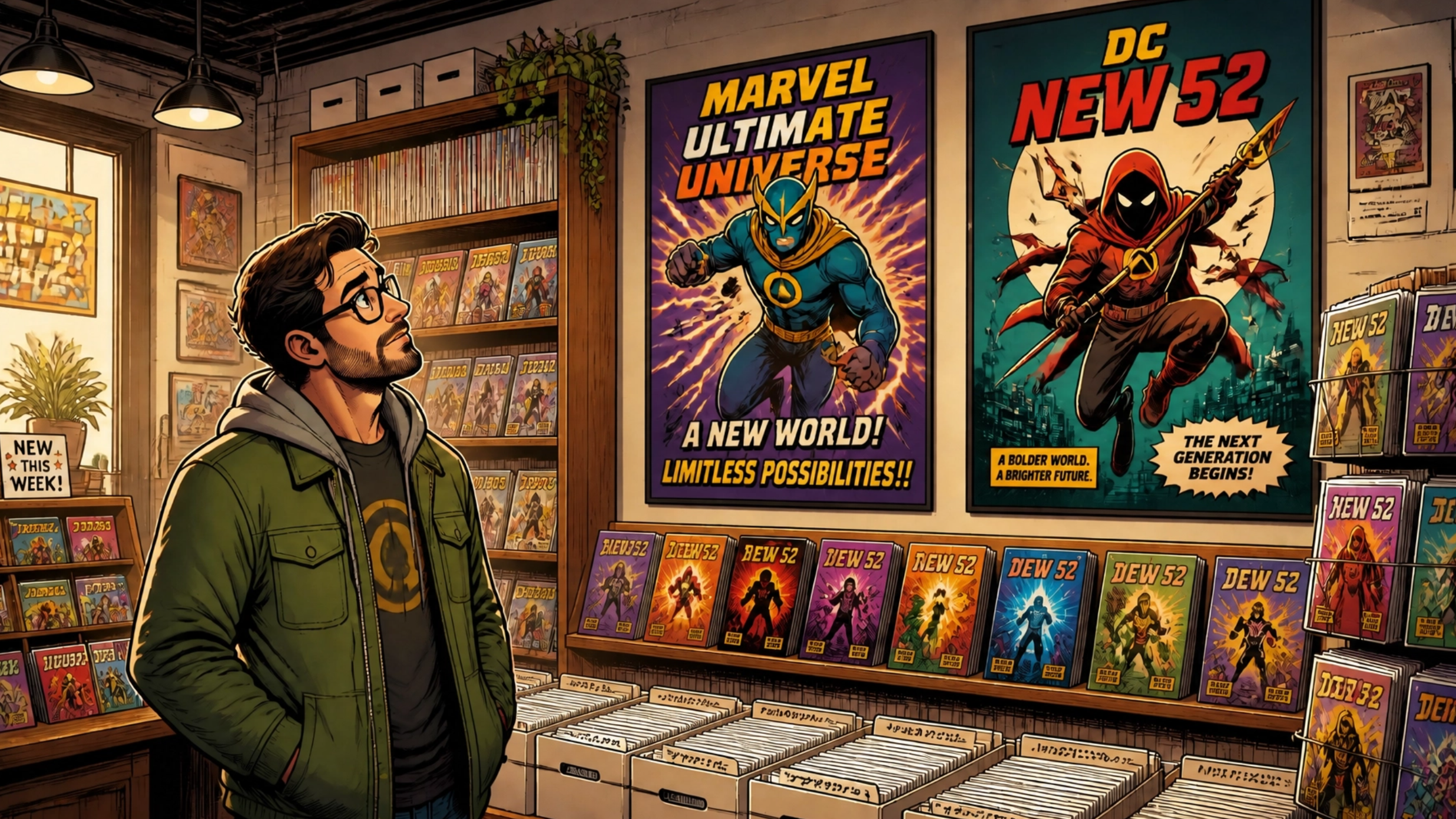
The early 2000s Ultimate Universe is one warning. DC's New 52 is another. Marvel's 2024 Ultimate reboot is the newest completed example. Now DC's Absolute Universe and Marvel's Midnight Universe are testing the same collector instincts all over again.
Slow down. Inspect closely. The cover may be exciting. The market may be loud. Neither tells you what a book will be worth years from now.
Historical Example One: The Early 2000s Ultimate Universe
Marvel launched the original Ultimate Universe in 2000 with Ultimate Spider-Man #1. The goal was clear: modernize Marvel's heroes for a new generation and create a cleaner on-ramp for readers.
Creatively, that worked.
Speculation also arrived fast.
Launch-era #1s looked important. They felt important. They were marketed like important books. But many of those launch books were printed in massive quantities and mostly never became long-term key comic books.
That is the first hard lesson.
A new universe launch can be exciting and still be common.
The lasting key of that era was not the obvious launch book. It was the quiet book that slipped into the market with far less noise: Ultimate Fallout #4 in 2011.
That issue contained the first appearance of Miles Morales.
It was not a shiny universe launch. It was not the kind of issue most collectors were treating as the centerpiece of the line at release. It almost entered the world sideways.
Then time did what time does.
Miles lasted. Miles mattered. Miles became one of the defining Marvel characters of the modern era across comics, animation, games, and the broader Spider-Verse.
So the defining key of the Ultimate era was not one of the giant launch books. It was the low-profile first appearance that almost nobody treated like the crown jewel on day one.
That pattern matters.
The real keys of alternate universes are often the quiet first appearances, not the flagship launches.
For more on separating meaningful first appearances from manufactured excitement, see our guide to first-appearance fever and modern speculation.
Key Takeaways
A launch #1 can be exciting and still be overprinted.
A modern #1 is not automatically scarce.
The book that matters most may arrive later and more quietly.
Character longevity matters more than launch-week hype.
Historical Example Two: DC's New 52
DC relaunched 52 titles in September 2011.
That was unprecedented.
It was a full wave of new #1s, new reader energy, sell-outs, second printings, and a flood of speculation. On paper, it looked like a perfect storm for modern key issues.
The sales were real.
According to CBR's September 2011 sales coverage, Action Comics #1 (2011) by Grant Morrison and Rags Morales sold roughly 182,748 copies in its first month. Detective Comics #1 (2011) by Tony S. Daniel sold roughly 103,392. ComicBook.com and CBR also covered the broader launch momentum as dozens of New 52 titles sold out and went back to press.
You can review the CBR sales report on DC's September 2011 dominance, ComicBook.com's coverage of the New 52 relaunch as a big early success, and ComicBook.com's report on sell-outs and reprints across the line.
This is the second hard lesson.
A universe-wide reboot creates scarcity of attention, not scarcity of supply.
Collectors could not watch every title at once. Publishers, retailers, and speculators all knew the launch mattered. So supply rose to meet the excitement.
And that is why so many New 52 #1s later settled into dollar-bin territory.
Regular first prints of Action Comics #1 (2011) and Detective Comics #1 (2011) commonly list in the $1-$9 range today. You can see that on Key Collector's pages for Action Comics #1 (2011) and Detective Comics #1 (2011).
That does not make them bad comics.
It makes them heavily watched launch books from a line that was printed to satisfy obvious demand.
Again, the market told the truth later than the marketing did.
Key Takeaways
A line-wide reboot can dominate attention without producing true scarcity.
Sell-outs and reprints are often signs of hype and distribution response, not lasting rarity.
Flagship #1s can cool hard when the print run is huge.
The crowd can focus on the whole launch and still miss the issues that matter most long term.
Historical Example Three: The 2024 Ultimate Universe Reboot
Marvel rebooted the concept in 2023 with Ultimate Invasion by Jonathan Hickman and Bryan Hitch. That led to Ultimate Universe #1 in 2023 and a new publishing line in 2024.
The line included:
Ultimate Spider-Man #1 by Jonathan Hickman and Marco Checchetto
Ultimate Black Panther
Ultimate X-Men
The Ultimates
The new Ultimate Spider-Man had an excellent hook: an adult, married Peter Parker. The issue also introduced Richard Parker II.
Collectors noticed immediately.
Near the beginning of 2024, Ultimate Spider-Man #1 Cover A reportedly reached roughly $200–$250 in CGC 9.8, with raw near-mint copies around $57–$88. Then the market received what modern markets usually receive: reprints, second printings, more issues, and more supply.
There were more than 60 variant covers. Speculation around Ultimate Invasion #1 second printings came and went. “First cover appearance” debates created temporary excitement.
The prices cooled significantly.
That does not mean the comic is bad. It means the first issue was printed into a market already expecting it to become valuable. Those are different things.
You can use Marvel’s Ultimate reading guide to follow the line as a reader. You can also review the Key Collector entry for Ultimate Invasion #1 and the Key Collector entry for Ultimate Spider-Man #1 to compare how launch issues and variants are cataloged.
The Recurring Pattern
Now step back and look at all three cycles together.
The pattern is not subtle.
Every universe reboot prints to speculator demand. The flagship #1s carry the hype. The launch books dominate conversation. Variants multiply. Attention gets stretched across too many books at once.
Then time filters the noise.
The books that actually hold value are usually:
quiet first appearances
genuinely great stories collectors come back to
rare covers that truly earn their premium through art and real scarcity
Not launch-week marketing.
Not blanket optimism.
Not a giant pile of regular-cover #1s that everybody already expected to become hot.
Possibility can make us see what we want to see. Time reveals what actually mattered.
What That Pattern Means for the Absolute Universe
DC launched the Absolute Universe with DC All In Special #1 on October 2, 2024.
That was followed by:
Absolute Batman #1 on October 9
Absolute Wonder Woman #1 on October 23
Absolute Superman #1 on November 6
The concepts were strong. Batman had no wealth, mansion, or butler. Wonder Woman had no island paradise or Amazon sisterhood. Superman had no family, Fortress of Solitude, or home.
Those are meaningful creative changes. They create a reason to read.
DC also created a reason to collect. Absolute Batman #1 had roughly 76 known cover variants. The Jim Lee 1:100 incentive reached around $150 raw, while CGC 9.8 copies sold around $400 in late 2024.
That was real market activity. It was also a market operating under maximum launch excitement.
GoCollect later reported an initial print run of at least 250,000 copies, with roughly 400,000 copies when reprints were included. Its Absolute Batman analysis also noted thousands of graded copies and strong sales volume.
So apply the pattern carefully.
The regular flagship launch book is the obvious place the crowd will go. That means it is also the obvious place supply will be thickest.
The better long-term questions are different:
Does a later issue introduce a character who sticks?
Does one series become the clear creative standout?
Does a specific variant have real scarcity instead of artificial urgency?
Are collectors chasing the story, the art, or just launch-week heat?
This is the crucial distinction:
The 1:100 incentive may have genuine relative scarcity. The regular issue does not have the same scarcity profile. A large print run can support a successful comic while limiting the long-term upside of common copies.
Buy Absolute Batman because you enjoy Scott Snyder and Nick Dragotta’s work. Buy Absolute Wonder Woman because Kelly Thompson and Hayden Sherman’s interpretation interests you. Buy Absolute Superman because you want to see what Jason Aaron and Rafa Sandoval do with a more isolated Clark Kent.
The creators and the stories are the value.
The 1:100 cover is a gamble.
Read DC’s official Absolute Universe announcement, then review Key Collector’s Absolute Batman listings and variants before paying a premium.
What That Pattern Means for the Midnight Universe
Marvel announced the Midnight Universe on May 11, 2026. The horror-tinged line launches October 7, 2026, with:
Midnight X-Men by Jonathan Hickman and Matteo Della Fonte
Midnight Fantastic Four by Benjamin Percy and Kev Walker
Midnight Spider-Man by Phillip Kennedy Johnson and ScieTronc
Marvel’s official Midnight Universe announcement gives collectors the essential starting point.
The line will feature “Cloaked Covers.” Full cover art is revealed only as pages are turned. Marvel is also using an ongoing A–E variant program:
Regular Cloaked Midnight trade dress
Midnight Bloodbath
Midnight Special
Midnight Horror Homage
Midnight Gallery prestige painted covers
That is a clever gimmick.
It is also designed to create buzz and collectibility.
Enjoy the gimmick. Do not confuse it with scarcity.
A Midnight Cloaked Cover may be the first appearance of a particular design or presentation. That does not make it equivalent to a true first appearance of a major character in a low-print issue.
If you want to learn from the early Ultimate line, the New 52, and the 2024 Ultimate reboot, then do not focus only on which Midnight X-Men #1 cover looks hottest on day one.
Ask instead:
Does a new character appear?
Does that character return?
Does the story establish a lasting role?
Is the issue widely available, or was it quietly overlooked?
Are later collectors responding to the character or only the cover?
Is the cover actually scarce, or just one more option in a crowded launch program?
The under-the-radar issue may matter more than the obvious first issue.
That was true before. It will probably be true again.
A Simple Pressing Candidate Diagram
A new comic does not need to be expensive to deserve careful inspection. It does need to have a realistic reason for professional preparation.
Modern books often spend time in shipping bags, distributor boxes, store racks, and crowded back-issue bins. That can leave spine ticks, bends, and surface dirt even when the comic is new.
At Pressing Issues, our process focuses on inspection first. Our modern comic pressing guide explains why the defect matters before anyone promises a result.
Pressing and cleaning can help. They do not guarantee a grade increase. Our complimentary value analysis can help you decide whether a raw book is worth preparing for CGC submission or whether the math says to leave it ungraded. We do not make grade promises. We help you inspect the book, understand the defect profile, and decide whether the numbers make sense before you spend more money.
A Responsible System for Collecting Alternate-Universe Comics
Before you buy, place the book into one of three Piles.
Pile One: Reader
You want the story.
Buy the regular cover. Read it. Keep it in a good bag and board. This is usually the healthiest way to enjoy an alternate universe.
Pile Two: Collector
You want a specific cover, artist, or design.
Set a clear limit. Choose the cover you genuinely prefer. Do not let a seller’s countdown clock decide what belongs in your collection.
Pile Three: Speculator
You are buying for potential future comic book market value.
Now the standards change. You need evidence, not excitement.
Use a repeatable system:
Separate fun money from speculation money.
Prefer the story first and the obvious flagship hype second.
Look harder for quiet first appearances than loud launch branding.
Avoid huge premiums during the first launch wave.
Wait six to twelve months before grading most modern speculation books.
Track completed sales, not asking prices.
Confirm the issue, printing, variant designation, and condition.
Treat population data as evidence: not proof of rarity.
Ask what cannot be fixed, financially or physically.
For market research, compare GoCollect, CovrPrice, and GPA, or GPAnalysis as a third reference. Check actual realized results through Heritage Auctions, eBay sold listings, and other auction archives.
The CGC Census can show how many copies have been graded. It cannot show how many raw copies are in collections, how many remain unsubmitted, or how many owners are willing to sell.
Population is not the same as true rarity.
Key Takeaways
Universe reboots usually print heavily.
Flagship #1s usually carry the loudest hype.
Quiet first appearances often age better than launch-week excitement.
Rare covers can hold value when the art is desirable and the scarcity is real.
If you cannot explain why a book matters beyond launch week, slow down.
What I Have Learned
I have learned that collectors rarely regret buying a comic they truly wanted at a price they could comfortably afford.
They regret paying a speculative price for a book they did not even love.
That distinction matters.
If you want a Cloaked Midnight X-Men cover because the design belongs in your collection, that is a clear decision. If you are buying five copies because someone called the book “the next Ultimate Fallout #4,” slow down.
No one knows that at launch.
The market needs time to separate a memorable cover from a meaningful key comic book. It needs time to identify recurring characters, important story developments, surviving series, and genuine first appearances.
Alternate universes are where the hobby gets to dream again. Keep the dream. Add discipline.
At Pressing Issues, that is how we approach modern books. We inspect closely. We compare the likely outcome with the actual cost. We look at what pressing and cleaning may help, and what they cannot fix. We use complimentary value analysis to help you decide whether submission prep is sensible. No grade promises. No fantasy math. Just a clear process.
if you love something, buy it, but always use caution.