
The 9.8 Trap: Why a High Comic Grade Does Not Guarantee Profit
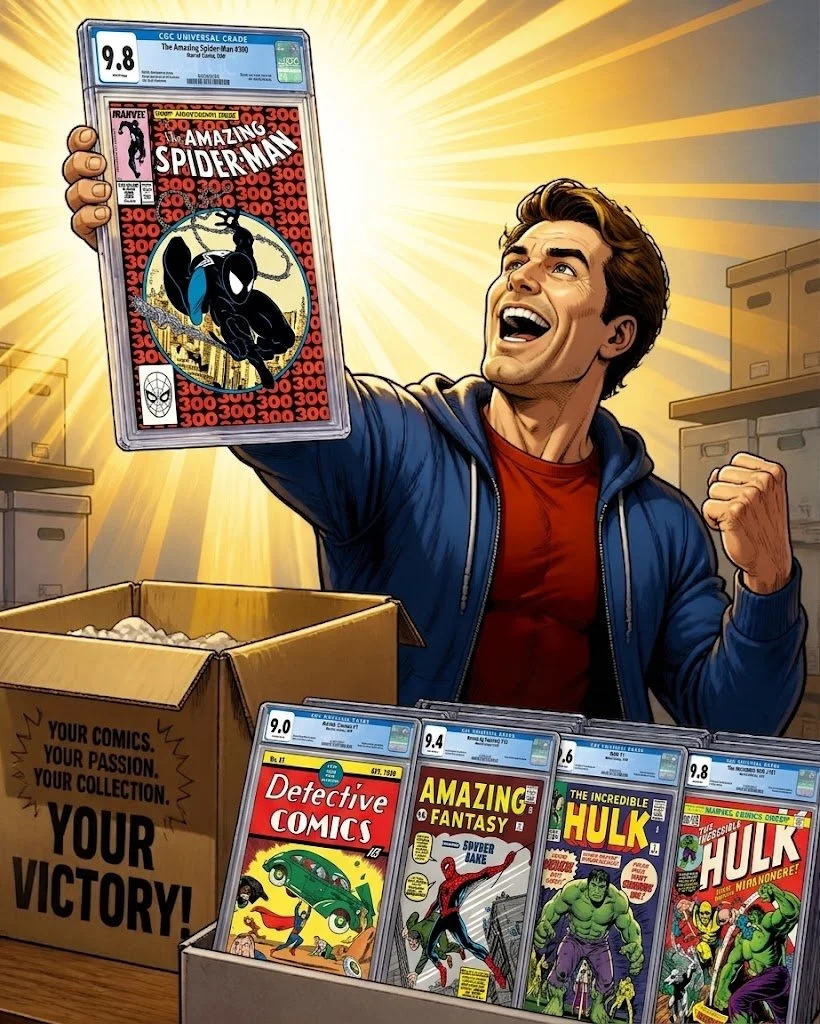
Nothing feels as good as getting fresh 9.8’s from CGC!
A CGC 9.8 is an excellent grade.
It is not a profit guarantee.
That distinction matters whether you collect modern comics, chase under-the-radar X-Men keys, or are entering comics from the sports-card market. A 9.8 can protect a book, document its condition, and create a strong premium. But grade alone does not create demand.
The book still needs a reason to matter.
Its story, character, creator, cover, edition, print run, timing, and supply all affect comic book market value. A high grade preserves condition. It does not preserve hype.
Why a 9.8 Feels Like a Guarantee
CGC grades comics on a numerical scale that reaches 10.0. In everyday collecting, however, 9.8 is the top commonly awarded grade most buyers encounter.
That gives it psychological power.
The label is clean. The book looks sharp through the holder. The corners, gloss, spine, and presentation create an immediate sense of quality. Sports-card collectors may naturally compare a CGC 9.8 to a PSA 10.
The market does not work exactly the same way.
A sports card’s value may center heavily on the athlete, set, card number, scarcity, and grade. Comics add more layers:
Is this a true first appearance?
Is it a cameo, a first full appearance, or only a cover appearance?
Is this the first printing?
Is the cover iconic?
Is the character still relevant?
How large was the print run?
How many similar variants exist?
How many 9.8 copies are already available?
A 9.8 answers one question:
How well did this particular copy survive manufacturing and handling?
It does not answer whether buyers will want it five years from now.
Supply Can Overwhelm Condition
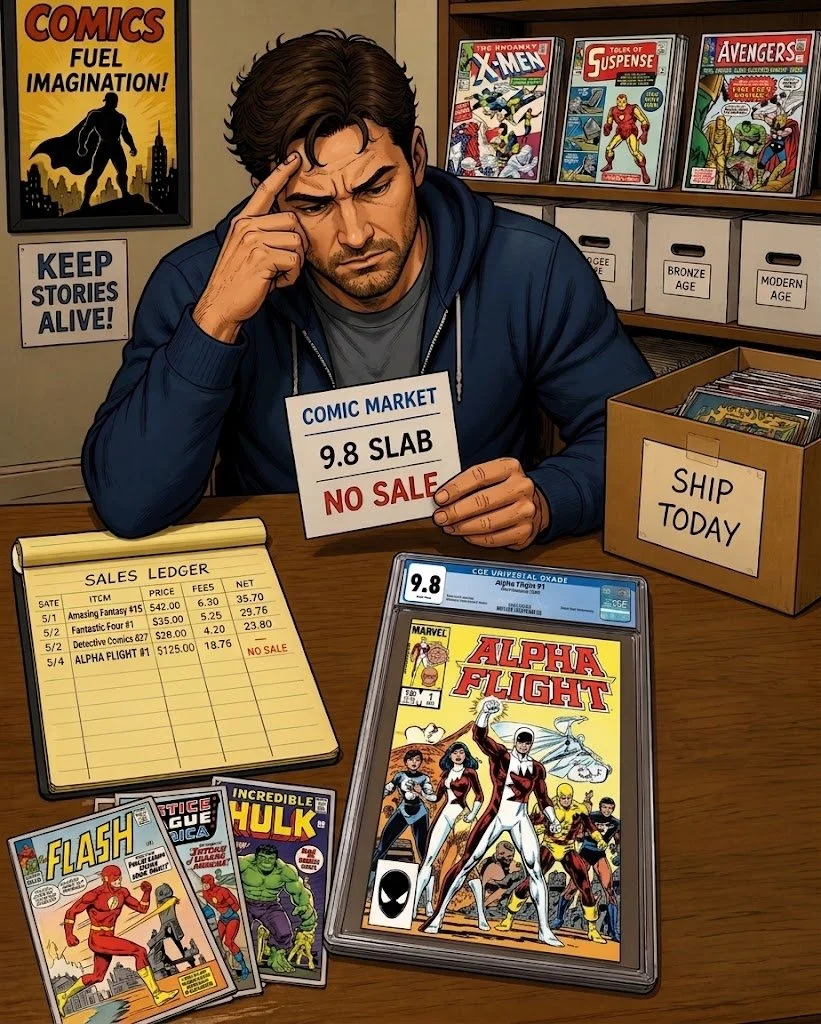
9.8 Comic Book Slabs have a tendency to sit… and sit… and sit… if you didn’t choose carefully.
Modern comics can be plentiful in high grade.
A hot #1 may receive a large initial print run, reprints, second printings, retailer exclusives, ratio variants, convention editions, and dozens of near-identical covers. If thousands of clean copies reach CGC, another 9.8 may be impressive but not scarce.
This is the difference between a high grade and meaningful scarcity.
Look at major launch waves such as the early-2000s Ultimate Universe, the 2011 New 52, the 2024 Ultimate Universe, the Absolute Universe, and the Midnight Universe. These lines created excitement and produced books that collectors still enjoy. But a new universe launch does not automatically make every first issue a long-term key.
Some books will develop durable importance.
Others will become plentiful reminders of a particular speculative moment.
Do not treat these examples as blanket judgments. Analyze each issue. A true first appearance, an important creative milestone, or an unusually constrained edition may perform very differently from a mass-produced launch book.
A low percentage of 9.8s can still mean thousands of copies if the original print run was enormous. A 9.8 may be statistically uncommon while remaining easy to find and replace.
That is not the same as market rarity.
Demand Can Fade
A book may become hot because of:
A trailer or casting rumor
A new series announcement
A first-issue launch
A popular cover artist
Social-media speculation
A character appearing in a current storyline
Then attention moves elsewhere.
A 9.8 preserves the paper. It does not preserve the excitement that caused buyers to overpay.
This is especially important with first appearance comics. Identify exactly what happened in the issue. A true first appearance generally has stronger long-term logic than a cameo, preview, cover appearance, or speculative connection. Even then, the character must develop meaningful demand.
Consider under-the-radar X-Men keys such as Uncanny X-Men #221, associated with the first appearance of Mister Sinister, or Uncanny X-Men #244, associated with Jubilee’s first appearance. These books have a clearer historical reason to matter than a random modern cover featuring a popular character.
That does not make any grade an automatic investment.
It gives you a stronger foundation for research.
Story significance usually outlasts launch-week excitement.
Variant Overload Changes the Math
A 1:25 or 1:100 ratio variant sounds scarce. Sometimes it is.
But ratio scarcity describes the relationship between orders and incentives. It does not necessarily reveal the total number printed. A huge issue order can produce a substantial number of 1:100 copies.
Retailer exclusives and store variants create another problem. A cover may be visually excellent and genuinely limited, but the buyer pool may be narrow. That is art-driven collecting, not necessarily durable speculation.
Ask yourself which type of buyer you are:
Do you want the cover because you love the artwork?
Are you buying because the character has durable demand?
Are you expecting another collector to pay more later?
Can you identify the specific reason the edition is scarce?
A beautiful variant can be worth owning.
It does not need to be a guaranteed investment to be a good purchase.
The Math Collectors Forget
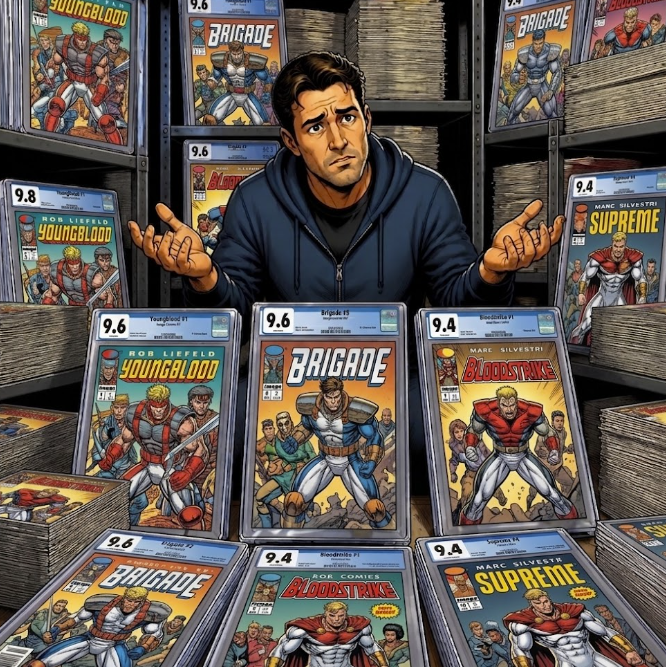
Let’s hope you love that book enough for 100’s of perfect condition copies in the closet!
Use a complete formula:
Expected sale price − all-in cost = projected result
Here is a fictional example:
A sale at $85 is not a meaningful win. It leaves only $5 before considering your time, taxes, insurance, possible return problems, and the risk that the book grades below expectation.
Your real costs may include:
Purchase price
Pressing and cleaning
Shipping to and from the presser
Shipping to CGC
Return shipping
Insurance
Packing materials
CGC handling or membership costs
Marketplace fees
Auction-house commissions
Taxes
Returns or discounts
A 9.8 can still be a bad submission if the spread is too thin.
How to Research Before You Submit
Start with completed sales, not asking prices.
Use GoCollect, CovrPrice, and GPA to compare raw and graded market activity. Check Heritage Auctions for auction results and use eBay’s comic marketplace to review completed listings.
For issue context, Key Collector Comics can help identify first appearances, key story events, and variants. For media-driven demand, follow reporting from ComicBook.com, but treat news as a possible demand catalyst rather than proof of lasting value.
Compare like with like:
Same issue number
Same printing
Same cover or variant
Same page quality
Same signature status
Same restoration or conservation status
Same grade
Similar sale date
Similar sales venue
Do not build your estimate from one outlier sale.
A single unusually high result may reflect timing, buyer emotion, exceptional eye appeal, or an unusual venue. Look for repeated sales and actual liquidity.
What the CGC Census Can and Cannot Tell You
The CGC Census and Population Report is useful. It shows how many copies CGC has graded at each grade.
It does not count every surviving copy.
The Census does not include raw books or all copies graded by other companies. It can also be affected by resubmissions, reholders, and other changes in grading activity. A low population may mean genuine scarcity. It may also mean collectors have not found the book worth submitting.
A low census is not automatically a low supply.
Ask:
How many copies are graded in total?
How many are 9.8?
How many are one grade below?
Is the population increasing?
Do 9.8 copies sell regularly?
Is the book important enough to attract future submissions?
A 9.8 with strong demand may remain liquid even when hundreds exist. A low-population book with no active buyer base may be difficult to sell.
The Census is graded-population data.
It is not a warehouse audit.
Pressing and Cleaning: Improve Presentation, Not Hope
A 9.8 submission requires a book that can realistically present at that level.
Professional comic book pressing and appropriate comic book cleaning may address non-color-breaking defects such as light bends, surface dirt, ripples, and certain dents. They can help a book present closer to its true condition.
They cannot guarantee a 9.8.
They cannot erase color-breaking creases, missing paper, deep tears, stains, brittle pages, or structural damage. A heavy crease may flatten while the broken ink remains visible.
This is where physical inspection matters. Slow down. Use bright, angled light. Watch the shadows across the cover surface. Inspect the spine, corners, back cover, page edges, and interior pages.
The back cover matters.
At Pressing Issues, our complimentary value analysis helps separate what can be improved from what cannot. The goal is to preserve the book in an unrestored state while deciding whether the likely benefit justifies the cost.
As a practical rule, books worth more than $500 deserve professional handling. For books in the $200–$250 range and above, professional pressing may be worth considering when the grade spread supports it. The exact decision depends on the issue, condition, demand, and total costs.
Why Professionals Avoid Drafting-Powder Dry Cleaning
Professional pressers do not use the dry-cleaning method involving drafting powder on valuable comics.
The powder contains fine particles designed to absorb or lift surface material. Rubbing those particles across paper can create problems:
Abrasion of paper fibers
Loss of cover gloss
Disturbed ink or surface coating
Powder lodged in paper texture
Uneven cleaning marks
Fiber thinning or permanent surface damage
The danger is not always obvious immediately. Under angled light, the treated area may show a different texture or sheen from the surrounding cover.
Do not experiment with unfamiliar cleaning techniques on expensive books. If you are learning, restrict experimentation to dollar-bin books you can afford to damage. A valuable comic is not a practice surface.
Pressing Candidate Diagram
When a 9.8 Makes Sense
A CGC 9.8 can make sense when you are dealing with:
A genuinely scarce key
An important first appearance with durable demand
An iconic cover or creator
A book with a constrained high-grade population
A personal-collection milestone
A comic you want protected and displayed
A 9.8 is probably a weak bet when the book is:
A mass-produced modern #1
An abundant ratio variant
A hype-only book
A book with a thin spread after fees
A comic you do not actually want to own
The point is not to avoid grading. It is to grade intentionally.
Practical Submission Checklist
Before you buy or submit, work through this system:
Identify why the book matters.
Confirm the exact issue, printing, cover, and first-appearance status.
Estimate the likely grade conservatively.
Inspect for color breaks, spine ticks, bends, dents, gloss loss, tears, stains, and page-quality problems.
Check total supply, 9.8 population, and variant volume.
Review repeated completed sales.
Calculate every cost.
Set a maximum purchase or submission price.
Decide whether you would still be happy owning the book if demand cools.
Submit: or walk away.
What I Have Learned
What I have learned is that collectors rarely get into trouble because they cared too much about a comic.
They get into trouble when possibility replaces inspection.
A raw book can look like a future 9.8 from across the room. Under angled light, the cover may reveal a color-breaking crease or a damaged back cover. A low census can feel like proof of rarity. A recent sale can feel like proof of permanent demand.
Possibility can make us see what we want to see.
Slow down.
A 9.8 is a condition achievement, not a profit promise. Buy books you understand and enjoy. if you love something, buy it, but always use caution.