
Why CGC 9.9s and PSA 10s Are Both Highly Valuable and Absolute Nonsense
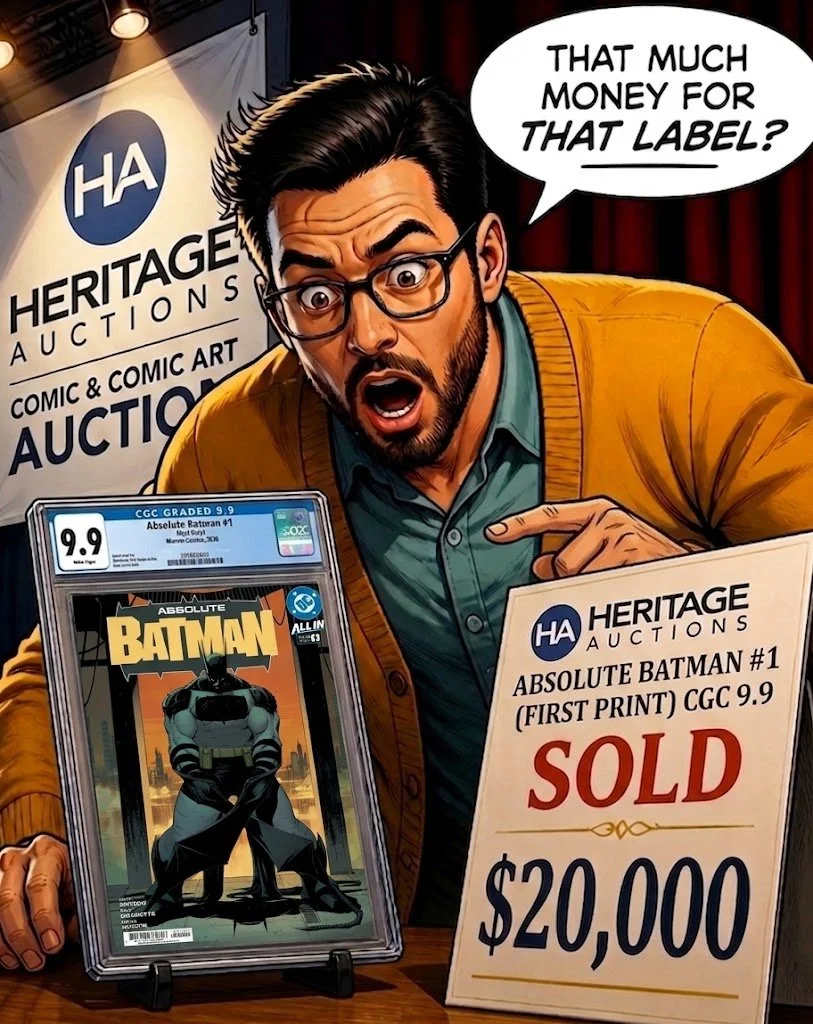
CGC 9.9 label auction prices can be mind boggling.
A CGC 9.9 can be worth dramatically more than a CGC 9.8.
A PSA 10 can command a premium over a PSA 9.
Collectors understand why. The label is rare. The condition is exceptional. The sale creates excitement.
But there is also something absurd about paying a large premium for a number that may depend on a microscopic manufacturing flaw, a subtle production difference, or a grader’s interpretation of the same evidence.
That is the strange double life of the near-perfect grade.
It is real. It is valuable. It is also not magic.
What a CGC 9.9 actually means
According to CGC’s grading scale, a 9.9 is a Mint comic. It is nearly indistinguishable from a 10.0, but it may have one very minor manufacturing defect. It cannot have evidence of handling defects.
A CGC 10.0 is Gem Mint. It is the highest grade assigned, and the comic must show no manufacturing or handling defects.
In practical terms, a CGC 9.9 is an almost flawless, museum-quality comic. A CGC 10 is the theoretical summit. It exists, but it is so uncommon that collectors should treat it as an extreme outlier rather than a normal target.
The practical ceiling for most comic books remains CGC 9.8.
That matters. A 9.8 is not a failure. It is usually the market anchor for modern comics and many high-grade copper and bronze books. The 9.9 sits above that anchor as an exceptional event.
CGC 9.9 versus PSA 10
A PSA 10 is best understood through sports-card culture. It is PSA’s top card grade and a widely recognized shorthand for Gem Mint condition among sports-card, Pokémon, and trading-card collectors.
PSA now grades comics and magazines as well. Its service is legitimate and its brand is powerful. But the meaning of a PSA 10 carries different market baggage when it crosses into comics.
Cards often trade around a simple hierarchy:
PSA 10
PSA 9
PSA 8
Comics carry more information. The issue, story, character, first appearance status, edition, page quality, restoration status, cover, and era all matter.
A number cannot replace context.
Why these grades are highly valuable
The value comes from several forces working together.
1. Label scarcity
There may be many copies of a modern comic in existence. There may be far fewer copies carrying a CGC 9.9 label.
That creates a new collectible category.
The buyer is not only purchasing the comic. The buyer is purchasing the rare event of that comic receiving a particular label.
The CGC Census can show how many copies CGC has certified at each grade. It cannot show every copy in existence. Raw books remain unsubmitted. Other companies hold other copies. Some comics are resubmitted, cracked out, or kept in private collections.
The population report is evidence of certified supply. It is not proof of true scarcity.
2. Completionist demand
Some collectors want the highest known grade. They want the 9.9 because the 9.8 is not enough for their set.
That desire is rational within the rules of a registry or personal collecting goal. It becomes less rational when the buyer forgets that the underlying comic may be common, weakly written, or unimportant.
3. Auction spectacle
A rare grade creates a story.
“First 9.9,” “highest graded,” and “one of only a few” are powerful auction language. They attract attention and encourage competitive bidding.
That does not make the premium fake. It means the premium is partly driven by scarcity, competition, and emotion.
4. Crossover buyers
Sports-card collectors entering comics may already understand the excitement of a PSA 10. They may bring that appetite for top labels with them.
This expands the buyer pool. It can also create confusion.
Why the grades are partly nonsense
Grading is a structured professional opinion. It is not a measurement taken from a machine that produces the same answer every time.
Print quality varies within a single print run. One copy may have a tiny bindery defect. Another may have cleaner corners. A third may have better color registration.
At the 9.8, 9.9, and 10.0 level, the differences can become microscopic.
A 9.9 versus a 9.8 may hinge on:
A minute production flaw
A barely visible spine stress
A slight corner imperfection
A subtle surface mark
The grader’s interpretation of whether a defect is manufacturing-related or handling-related
Collectors sometimes call this “the grader’s morning.” That is not an accusation of misconduct. It is an acknowledgment that honest human judgment exists inside a narrow range.
A comic can be the same physical object tomorrow and receive a different result after resubmission. The process is not arbitrary. But it is not perfectly mechanical, either.
Reholdering adds another layer of confusion. A CGC reholder generally replaces the holder without reconsidering the grade. A resubmission is different. The comic can be re-evaluated and move up, stay the same, or move down.
Population counts can also be distorted by resubmissions. One comic may leave a 9.8 count and reappear as a 9.9. Another may be cracked out and never returned. The census is useful, but it is not a perfect inventory system.
The crossover trap: PSA culture does not transfer cleanly
PSA is dominant in sports cards. CGC remains the comic-industry leader.
That difference matters.
The market for graded comics is built around CGC’s long history, familiar holder, population data, certification records, dealer adoption, and extensive sales history. CGC’s Census is deeply familiar to comic collectors.
PSA’s comic service is newer. Its brand recognition is enormous, but its comic-market history is still developing.
This is where PSA risks making a branding mistake: treating the comic community too much like the sports-card community.
A PSA 10 may be instantly understood by a card collector. A comic collector may ask different questions:
Is this a first appearance or a cameo?
Is the cover important?
Is it a direct edition or newsstand?
Are the pages white?
Is the book restored, conserved, or qualified?
Is the story historically significant?
Does the character matter beyond the current hype?
As ComicBook.com’s comics coverage demonstrates, comics are part of a broader story-driven culture. The number matters. The story matters more.
The lottery economics
Every submission is a ticket.
You may have a real chance at a premium grade, but the probability is not the same as the size of the prize.
Fictional example
You buy a modern variant for $40.
Your total costs are:
Comic: $40
Professional pressing and cleaning: $35
CGC grading: $45
Shipping and insurance: $30
Selling fees: $35
Your all-in cost is $185.
A CGC 9.8 might sell for $210. A CGC 9.9 might sell for $500.
That 9.9 looks exciting. But if your realistic chance of receiving it is very low, repeated submissions can erase the premium. Two failed attempts could add another $150 or more before the book ever reaches a buyer.
This is not an investment guarantee. It is a fictional illustration of expected-value thinking.
Use the formula:
Expected net result = probable sale price − all-in costs − selling fees.
Do not calculate from the best possible grade. Calculate from the most likely grade.
What actually matters
A famous key in CGC 9.8 can be worth far more than an obscure modern book in CGC 9.9.
Start with the book, not the label.
Consider:
Character importance
First appearance status
Story significance
Era
Print run
Cover desirability
Genuine scarcity
Condition
Page quality
Buyer demand
Under-the-radar X-Men issues show the point well. X-Men #129 introduced Kitty Pryde and Emma Frost. X-Men #131 developed the Hellfire Club storyline. X-Men #244 introduced Jubilee.
These books have meaningful character and story relevance. Their long-term appeal does not depend only on whether one copy receives a 9.9.
Use Key Collector Comics to check key significance. Then review actual sales through GoCollect, CovrPrice, and GPA/GPAnalysis, in that order when comparing the three. Check Heritage Auctions, eBay, and other venues for completed sales.
Compare the same issue, edition, grade, label type, and sales channel.
Do not compare a CGC 9.9 newsstand copy with a PSA 10 direct edition and call the difference meaningful.
Pressing can improve the book. It cannot manufacture certainty.
Professional comic book pressing and comic book cleaning can address non-color-breaking defects and surface dirt. They may help a comic present at its true condition.
They do not guarantee a 9.8, 9.9, or PSA 10.
A proper evaluation separates what can be improved from what cannot.
Professional pressers do not use the dry-clean method involving drafting powder on expensive comics. Drafting powder can abrade the surface, disturb inks, leave residue, create uneven sheen, and pull at fragile fibers. It can permanently alter the book.
Do not experiment on a valuable key. If you are learning a new technique, restrict experimentation to dollar books. A cheap test copy is far less expensive than a damaged grail.
At Pressing Issues, our process includes a complimentary value analysis before work begins. We keep the book in an unrestored state and focus on comic book preservation, safe handling, and realistic expectations. Books over $500 deserve professional handling. For many collectors, a rough professional-pressing threshold begins around $200 to $250, depending on the book and its potential.
When chasing the top label makes sense
Chasing a CGC 9.9 or PSA 10 can make sense when:
You genuinely love the book
It is a true grail
You want a personal milestone
You are building a high-grade set
The all-in cost is affordable
You would be happy owning it at a lower grade
It usually makes little sense when:
The book is mass-produced
The appeal is based only on temporary hype
The margin is thin
You are repeating submissions to force a rare label
You would not want the book at CGC 9.8
That last question is the system.
Would you still want this comic at 9.8?
If the answer is no, you may not want the comic. You may want the lottery ticket.
What I have learned
The highest grade is exciting. That excitement is part of collecting.
But possibility can make us see what we want to see.
Slow down. Inspect closely. Check the back cover. Study the surface texture under angled light. Look at completed sales. Calculate the all-in cost. Then decide whether the book deserves the chase.
Buy the character. Buy the story. Buy genuine scarcity.
Treat the label as useful information, not a guarantee of value.
If you love something, buy it, but always use caution.