
Why Professional Pressers Never Use Drafting Powder to Dry Clean Comics
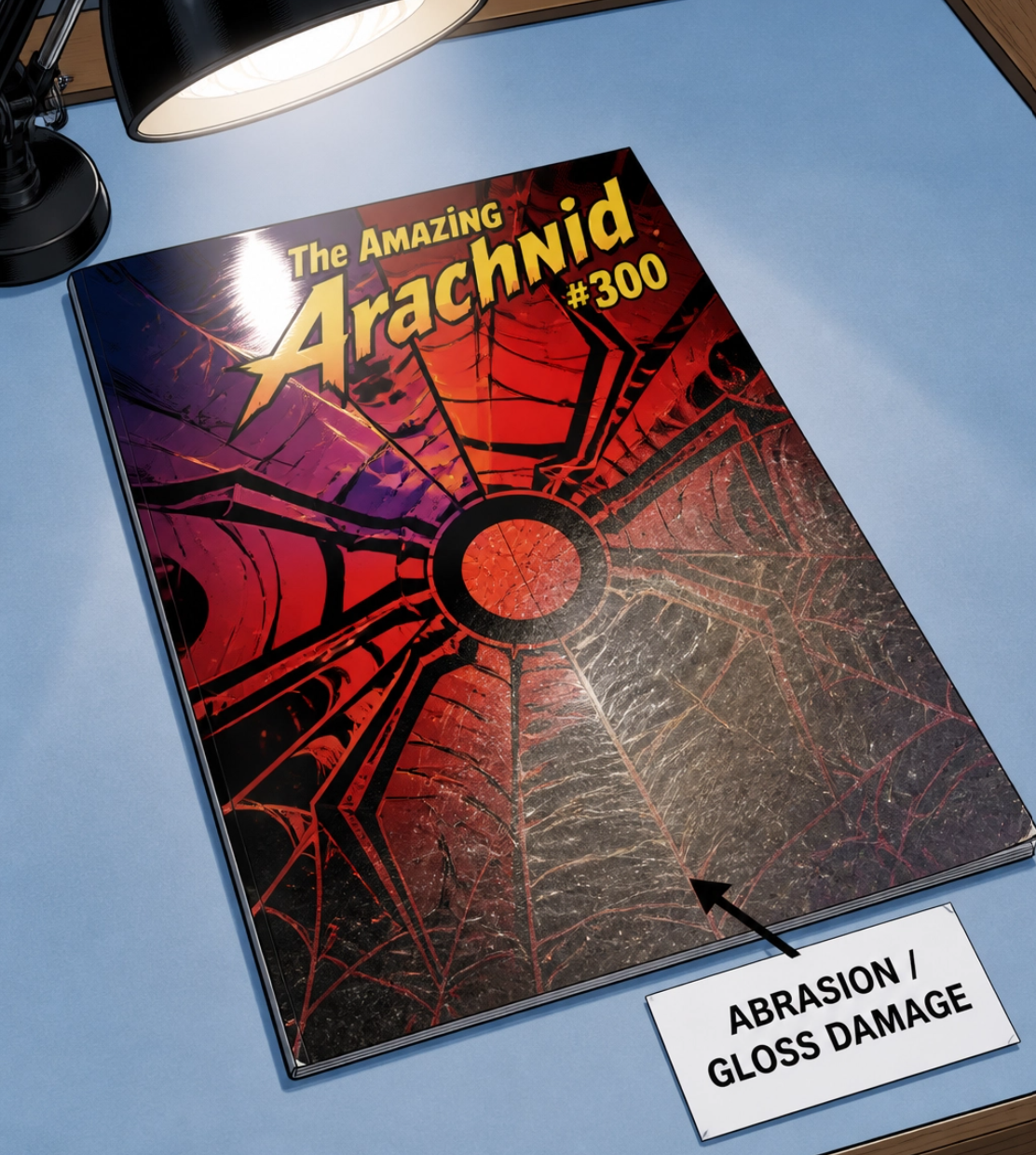
There is no safe amount of pressure with drafting powder.
You have probably seen the videos.
A collector spreads a comic on a clean surface, shakes out drafting powder, loose drafting dust, or rubbing-eraser debris, and rubs it across the cover. Dirt seems to disappear. The cover looks brighter. The process appears cheap, simple, and low risk.
That appearance is exactly the problem.
Professional pressers avoid this method on valuable comics because the danger is often not obvious while it is happening. A book can look cleaner under ordinary room light while the surface has already been scuffed, dulled, burnished, or contaminated with residue. The real damage often shows up later under hard, angled inspection light.
By then, it may be permanent.
This is the framing that matters. The issue is not that professionals are being overly cautious. The issue is that valuable comic books have thin inks, delicate coatings, porous paper, and old structural stress. A loose abrasive or dusty rubbing method introduces too many variables at once.
What Drafting Powder Actually Is
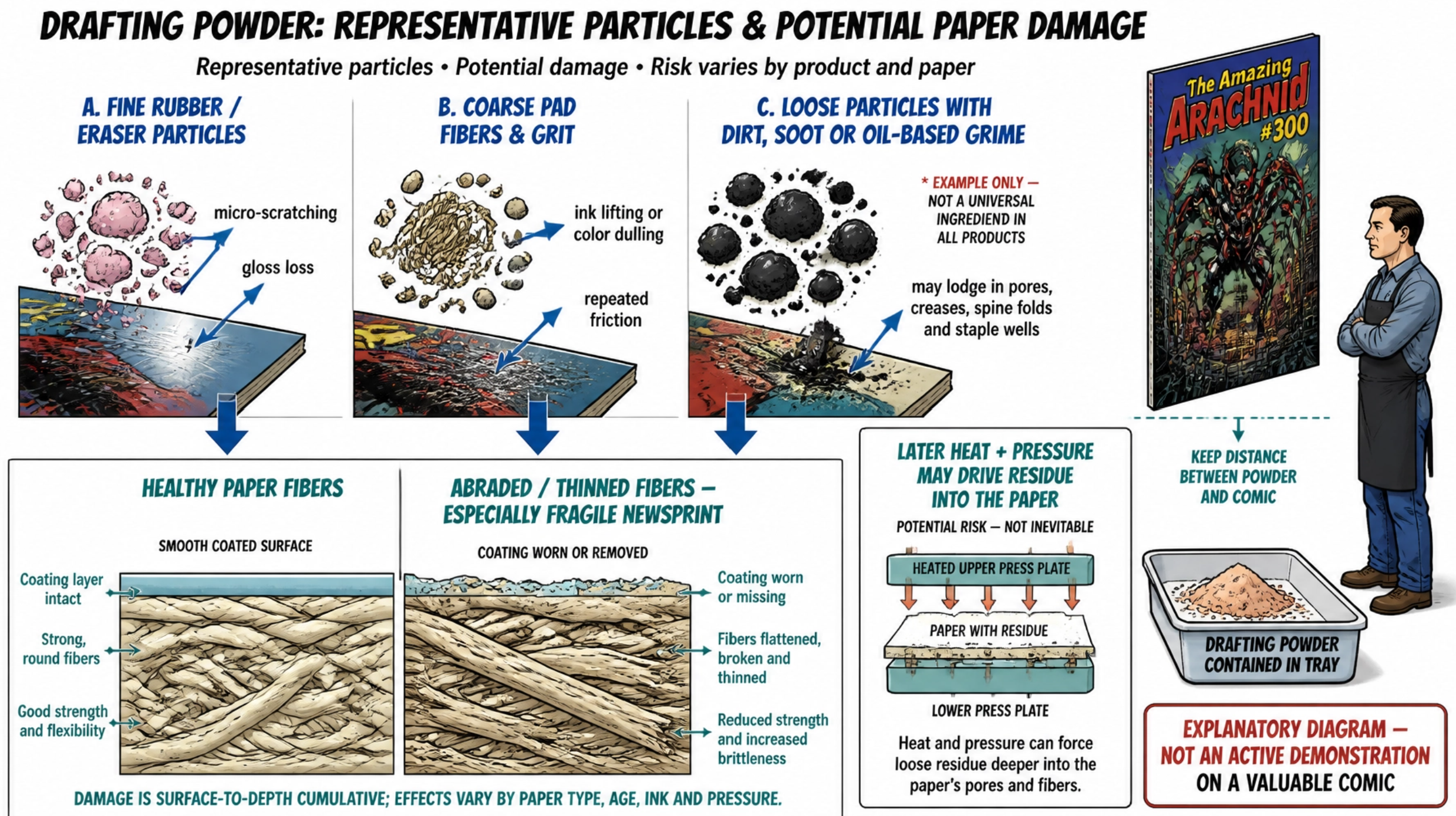
You may not see the damage, but CGC graders are more likely to.
Drafting powder is usually discussed as a paper-cleaning or erasing aid from the drafting world. In comic circles, the term also gets used loosely for dry-cleaning dust, loose eraser crumbs, or debris from coarse cleaning pads.
That loose terminology is part of the danger.
Comic books are not thick drafting sheets. Their covers may have thin glossy coatings, printed inks, foil, varnish, clay layers, and very specific surface texture. Interior pages may be porous newsprint that has already become weaker with age.
Comic printing inks can sit on top of porous paper or on top of a thin glossy coating. That means friction matters. Surface contact matters. Residue matters.
A product or debris that behaves acceptably on drafting paper is not automatically safe for a Bronze Age, Copper Age, or Modern comic cover. It is even less forgiving on fragile Golden Age or Silver Age interiors.
If you cannot identify exactly what the material is, how abrasive it is, what residue it leaves behind, and how that specific comic stock responds under light pressure, you do not have a controlled cleaning process. You have an experiment.
Why Professional Pressers Avoid the Powder Method
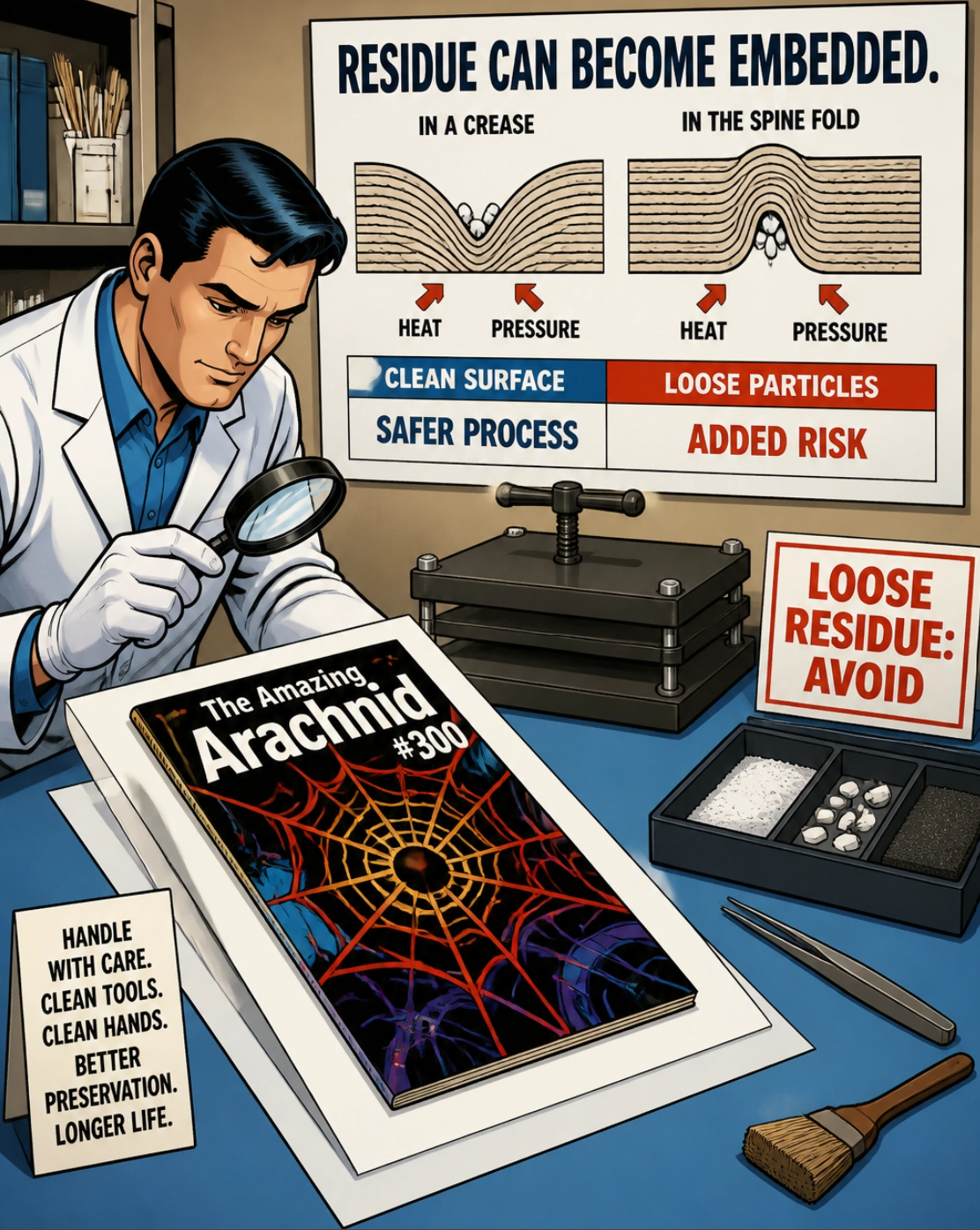
Comic book dry cleaning is an art and a science.
1. On glossy covers, the debris can act like ultra-fine sandpaper
A glossy comic cover is not just colored paper. It has a surface that reflects light in a very specific way.
When drafting powder, loose drafting dust, or debris from a coarse dry-cleaning pad is rubbed across that surface, the particles can behave like ultra-fine sandpaper. On Bronze Age, Copper Age, and Modern books, that friction can create visible scuffing, hazing, burnishing, and loss of gloss under angled light.
You may not see the damage immediately.
The finish looks a little flatter.
The reflection looks broken.
The surface catches light unevenly.
That is why professionals inspect with light, texture, and angle in mind. A cover can seem brighter while the original gloss has been dulled. Pressing cannot rebuild an abraded coating.
2. Ink and color can be disturbed by abrasive friction
Comic printing inks are not all sitting safely inside a thick protective layer. On some books, pigment sits on top of porous newsprint. On others, it sits over a thin glossy coating.
Abrasive friction can disturb that printed surface.
Colors can dull.
Pigment can lift.
Halos can form around line art.
Bare spots can appear where the surface has been rubbed too aggressively.
Black covers, dark inks, strong reds, and broad flat color fields often show this fastest, but the risk is not limited to those books. If the cleaning method depends on rubbing an unidentified residue over printed ink, the process is already moving in the wrong direction.
3. Loose particles can lodge deep in the structure of the book
Powder does not stay neatly in one spot.
Fine particles can lodge in:
Paper pores
Spine folds
Staple wells
Creases
Page edges
Folded corners
The spaces between pages
Once trapped, they are extremely difficult to remove completely. The back cover matters. The inside cover matters. The spine matters.
Inspect closely.
What looks clean from three feet away may still be holding residue exactly where you do not want it.
4. Heat and pressure can make residue problems worse
Dry cleaning comes before pressing. That part is true.
But professionals also know that residue must be removed and the surface must be inspected before any pressing begins. If loose particles remain in a crease, staple area, spine line, or along the edge of a glossy cover, later heat and pressure can drive that contamination deeper into the paper or coating.
Possible outcomes include:
Embedded grit
Dark marks
Hazy patches
Permanent surface contamination
The Comic Book CPR dry-cleaning guide makes the basic sequencing point clearly: dry cleaning comes before heat pressing, because heat and pressure can permanently set contaminants into the paper.
It is important to stay technically careful here. Professionals do not avoid drafting-powder methods because of one single universal chemical claim. They avoid them because uncontrolled residue plus friction plus later heat and pressure creates too much risk. If the debris includes rubber or polymer dust, the long-term aging behavior of that unknown residue is another reason not to introduce it into a valuable book.
5. Soil can be spread and ground deeper into the paper
Collectors sometimes assume any dry material will lift grime. That is not always what happens.
If loose powder or pad debris is dragged across oil-based grime, soot, or heavy oxidation, it can spread the soil and grind it deeper into the paper matrix. A surface problem can become a more permanent stain.
That is the opposite of controlled cleaning.
Professionals first evaluate what the soil actually is. Loose surface dirt is one thing. Embedded grime, oxidation, transfer, or staining is something else. The method must fit the problem.
6. Fragile newsprint can lose fibers and structural strength
Golden Age and Silver Age paper can already be stressed, thin, and brittle. Abrasive friction on that kind of stock can cause fiber thinning, fuzzy edges, feathering, and even tear propagation along stressed spine lines.
You are not just risking appearance. You are risking structure.
That matters on any old book, but it matters even more near staples, along folds, and on pages that already show stress whitening, small splits, or soft edges.
7. The damage often hides until proper inspection light reveals it
This is the central problem.
Under soft household light, a powder-cleaned cover may look improved. Under bright grading lights or raking light, the scuffing, burnishing, gloss loss, and disturbed surface texture can become obvious.
That difference can affect:
Cover gloss
Surface texture
Eye appeal
The grader’s assessment of condition
The book’s market value
Whether the book still presents at its best unrestored standard
Possibility can make us see what we want to see. A brighter-looking cover is not necessarily a healthier cover.
Professional Dry Cleaning Is Not the Same Thing
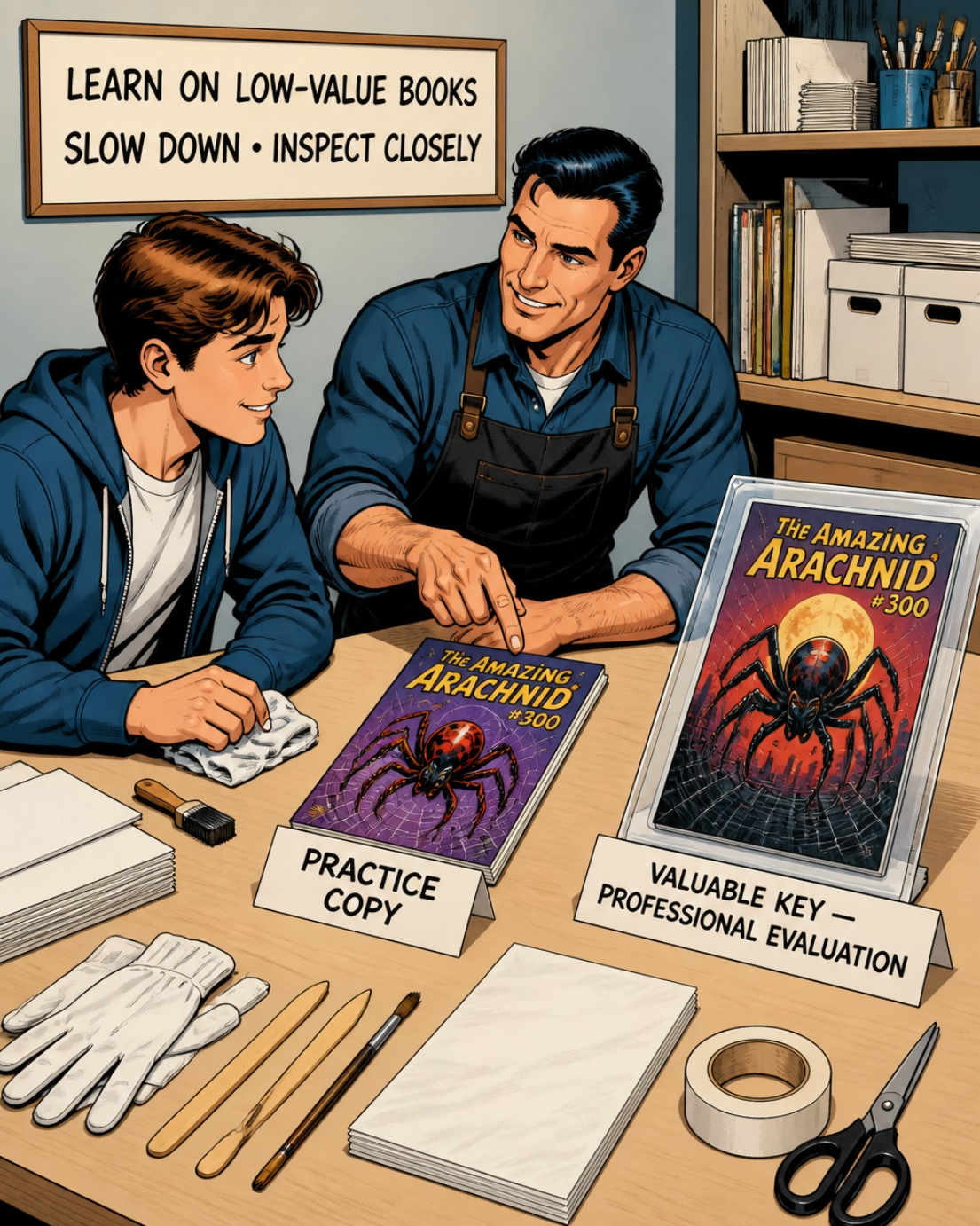
Experiment on dollar books, use tried and true professional methods on the keys.
Safe professional comic book cleaning is controlled and selective. A trained presser or conservator may use ultra-soft, residue-free tools such as appropriate soot-removal sponges or other soft conservation cleaning materials, with minimal pressure, after testing and inspecting the specific paper and ink.
That controlled process is not equivalent to rubbing loose drafting powder, eraser dust, or debris from a coarse drafting pad across a comic.
The process depends on the book.
A professional first determines:
What type of paper is present.
Whether the cover is coated or uncoated.
Whether the dirt is loose surface soil, transferred grime, oxidation, or a permanent stain.
Whether the ink is stable.
Whether the book has tears, flaking, brittle edges, weak staples, or color-breaking damage.
Whether cleaning offers enough benefit to justify the risk.
The objective is not to make every book look new. It is to present the book at its true condition without causing new damage.
Professional dry cleaning is also followed by careful residue removal and inspection before any pressing begins. Professionals do not casually combine abrasive powder with heat or pressure.
The official CGC pressing guidance describes pressing as a way to address non-color-breaking defects such as bends, dents, ripples, and spine rolls. It is not a magic eraser for stains, tears, missing paper, or damaged gloss.
The Experimentation Rule: Dollar Books Are Your Laboratory
Learning comic book pressing does involve experimentation.
You need to understand how different books respond to:
Heat settings
Pressure
Humidity
Backing boards
Release paper
Cleaning tools
Press times
Spine-roll correction
Interior-page handling
Cooling and stabilization
Trial and error is part of learning the craft. That is legitimate.
But the distinction must stay clear.
A dollar book is a practice tool.
An expensive key is not.
A sentimental book is not.
A high-value first appearance is not a laboratory.
New techniques should be tested on dollar-bin books first because powder, abrasion, heat, and pressure can permanently damage gloss, ink, paper fibers, staples, and overall structure. That is true even when the first pass looks successful. Damage often appears later, under better light, or after the book has already gone through pressing.
Practice on books with no meaningful financial or sentimental risk. Learn what a non-color-breaking spine tick looks like before and after pressing. Learn how a cover reacts to light pressure. Learn how quickly paper can become damaged when you rush.
Do not learn these lessons on an important copy of an under-the-radar X-Men key such as X-Men #120, the first appearance of Alpha Flight, or Uncanny X-Men #244, the first appearance of Jubilee. A book does not need to be a million-dollar blue-chip comic to deserve caution.
When the book matters, stop and seek experienced professional evaluation.
What Can Be Fixed: and What Cannot
Pressing and comic book cleaning can sometimes improve non-color-breaking defects. They may help with:
Light bends.
Surface dents.
Ripples.
Waves.
Minor spine roll.
Non-color-breaking folds.
Surface dirt.
Some pencil marks.
Minor handling impressions.
They cannot reliably repair:
Color-breaking creases.
Tears.
Missing pieces.
Deep stains.
Foxing.
Fading.
Brittle paper.
Spine splits.
Detached staples.
Rust stains.
Ink lift.
Permanently damaged gloss.
Attempting to treat an unfixable defect can create a second defect. You may begin with a color-breaking crease and finish with a crease, a stain, gloss loss, and a warped cover.
Pressing Candidate Diagram
Your Financial Threshold Matters
Our practical recommendation is conservative:
Around $200 is where professional pressing often becomes worth considering.
Between $200 and $250, professional attention is a sensible threshold.
Books over $500 deserve mandatory professional handling.
These are not guarantees of a grade increase. They are risk-management guidelines.
Before spending money on pressing, grading, shipping, or cleaning, compare the likely market value of the book before and after the work. Use several sources rather than trusting one optimistic estimate. You can compare GoCollect, CovrPrice, and GPAnalysis: the third example in this tracking-tool list: to understand graded sales. Then verify unusual results through Heritage Auctions, eBay sold listings, and other completed sales.
For key identification, Key Collector Comics can provide useful context. The CGC Census can help you understand graded supply. ComicBook.com’s comics section can help you follow news that may influence demand.
Do the math.
If the possible gain is small and the damage risk is real, leave the book alone.
If you would not risk a book in a homemade press, do not risk it with an untested cleaning powder.
What I Have Learned
What I have learned is that the most expensive mistakes usually begin with confidence.
A collector sees a tutorial. The tool is inexpensive. The result looks immediate. The book appears cleaner after five minutes.
That is enough to create false certainty.
Professional comic book preservation is slower than a tutorial. You inspect the paper. You study the texture under angled light. You check the back cover. You look at the spine and staples. You separate what can be improved from what cannot.
At Pressing Issues, our process includes a complimentary value analysis before work begins. We use controlled comic book pressing and comic book cleaning methods designed to preserve an unrestored standard. We inspect first. We test carefully. We remove residue before pressing. We do not promise grade increases. The goal is more practical:
Present the book at its true condition without risking permanent damage.
For valuable books, that restraint is part of the service.
Final Takeaways
Professional pressers avoid drafting powder, loose drafting dust, eraser dust, and coarse pad debris on valuable comics because abrasive friction and residue create unnecessary risk.
On glossy Bronze Age, Copper Age, and Modern covers, that risk can include scuffing, hazing, burnishing, and loss of gloss under angled light.
On porous paper, abrasive cleaning can disturb ink, dull color, and grind grime deeper into the sheet.
Fine particles can lodge in creases, spine folds, staple wells, and page edges, then become harder to remove before pressing.
Heat and pressure can turn leftover contamination into embedded grit, dark marks, hazing, or permanent surface problems.
Learn pressing and cleaning on dollar books first.
An expensive key, sentimental book, or important first appearance is not a laboratory.
Pressing cannot repair color-breaking creases, tears, stains, missing paper, or brittle pages.
Slow down. Inspect closely.
If the book matters financially or emotionally, ask questions before touching it.
The hobby rewards patience. Learn the process. Practice on books you can afford to lose. And if you love something, buy it, but always use caution.