
The Fear and the Magic of Your First CGC Submission (and How to Do It Right the First Time)
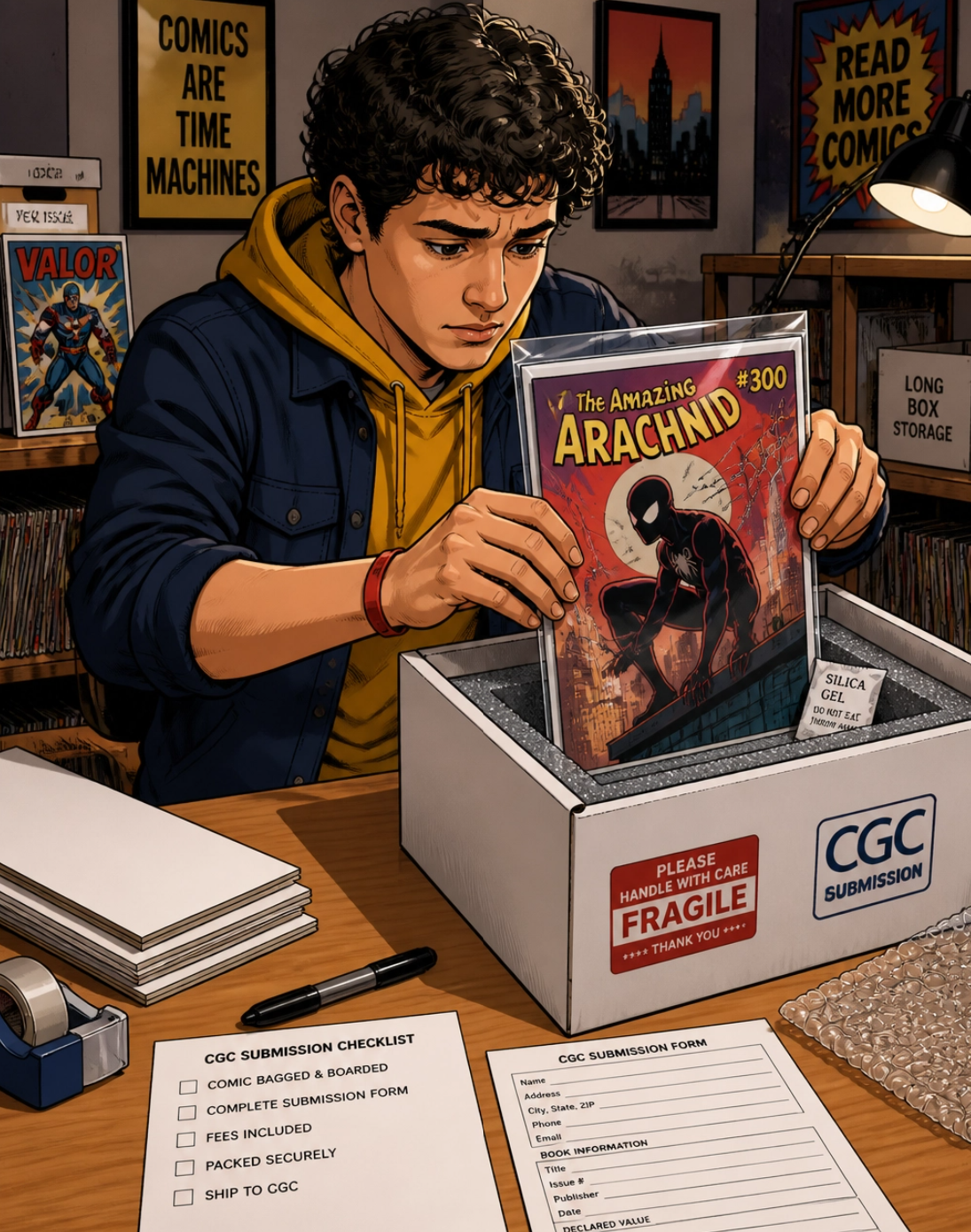
Safely packing your comics to send away to CGC is extremely important, it affects your grades!
Your first CGC submission can produce two strong feelings at the same time.
Magic. One day, a comic you have owned, protected, and loved comes back in a slab. A grade puts a number on years of care. The book changes from “my comic” into a certified piece of the hobby’s history.
Fear. You worry about shipping damage. You wonder what happens if the grade comes back lower than expected. You dread a rejection. You worry that one wrong box, form, or declared value will create an expensive problem.
Both feelings are normal.
Every serious collector has experienced them. The first CGC submission feels different because you are not simply buying a graded comic. You are entrusting a personal object to a process you do not control.
Slow down. You do not have to guess your way through it.
Why the first submission feels so risky

A trusted expert (like a comic book presser) can help you with your first CGC submission.
Let’s break the fear into manageable parts.
Fear of damage in transit
This is practical fear, not overreaction. A raw comic can pick up a corner ding, spine tick, or bend inside a loose box. That damage can happen before the book ever reaches CGC.
The solution is simple discipline:
Use a protective Mylar bag and backing board.
Keep books flat and aligned.
Add rigid support and foam padding.
Remove empty space from the box so nothing shifts.
Use tracking and insurance.
Keep the receipt and photograph the packed box before shipping.
A sturdy box matters. A padded envelope is not a submission system.
Fear of a disappointing grade
This is the emotional center of the process. You see the book every day. You know its history. You may remember buying it at a convention or pulling it from a long box years ago.
But CGC grades the physical book in front of them. Not the story behind it.
The back cover matters. The inside covers matter. Page quality matters. A tiny spine stress can matter. A book that looks perfect under warm room light may reveal a bend under a bright, angled light.
Inspect closely. Do not grade by memory or hope.
Fear of paperwork errors
CGC requires a submission form, service tier, declared value, and book information. That sounds intimidating until you treat it like a checklist.
List the exact title, issue number, year, variant information, estimated grade, and restoration history. Review the form against the books before sealing the box.
Do not rush this step. The paperwork is part of the preservation process.
Fear of the cost
The grading fee is only one line in the budget. You also need to consider:
Comic book pressing and cleaning
CGC grading
Shipping to CGC
Return shipping
Insurance
Declared value
Membership or handling fees
Selling fees, if you plan to sell
A slab is not automatically a profit. Run the math before you send the book.
Fear of not knowing the rules
You do not need to memorize every CGC policy. You do need to understand the basic system: value determines the tier, condition determines the grade, and preparation affects how clearly the book presents its true condition.
That is enough to begin.
The magic: a slab is more than plastic
A CGC holder protects the comic, but the real value is the record.
The certification label records the title, issue, grade, and identifying information. The grade gives buyers and collectors a shared language. The holder makes the book easier to store, display, insure, and sell.
A slab is not a guarantee that the book will rise in value. It is not a promise of a 9.8. It is a professional record of the book’s condition at a particular point in time.
That makes your first CGC submission a rite of passage in modern comic collecting.
This is especially true with under-the-radar X-Men key comic books. You do not need to begin with the most famous blue-chip books. A strong first submission might be an Uncanny X-Men #120, the first appearance of Alpha Flight; #129, featuring the first appearances of Kitty Pryde, Emma Frost, and Sebastian Shaw; #244, the first appearance of Jubilee; or #266, the market-recognized first full appearance of Gambit.
These books have real collector interest. They also give you a chance to learn the submission process without immediately putting a five-figure asset into the mail.
The biggest first-timer mistake: skipping prep work

There’s nothing like the feeling of your first CGC 9.8 slabbed comic book in hand.
The most common mistake is sending a raw book straight to CGC without inspection, cleaning, or pressing.
That is how a book fails to show its true condition.
Professional comic book pressing and comic book cleaning can reduce non-color-breaking defects such as:
Spine ticks
Light bends
Surface dirt
Finger bends
Ripples
Indentations
Minor spine roll
Stacking bends
Pressing can flatten a defect. It cannot recreate missing ink or repair broken paper fibers.
A pressable defect is usually a shape or surface problem that does not break color. A structural defect may involve a tear, stain, missing piece, detached staple, brittle paper, or color-breaking crease.
Look at the book under a bright light at a low angle. Turn it slowly. Watch how the light travels across the cover. A smooth reflection suggests a flat surface. A broken reflection can reveal a dent, ripple, or crease.
CGC considers appropriate pressing and dry cleaning non-restorative. These processes do not add material or alter the book. They are intended to improve presentation while preserving the book’s unrestored status.
There is no guaranteed grade increase. The goal is more honest than that:
Present the book at its true condition.
Pressing candidate diagram
Possibility can make us see what we want to see. A professional appraisal protects you from that mistake.
How to do it right the first time
1. Start with a value check
Before you think about CGC grading, ask whether the book is worth submitting.
As a rough professional-pressing threshold, books around $200 are worth reviewing carefully. A more conservative recommendation is $200–$250 in likely market value. Books over $500 deserve professional handling because the downside of careless preparation is much greater.
For current comic book market value, check recent sold listings rather than asking prices. You can compare data through eBay, GoCollect, and CovrPrice. For CGC-specific sales analysis, GPA, or GPAnalysis, is a useful third reference in the list.
For high-value books, also review Heritage Auctions realized prices. Use Key Collector Comics to confirm key status, and consult the CGC Population Report for census context.
The census is not a price guide. A low population does not automatically create demand.
2. Choose the correct CGC grading tier
CGC’s current U.S. comics fees include:
Modern: $30, for 1975–present books valued up to $400
Modern Bulk: $27, 25-book minimum
Vintage: $45, for pre-1975 books valued up to $400
Vintage Bulk: $42, 25-book minimum
High Value: $105, for books valued up to $1,000
Unlimited Value: 4% of fair market value, with a $135 minimum
Fast Track is currently an additional $15 per comic on eligible tiers.
CGC prices and turnaround times can change. Verify the current information on the official CGC Comics grading tiers and fees page before submitting.
Your declared value should be a reasonable estimate of current fair market value. Do not understate it to save money. That can place the book in the wrong tier and leave it inadequately insured.
3. Batch books by era
Submit Modern books with Modern books. Submit Bronze Age books with Bronze Age books.
This saves on shipping and creates a more consistent group for evaluation. Ten books from the same era can often fit securely in one return box.
A 1970s X-Men book has different paper, printing, and production characteristics than a 1990s book. Keeping similar books together makes your submission easier to organize and evaluate.
4. Prepare the books properly
Use archival Mylar and appropriate backing boards. Keep each book clean, flat, and protected.
Place the books in a rigid outer box with foam padding. Add silica gel packets to help manage moisture during transit, but do not allow them to press directly against the comics.
Include a packing list with:
Title
Issue number
Year
Estimated grade
Variant details
Estimated declared value
Restoration history, if known
CGC provides its own submission instructions. Read them before packing.
5. Insure and track the shipment
Insure the shipment to a reasonable declared value. Use tracking and delivery confirmation. Signature confirmation is sensible for higher-value submissions.
Photograph the books, packing materials, and sealed box. Documentation does not prevent damage, but it gives you a clear record if something goes wrong.
6. Understand the 9.8 prescreen
The difference between a 9.6 and a 9.8 can be subjective. A tiny back-cover scuff, faint bend, or barely visible spine stress may decide the outcome.
A 9.8 prescreen can make financial sense when a lower grade would not justify the total cost of grading. If a book misses the selected threshold, it can be returned raw rather than encapsulated.
A rejected book is not abandoned. You can inspect it again, consider professional comic book pressing, and resubmit it in a future batch. A different review may produce a different result, but there is never a guarantee.
7. Use Fast Track sparingly
Fast Track is useful when time genuinely matters. Perhaps you are preparing for a sale, an event, or a deadline.
Do not pay extra simply because waiting feels uncomfortable. Speed does not improve the grade.
You do not have to do it alone
The full-service path is straightforward.
You submit photos of the front, back, spine, and problem areas for a complimentary appraisal. You receive a written estimate covering the likely condition, pressability, projected costs, and value considerations.
If the math makes sense, a professional service can handle the paperwork, tier selection, declared value, insurance, and tracking. You ship the books and wait for updates.
That is the Pressing Issues model. It is designed for collectors who want the fear taken out of the process without surrendering control. The goal is not to push every book into a slab. The goal is to help you decide which books deserve the time, money, and risk.
You should know what can be fixed. You should know what cannot.
What I have learned
Collectors rarely need more excitement. The hobby provides plenty of that.
What collectors need is a calm second opinion before emotion turns into an expensive decision. I have learned that the best submission is not always the largest one. Sometimes the right answer is to keep a book raw. Sometimes a lower-grade X-Men key is worth grading because preservation matters more than resale. Sometimes the math says to stop.
That is not failure. That is discipline.
Key takeaways
Your first CGC submission can be frightening and meaningful at the same time.
Inspect the front and back under bright, angled light.
Pressable defects are not the same as structural defects.
Appropriate pressing and dry cleaning are considered non-restorative by CGC.
Check market value before paying submission costs.
Choose the tier according to publication date and declared value.
Pack securely, insure the shipment, and keep tracking information.
Use a 9.8 prescreen only when the financial math supports it.
Ask for help if the process feels uncertain.
The first submission is scary the first time and exciting forever after.
Do the prep. Know the tiers. Protect the books. And if you love something, buy it, but always use caution.