
Buying Comics at Conventions in the App Era: Why Dealers Need to Get Smarter
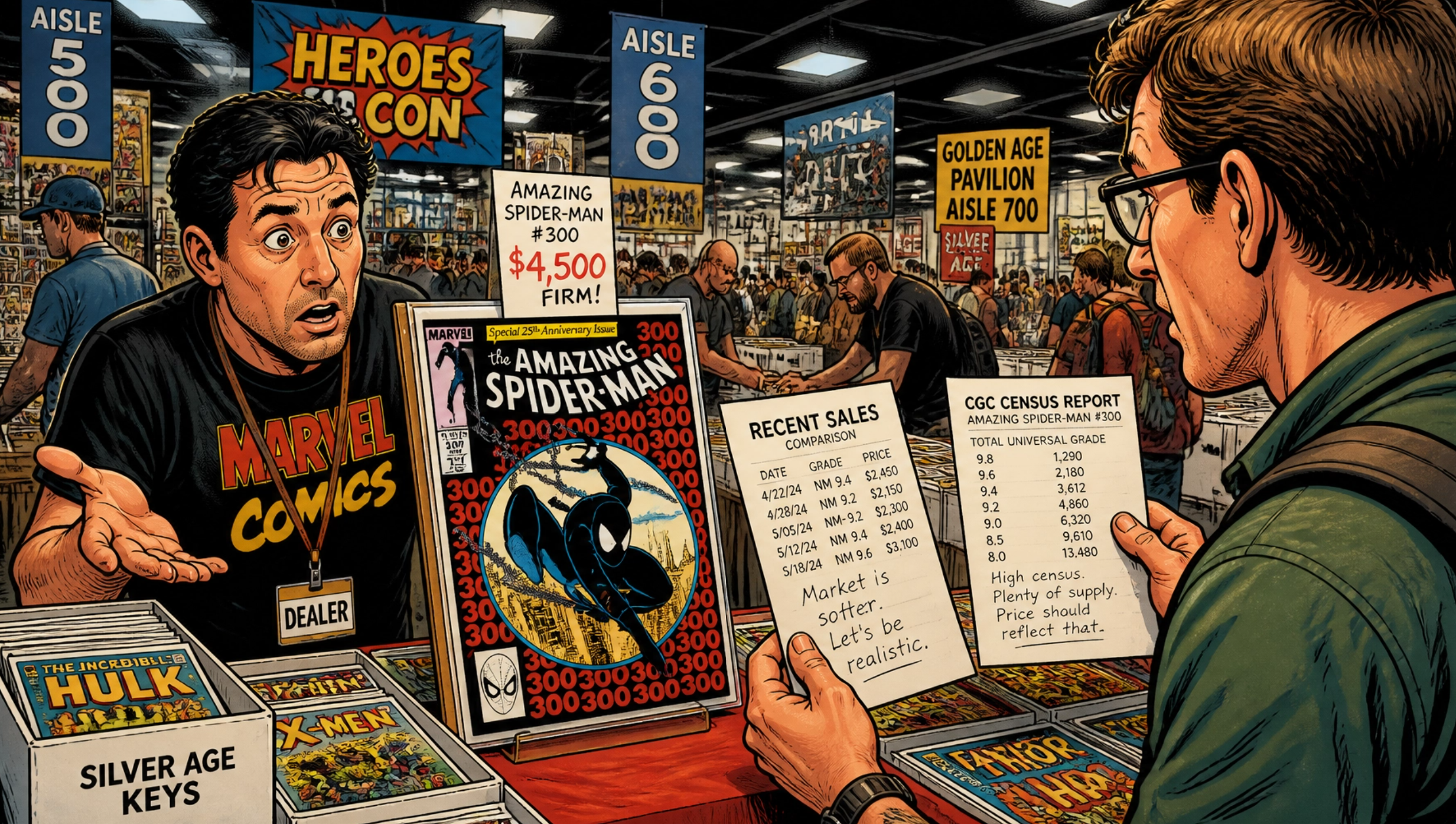
Buying comics at conventions has changed.
You can stand at a dealer’s table, search the exact issue, confirm a first appearance, compare recent sales, review the CGC Census, and check graded or raw prices before the dealer finishes explaining why the book is “hard to find.”
That does not make every app result correct. It does change the conversation.
The convention buyer is no longer operating from memory, an old price guide, or a dealer’s confidence alone. The modern collector has data in hand.
Dealers need to adapt.
Collectors need to use that data responsibly.
Both sides still need one thing: a fair transaction based on evidence, condition, and trust.
The Convention Buyer Has Changed
Years ago, many collectors arrived at comic book conventions with a want list and a general sense of value. A dealer’s price tag often became the starting point for the entire conversation.
That model is gone.
Today, collectors can use resources such as Key Collector Comics to verify key issues, first appearances, cameos, cover appearances, and variants. They can compare market history through GoCollect, CovrPrice, and GPA/GPAnalysis. They can review eBay completed listings, Heritage Auctions, and the CGC Census.
A collector looking at an under-the-radar X-Men key can now check whether the issue is genuinely important or simply being marketed as one. Is it X-Men #244, a recognized Jubilee first appearance? Is it New Mutants #87, a Cable key? Is it a true first appearance, a cameo, or a cover-only appearance?
The collector can check before making an offer.
The app is not always right. The database may contain incomplete information. A recent sale may be an outlier. But the buyer is no longer uninformed.
That matters.
Why Dealers Overprice Books
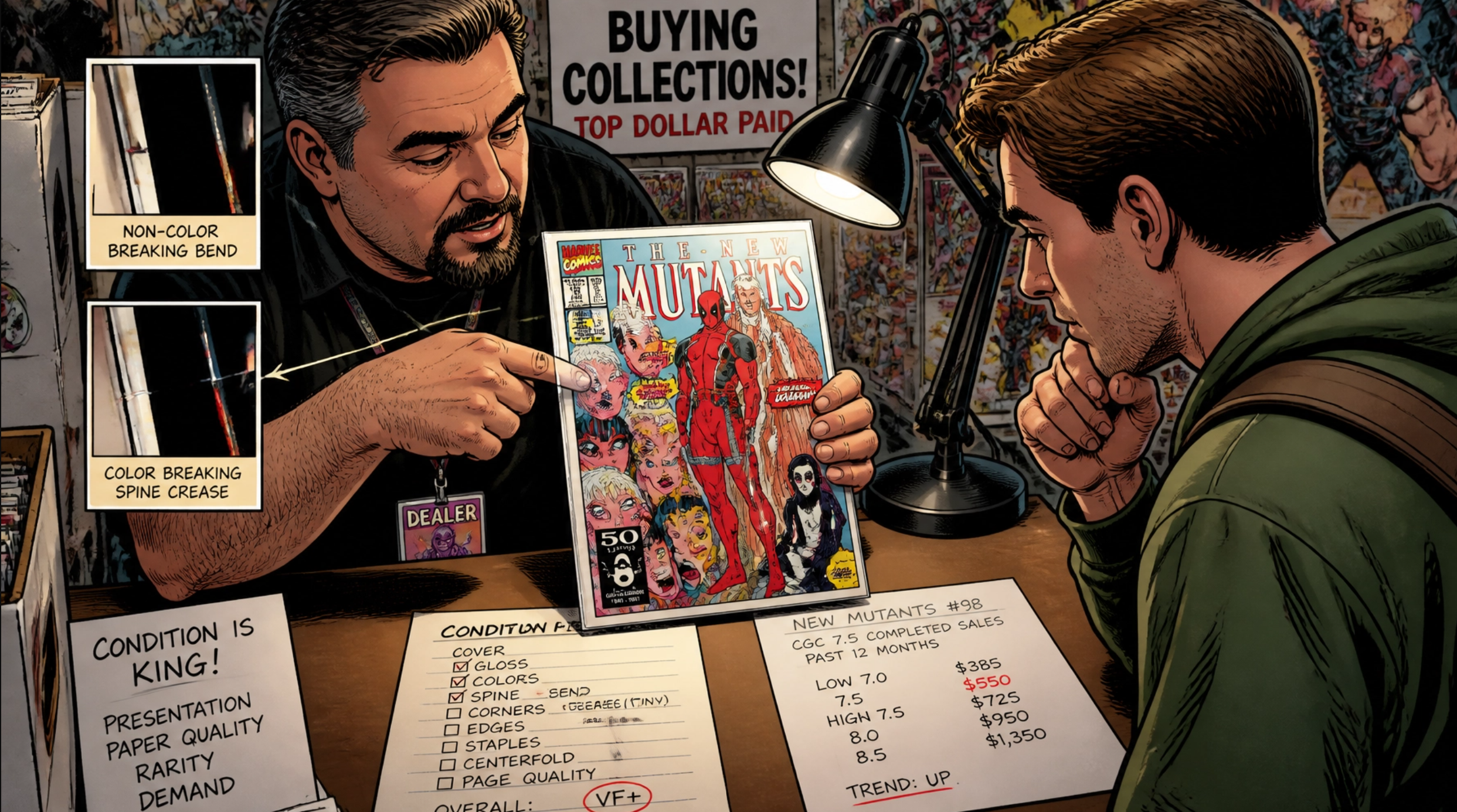
Not every expensive convention book is unfairly priced. Dealers have real costs:
Table fees
Travel and lodging
Insurance
Taxes
Staff
Payment processing
Inventory risk
Storage
Buying mistakes
Time spent sorting and preparing collections
A dealer must make a profit. A convention also provides convenience. You get to see the book in person, compare copies, ask questions, and take it home immediately.
A reasonable retail premium can account for those advantages.
The problem is not every premium. The problem is pricing that is disconnected from current evidence.
Common causes include:
1. Stale price guides and old convention comps
A dealer may have bought a book when the market was stronger. They may still be pricing from an old guide or a sale from two years ago.
That is not current comic book pricing.
2. Anchoring to one high sale
One impressive sale can distort expectations. A single high-grade copy may have exceptional eye appeal, white pages, a desirable label, or unusually strong timing.
One sale is not a market.
3. Confusing asking prices with completed sales
A book listed at $1,000 is not automatically worth $1,000. It may remain unsold for months.
Completed transactions are stronger evidence than optimistic listings.
4. Misreading the census
A low CGC Census number does not automatically mean a comic is rare. It may have many raw copies, unsubmitted copies, or copies graded by another company.
A high census number does not automatically make a book worthless. Demand, grade distribution, and liquidity still matter.
5. Emotional attachment
Dealers are collectors, too. Sometimes a price reflects what the dealer paid, what the book means to them, or what they hope it will become worth.
That explains the price. It does not justify it.
6. Overvaluing variants and speculation
A ratio variant may be difficult to find, but scarcity alone does not create lasting demand. Comic book speculation can turn a common book into a hot book overnight: and back into dead inventory just as quickly.
7. Pricing for the best possible buyer
Some dealers price every book as though the perfect buyer is already standing in front of them.
That is not a strategy. It is wishful thinking.
Stale Pricing Hurts Dealers
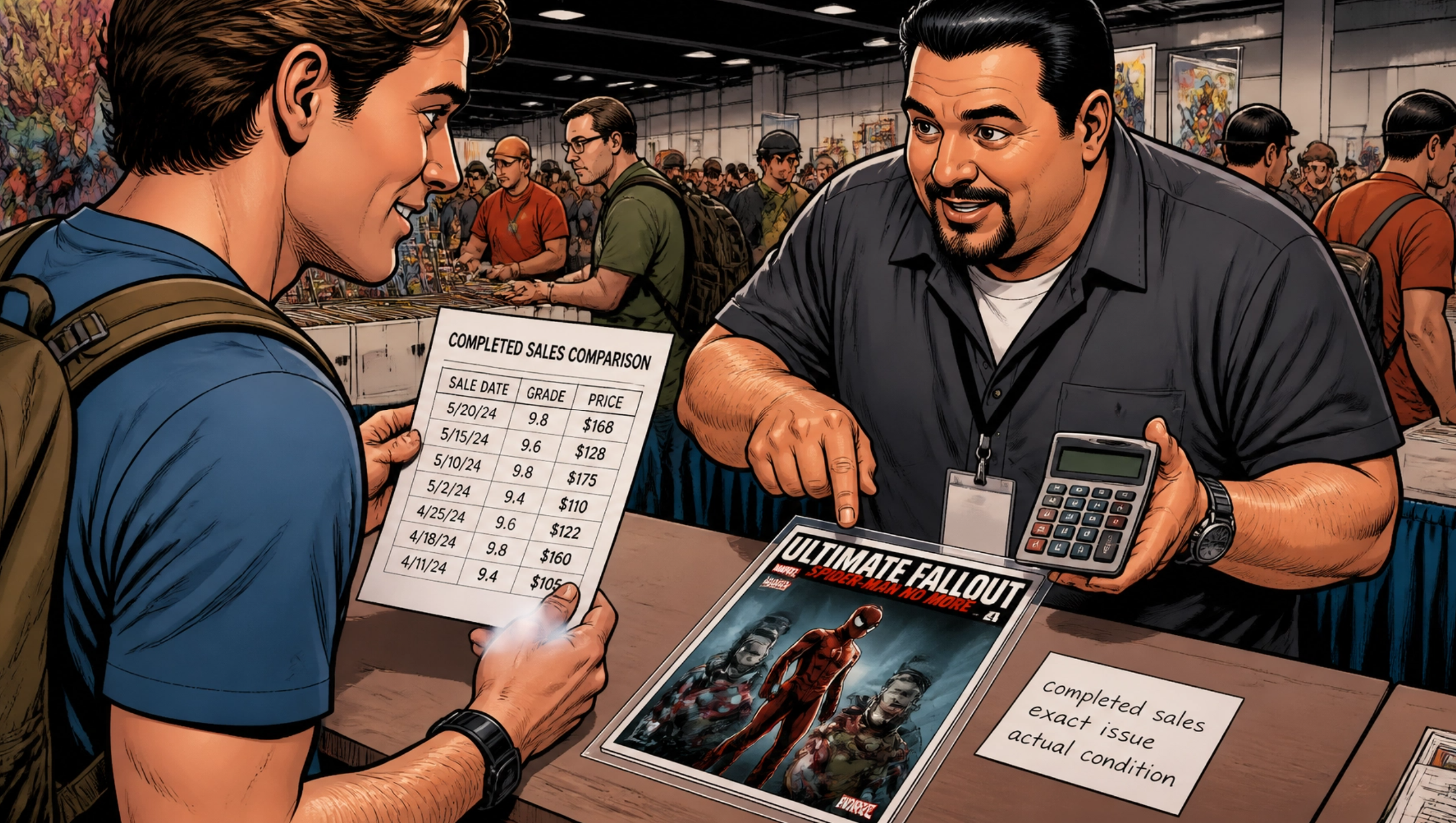
An overpriced comic is not automatically an asset.
It may be dead inventory tying up cash.
When informed buyers see a price that is obviously disconnected from recent sales, they often do not argue. They walk away. The book then travels to another convention with the same price tag.
Over time, several problems follow:
The dealer loses the sale.
The book occupies valuable display space.
Buyers lose confidence in the rest of the inventory.
Social media spreads examples of disconnected pricing.
Repeat customers stop checking the booth.
Cash remains trapped in a book that is not moving.
A dealer who refuses to update pricing may believe they are protecting value. In reality, they may be protecting an outdated number.
The Dealer’s New Advantage Is Expertise
Apps do not replace dealers.
They change what dealers need to offer.
A good dealer can provide things an app cannot:
Immediate physical inspection
Condition judgment
Variant identification
Provenance
Page-quality assessment
Restoration or conservation awareness
Curated selection
Negotiation
Convenience
Personal trust
The app can tell you what similar copies sold for.
An experienced dealer can explain why this specific copy deserves more: or less.
That conversation should include condition, not defensiveness. A dealer might say:
> “The last three copies in this grade sold around that range. This copy has better eye appeal and unusually strong page quality, so I priced it slightly higher.”
That is useful.
“I know what I have” is not an explanation.
How Dealers Should Price in 2026
A practical pricing system has several steps.
Step 1: Identify the exact book
Confirm:
Title and issue number
Publication year
Printing
Direct or newsstand edition
Variant
Signature status
Page quality
Restoration or conservation
Raw or graded condition
This is especially important with first appearance comics and modern comic book variants.
Step 2: Separate asking price from completed-sale range
Use multiple sources. When comparing the three major market tools, start with GoCollect, then CovrPrice, and then GPA/GPAnalysis for graded data.
Cross-check with Heritage Auctions and eBay completed listings.
Do not build a price around one outlier.
Step 3: Set a defensible retail premium
A premium may be justified by:
Better-than-average condition
Strong eye appeal
Scarce edition or variant
Desirable page quality
Professional preparation
Reliable authentication
Immediate availability
If the premium is justified, explain it.
Step 4: Leave room for reasonable negotiation
Negotiation is part of convention culture. But the sticker price should not be so inflated that the buyer must perform an elaborate ritual to reach fair market value.
Step 5: Reprice inventory that does not move
Hot books cool. Cold books get colder.
Dealers should update media-driven keys, speculative books, variants, and books that have traveled through multiple shows without serious offers.
How Collectors Should Use Apps Responsibly
Collector data is powerful. It is not automatic truth.
Before making an offer:
Verify the exact issue and edition.
Confirm whether the appearance is a first appearance, cameo, or cover appearance.
Compare several recent completed sales.
Check the venue, grade, page quality, and label.
Account for buyer premiums, shipping, taxes, and selling fees.
Use the CGC Census without treating it as a count of every surviving copy.
Compare raw books with raw sales.
Do not price a dealer’s raw copy like a CGC slab.
Include grading risk and submission costs.
Inspect the exact copy in front of you.
A raw comic cannot be priced like a CGC 9.6 without accounting for grading uncertainty. The book may have a hidden crease, restoration, page-quality issue, or defect that does not appear in the dealer’s description.
Online data gives you a range.
It does not grade the copy in your hands.
The Convention Negotiation
Be specific and respectful.
Try:
> “I’m seeing recent completed sales around this range for the same issue and condition. Can we work toward that?”
This gives the dealer an opportunity to explain differences.
Maybe the copy has better page quality. Maybe it is a scarce newsstand edition. Maybe the comparable sale was a damaged copy or an unusually low result.
A good dealer responds with evidence.
A poor response is to dismiss the app without addressing the data.
Collectors also need to be reasonable. A single low sale is not the universal price. The dealer may be paying overhead that an online seller is not. A convention offers immediate access and physical inspection.
If the numbers still do not work, walk away.
Buying the book you love remains valid. Just make it an informed choice.
Condition, Pressing, and Preservation
Apps cannot fully judge the copy’s physical condition.
Inspect under good light. Tilt the book slowly. Watch how the light moves across the surface. Look for:
Color-breaking creases
Spine ticks
Bends
Dents
Gloss loss
Stains
Page-quality problems
Restoration
Detached staples
Edge wear
Some non-color-breaking defects may respond to professional comic book pressing or appropriate comic book cleaning. Pressing does not guarantee a higher grade or a profit.
Professional pressers also do not use the dry-clean method involving drafting powder on valuable books. Drafting powder can abrade ink and gloss, leave residue, embed particles in the paper, and permanently change surface texture. New techniques should be tested only on dollar books: not expensive keys.
Comic book preservation is not only about improving comic book grade. A dirty, bent raw book can age poorly in storage. This is preservation drift: small problems become larger problems when poor storage and handling continue over time.
Pressing Candidate Diagram
A Fair Convention Transaction Benefits Both Sides
The dealer gets a sale and a possible repeat customer.
The collector gets a comic at a defensible price.
That is the goal.
Dealers should not resent collectors for checking data. Collectors should not assume every retail premium is a scam. The right question is whether the price can be explained by current market evidence, condition, expertise, convenience, and risk.
Transparency builds trust.
Practical Buyer Checklist
Before you buy at a comic book convention:
Photograph or record the issue.
Verify the exact edition and variant.
Confirm the first appearance or key designation.
Check recent completed sales.
Compare GoCollect, CovrPrice, and GPA when appropriate.
Cross-check eBay and Heritage Auctions.
Review the CGC Census without overreading it.
Inspect the front, back, spine, and interior under good light.
Look for restoration or conservation.
Ask about pressing and cleaning history.
Calculate the all-in cost if you plan a CGC grading submission.
Compare the dealer’s price with a reasonable retail premium.
Walk away if the numbers do not work.
What I Have Learned
What I have learned is that collectors rarely make mistakes because they care too much about a comic.
They make mistakes because possibility makes them stop inspecting.
A book can be a genuine key and still be overpriced. A low census can be interesting and still fail to prove scarcity. A beautiful raw comic can still have a defect that limits the grade.
Slow down.
The app is not the enemy of the dealer. It is the new starting point. Dealers who adapt can sell with greater confidence because they can explain value. Dealers who refuse to adapt will be left with books priced for a market that no longer exists.
And for collectors, the rule is simple: if you love something, buy it, but always use caution.