
Why Manufactured Scarcity Works for Sports Cards: but Rarely Works for Comic Books
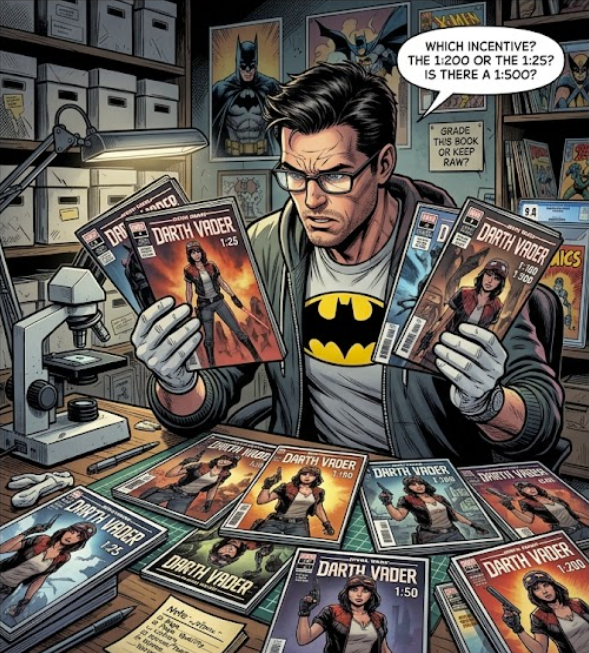
Manufactured scarcity is one of the strongest sales tools in collectibles.
It is also one of the easiest ways to confuse availability with value.
A limited print run can create excitement. A retailer incentive can create a chase. A foil, metal, virgin, convention, or store-exclusive cover can make a book feel special.
But scarcity is not value by itself.
In sports cards, manufactured scarcity often becomes the central object of the hobby. In comic books, it usually works only when it is attached to something collectors already care about: a major first appearance, an important story, a respected creator, or a cover that remains culturally relevant.
That distinction matters if you collect comics, collect sports cards, or are moving from one hobby into the other.
What Is Manufactured Scarcity?
Manufactured scarcity is scarcity designed into a product at launch.
Examples include:
Retailer incentive ratios such as 1:25, 1:50, or 1:100
Convention exclusives
Store exclusives
Foil, metal, or virgin covers
Deliberately restricted print runs
Numbered parallels
Exclusive distribution through selected retailers
Organic scarcity develops differently.
An older comic may be scarce because few copies survived. Poor storage, low original distribution, regional availability, natural disasters, and simple neglect can reduce the surviving supply over decades.
That scarcity was not part of the original marketing plan.
Manufactured scarcity was.
This does not automatically make it dishonest or worthless. It is a marketing mechanism. Sometimes it works beautifully. The mistake is assuming that limited availability guarantees lasting demand.
Why Manufactured Scarcity Works Better in Sports Cards
Sports cards are built for the chase.
A modern card set may include a base card, a rainbow of parallels, autographs, patches, short prints, and numbered versions. Collectors understand the structure. They know what “/99,” “/25,” or “1/1” means.
The scarcity is printed directly on the card.
If you own card 07/25, you know where that card sits in the production run. The checklist is finite. The numbering is clear. The hierarchy is familiar.
There is also an active statistical story attached to the athlete.
A player can win an award, break a record, reach the playoffs, win a championship, or become a Hall of Fame candidate. Every new achievement can renew interest in the card. The manufactured scarcity remains the same, but the demand can grow.
Grading populations and registry competition reinforce the chase. Collectors compete for the highest grade, the lowest serial number, a complete rainbow, or a specific parallel from a particular product.
Not every sports-card short print succeeds. Many do not. Overproduction, too many parallels, weak players, and fading interest can damage demand.
But the structure gives scarcity a place to work.
In sports cards, the rare parallel may be the product.
In comics, it is usually only one version of the product.
Why the Formula Usually Breaks in Comics
A comic is not just a scarce object.
The market asks what the issue means.
Does it introduce an important character? Is it a first full appearance? Does it contain a major story event? Is it part of a respected creator’s run? Does the cover have lasting appeal? Does the character still matter years later?
A 1:100 variant can be harder to find than the regular cover and still be unwanted if the underlying character, story, creator, and cover do not retain demand.
Ratios are not population reports.
A 1:25 incentive does not mean exactly 1,000 copies exist. Retailers may order beyond the minimum needed to qualify. Publishers may produce extras. Copies may remain in warehouses, retailer inventories, collections, or unsold stock. Damage and distribution issues also complicate the picture.
The ratio tells you how the book was offered. It does not tell you the exact surviving population.
An exclusive label can create temporary excitement. It cannot guarantee a secondary market.
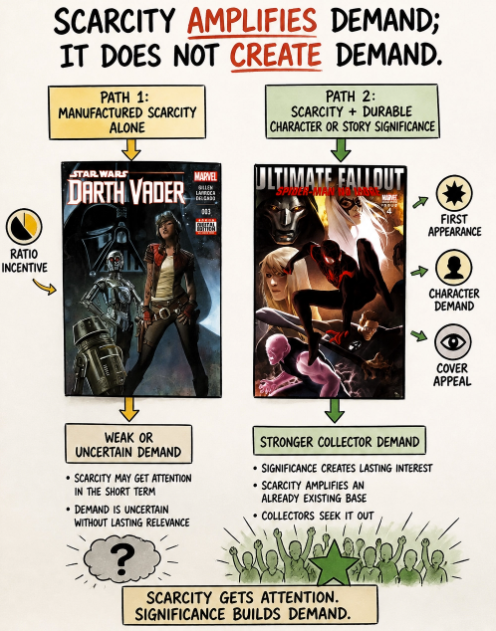
A Practical Scarcity Diagram
This is why comic book variants behave differently from numbered sports-card parallels. Comics have no universal serial-number checklist. The same character may appear on dozens of covers, store exclusives, foil editions, virgin editions, convention editions, and incentive variants.
Those versions can compete with one another for the same dollars.
Darth Vader #3 and the Doctor Aphra Lesson
Star Wars: Darth Vader #3 from 2015 is a legitimate modern key. It contains the first full appearance of Doctor Chelli Aphra, along with the first appearances of 0-0-0 and BT-1.
The character matters. The franchise matters. The first-appearance status matters.
That is why the book has durable interest.
You can review the issue’s key details through Marvel’s official listing, then compare how the issue is cataloged by Key Collector Comics and GoCollect.
The important point is simple:
Darth Vader #3 is valuable primarily because Doctor Aphra became an important Star Wars character: not merely because one version was difficult for retailers to order.
There are multiple printings and variants. Some collectors specifically pursue the Salvador Larroca ratio variant. Others want the standard first-print cover. Some collect later Doctor Aphra issues and their store variants.
Those are valid collecting choices.
But a rare Doctor Aphra cover does not automatically outrank the recognized first appearance. A collector needs to know what they are buying:
The character’s first appearance
The standard first print
A ratio variant
A later printing
A store-exclusive cover
A cover they personally prefer
A scarcity label attached by the seller
Every additional version divides attention and money.
If demand cools, a low-ratio or store-exclusive cover can fall faster than the recognized first appearance. The durable anchor remains the key issue.
The lesson is not “never buy a variant.”
The lesson is: know whether you are buying the character, the cover, the story, or the scarcity label.
The Rare Success: Ultimate Fallout #4
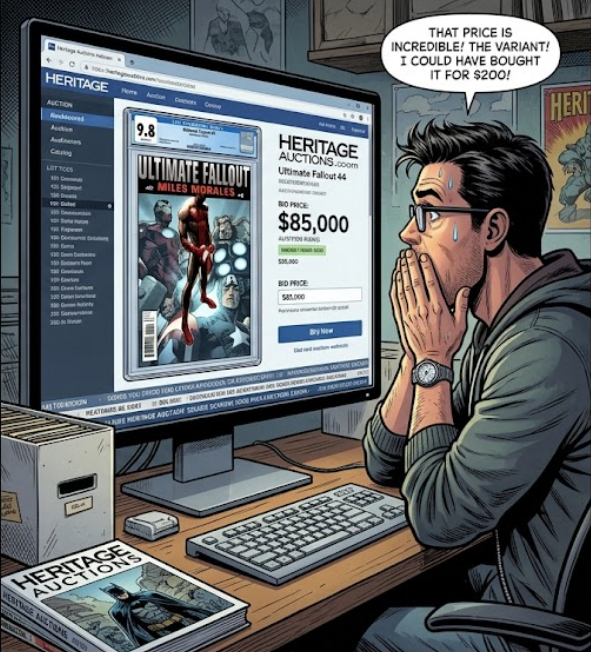
The Marko Djurdjević 1:25 incentive cover for Ultimate Fallout #4 is the rare comic-book example that proves the rule.
The book combines three powerful forces:
A genuinely important issue
A memorable cover by a respected artist
Designed scarcity through a retailer incentive ratio
Ultimate Fallout #4 contains the first appearance of Miles Morales as Spider-Man. Miles developed into a major Marvel character with sustained demand across comics, animation, games, and film.
The Djurdjević cover is commonly described as a 1:25 retailer incentive. That made it harder to obtain than the regular edition, but the ratio was not magic. It did not create Miles Morales. It amplified demand for an already meaningful first appearance.
Marvel’s listing identifies the Djurdjević variant. You can also review market and issue information through GoCollect, Key Collector Comics, and Heritage Auctions’ archived results.
Do not treat the 1:25 ratio as an exact population count. Retailer ordering, extra copies, damaged books, inventory, and later submissions all complicate the math. Comichron can help provide broader print and sales context, but ratio variants still require caution.
The variant is valuable because scarcity and demand reinforce each other.
That is unusual.
For every incentive cover with a Miles Morales-level key behind it, many others never develop lasting demand. Even a strong character does not guarantee that every scarce cover will win.
Ultimate Fallout #4 proves that scarcity works best as an amplifier.
It does not prove that scarcity creates value from nothing.
Do Not Mistake a Low Census for Proof of Rarity
A low CGC Census count can be useful. It is not conclusive.
The census shows books that have been submitted to CGC. It does not show every copy that exists. Some collectors never grade their books. Some copies are sitting raw. Some are damaged. Some are in long-term collections.
Resubmissions can also affect the numbers.
A low census may mean a book is rare. It may also mean collectors have not submitted many copies because demand is weak.
Use the CGC Census as one piece of evidence, not the entire argument.
For completed-sales research, compare GoCollect, CovrPrice, and GPA/GPAnalysis. Then check Heritage’s auction archives and eBay completed sales.
Compare completed sales, not asking prices.
The Collector’s Test
Before buying a manufactured-scarcity comic, slow down and ask:
What makes the underlying issue matter?
Is it a first appearance, first full appearance, cameo, cover appearance, major story, or important creator work?
Is demand coming from readers and collectors, or mainly from sellers?
How many versions compete for the same dollars?
Is there completed-sales evidence across time?
Is the premium based on actual scarcity or marketing language?
Would you still want the book if the hype disappeared?
Your decision formula should be:
Underlying importance + sustained demand + condition + clear edition identity = stronger purchase
Scarcity is the bonus.
It should not be the foundation.
Preservation Still Matters
A scarce book still needs care.
Cleaning and pressing are not only tools for improving comic book grade before a CGC grading submission. They are preservation steps for raw comic books that deserve long-term protection.
Professional comic book pressing and comic book cleaning can address appropriate non-color-breaking defects and surface dirt. They may help a book present at its true condition while keeping it in an unrestored state.
They do not guarantee a grade or a profit.
Do not experiment on an expensive incentive variant. New techniques should be tested on dollar books first. Permanent damage is a poor tuition bill.
Professional pressers also do not use the dry-clean method involving drafting powder. Powder can lodge in paper fibers, alter surface texture, leave residue, create abrasion, and damage a book permanently. The risk is not justified on a valuable comic.
At Pressing Issues, our process includes a complimentary value analysis, transparent communication, photo updates, and CGC submission assistance. As a rough rule, books with meaningful value above $200–$250 deserve careful professional consideration. Books valued above $500 deserve professional handling.
You can also review our guides on CGC Census limitations, market-tracking tools, and comic preservation.
Key Takeaways
Manufactured scarcity is a marketing mechanism, not automatic value.
Sports cards support scarcity through numbering, checklists, parallels, grading, and active player statistics.
Comics depend more heavily on story, character, creator, cover appeal, and cultural relevance.
Darth Vader #3 remains important because it is Doctor Aphra’s first full appearance.
The Ultimate Fallout #4 Djurdjević variant succeeds because its scarcity is attached to Miles Morales’s first appearance and a memorable cover.
A 1:25 ratio does not establish an exact surviving population.
A low CGC Census count does not prove a book is rare.
Buy the underlying key first. Treat the scarce cover as a bonus.
Compare completed sales and calculate your all-in cost.
Preserve valuable raw books carefully, whether or not you plan to submit them.
Manufactured scarcity can start a chase, but it cannot manufacture a fandom.
In sports cards, a finite parallel can attach itself to a living statistical career. In comics, the lasting winners usually have a character, story, creator, or cultural moment that collectors still care about years later.
And if you love something, buy it, but always use caution.