
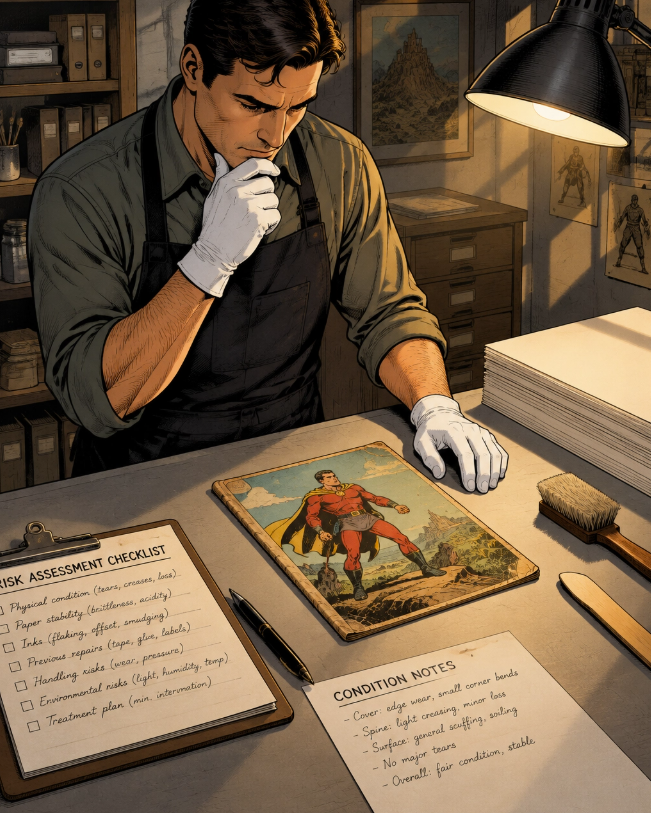
Every comic book pressing job begins before the press, and ends after the work is done. From opening the shipping package to handing the book off for grading, each movement creates a chance to change the comic’s condition.
That does not mean you should fear every step. It means each step deserves a reason.
A professional presser’s skill is not measured only by the defects they can address. It is measured by whether they recognize what could go wrong, judge whether the possible benefit is worth that exposure, and tell you when the answer changes.
Risk starts before the press
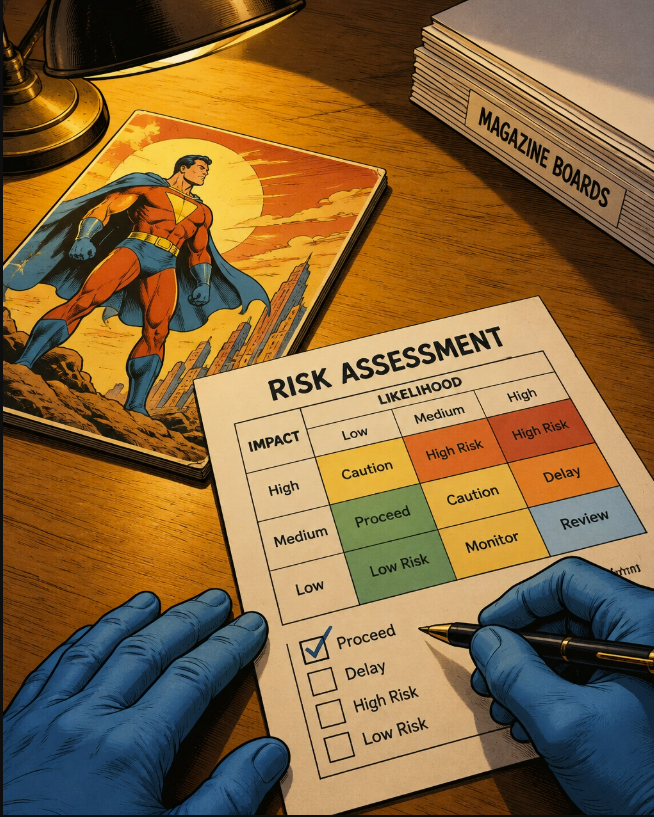
The first risks can appear while opening the package. Tape can catch a sleeve. A book can slide out before it is supported. Packaging debris can get onto the work surface. Even moving a comic from its bag to an inspection table takes care.
Then comes the condition assessment. Turning a cover, opening pages, checking the staples, or shifting the book under angled light can reveal useful information, but every movement is another chance to stress a fragile spine or catch a loose piece.
Cleaning and pressing bring their own risks. So do putting the comic back in its bag and board, packing it for shipment, and sending it onward for grading. No stage is risk-free. Each one is a decision point.
That is why “I’ll be careful” is not enough. Care has to become a process: support the book, use a clean surface, handle it only as much as needed, document what you see, and stop when the next action no longer makes sense.
The point is not to avoid all risk. That is impossible. The point is to avoid taking risk without a clear reason.
How a professional weighs an action
Before taking an action, a presser should be able to answer four questions:
What are we trying to change?
What could go wrong?
How likely is that problem, and how serious would it be?
What is the realistic benefit if the action works?
Then comes the deciding question: Is the risk worth the reward of finishing this task on this specific book?
Sometimes the answer is yes. A stable comic with a non-color-breaking bend may be a reasonable candidate for pressing. Sometimes the answer is no. A fragile book with loose paper around a staple may have too much to lose for a speculative improvement. Sometimes the book does not need the proposed action at all.
A defect may be visible without being safely removable. Pressing can reduce the appearance of some bends, dents, ripples, and other non-color-breaking defects. It cannot put missing paper back or erase a color break. Cleaning is not a reason to rub harder when a mark is embedded or the surface is vulnerable.
There is no honest grade guarantee. A comic can look flatter and still receive the same grade. It can also receive a lower grade. The condition, the material, the work performed, and the grading decision all matter.
A presser who cannot explain the purpose, risk, and stopping point of a task should not proceed until they can.
Your comic. Your decision.
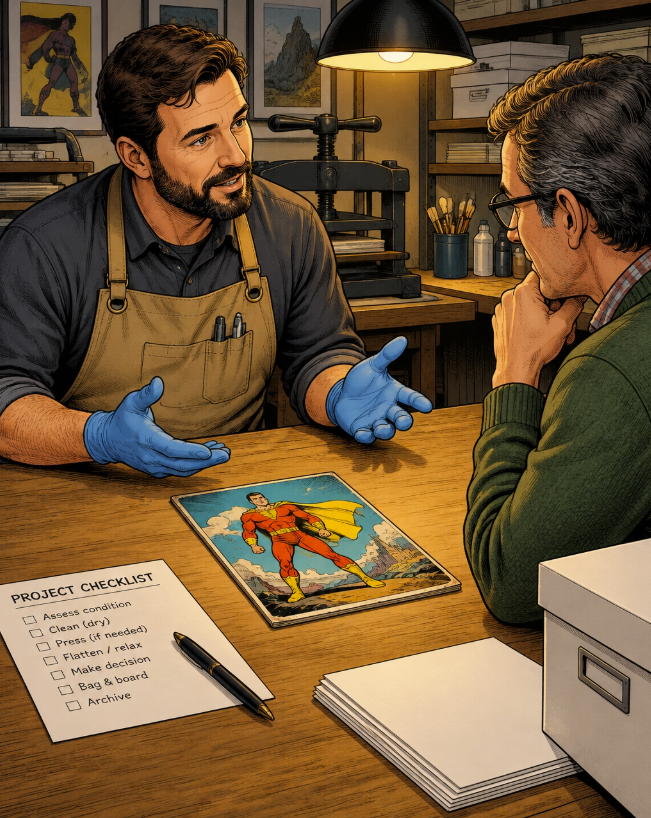
A good presser stays in communication with you because it is your book, your money, and your outcome. The presser brings experience and a recommendation. You should have the information and agency to decide whether the work continues.
That communication should happen at three points.
Before work begins: You should know what the presser proposes, what the comic appears to need, what the limits are, and what risks come with the plan. If you have specific boundaries, such as declining a particular kind of cleaning, say so. A responsible presser should make those boundaries part of the job.
When something unexpected appears: A book can reveal a loose staple, a fragile area, or a defect that was not clear in the initial assessment. That is a pause point. The presser should describe what they found, what options remain, and what each option could mean. If the risk has changed, the plan should change too.
When the task stops making sense: A defect may not respond. More handling or another attempt might bring little benefit and more exposure. The presser should tell you when they recommend stopping rather than repeating an action to chase a result.
The presser recommends; the owner decides. That does not mean a professional must carry out every request. It means they owe you a clear explanation if they advise against it, and should never quietly make a meaningful change to the agreed plan.
Ethics means knowing when not to act
Ethics in comic book preservation is not a slogan. It is the practical choice to protect the book from unnecessary or disproportionate risk.
That can mean declining work when the comic is too fragile for the proposed treatment. It can mean refusing to attempt an action even when an owner asks for it, if the likely harm outweighs the possible benefit. It can mean being direct when the odds are poor, even if the less exciting answer is not what you hoped to hear.
A complimentary value analysis can help put the decision in context: what the book is, what condition it is in, what might realistically improve, and whether the potential value change justifies the cost and risk. It is not a promise about a future grade or sale price. It is one more way to replace wishful thinking with a reasoned choice.
The same standard applies to an unrestored outcome. The goal should be careful preservation without crossing into work that changes the book’s character or status. A professional should explain the scope clearly rather than promise a label or result they cannot control.
The YouTube problem: spectacle is not service
Some techniques make dramatic videos. That does not make them the right choice for your comic.
A method that looks impressive on camera may be unusually risky when a quieter, more controlled approach could address the same issue. The job is not to produce a memorable clip. The job is to make a sound decision for the book in front of you.
If a proposed technique looks dramatic, ask: What is the safer alternative? Why is that alternative not being used? What could go wrong with this method, and what would make you stop?
That question is not an accusation. It is a reasonable part of choosing someone to handle a collectible you care about. Showmanship should never substitute for a clear explanation of risk.
The same principle applies to comic book dry cleaning. Professional pressers avoid using drafting powder as a casual dry-cleaning method because powder can spread beyond the target area, leave residue, or create abrasion when rubbed across a printed surface. It can be difficult to control where it goes and how it affects the paper. A technique that is hard to reverse deserves particular caution.
If you are learning a new technique, experiment on dollar books, not on a valuable comic. A permanent mistake is an expensive way to discover that a method was unsuitable.
Questions to ask before hiring a presser
Use these questions when you interview a presser:
How do you assess the risk of each cleaning and pressing task on my specific book?
What conditions would make you recommend doing nothing?
What defects can you realistically address, and what will remain?
How will you contact me if you find unexpected damage or the risk changes mid-job?
Will you stop and ask before performing work outside the agreed plan?
How often will you update me, and can you provide photos before and after work?
How do you document what you did, and what you chose not to do?
What happens if a problem occurs while the book is in your care?
How will you protect the comic during re-bagging, repacking, and submission?
What outcome can you promise, and what outcome can’t you promise?
Listen for specific answers. “I’m always careful” does not explain how someone assesses risk. A good response describes the book’s condition, the proposed action, the limits, the communication plan, and the point at which work stops.
What I have learned
What I have learned is that responsible comic book preservation often comes down to one quiet decision: whether the next action is necessary.
That decision can be less satisfying than doing more. It may not make an exciting video. It may not produce a dramatic before-and-after photo. But if the expected improvement is small and the risk is meaningful, restraint is the work.
This is why documentation matters. Photos help show what was present at intake, what changed, and whether repeating an action is actually achieving anything. That is also the thinking behind rule four and rule five in The Five Golden Rules of Comic Book Pressing and Cleaning: document the work, and treat every action as carrying risk that must be spent wisely. It connects to the simplest rule, too: do no harm.
Comic book pressing and cleaning can support comic book preservation whether you plan to grade the book or keep it raw. The aim is not to chase every possible grade bump. It is to protect the book, improve what can responsibly be improved, and leave the rest alone. If you are considering CGC pressing, ask for an honest assessment before you commit. You can also review the grading service’s pressing guidance and its limits.
If you love something, buy it, but always use caution.