
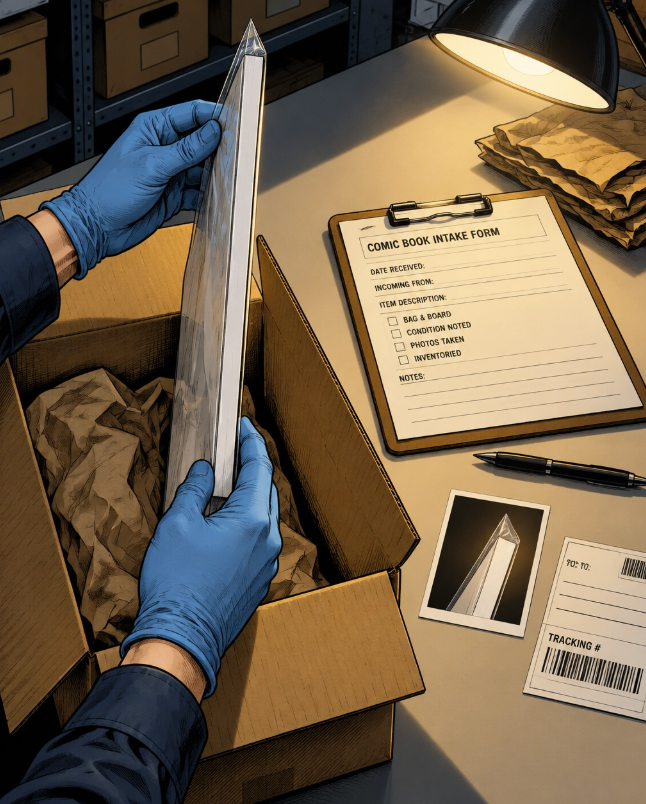
The Book You Sent Is Not Always the Book You Get Back: Chain of Custody, Swapping, and Trust in Comic Book Services.
Comic swapping is every collector’s nightmare: you send in a valuable book, and a different, lesser-value copy comes back.
That fear is not a reason to panic. It is a reason to slow down and ask how a service provider proves that the book they return is the one you sent. Good intentions matter. A documented process matters more.
The protection is called chain of custody: a clear record of who handled your comic, when they handled it, where it was stored, and what was done to it. It matters at every stage of comic book preservation, from cleaning and pressing to grading, storage, and shipping.
What swapping is, and why documentation matters
In a swap, someone replaces a valuable comic with a lower-value copy of the same or a similar issue. If the books look alike, and there are no detailed photos or intake notes, the owner may have trouble proving that the returned copy is different.
That does not mean every service is suspect. It means memory alone is a weak record. A stack of similar comics can be difficult to distinguish later, especially when a provider handles many customers’ books.
A trustworthy process makes each book identifiable before work begins.
The CGC incident: what collectors should know
In late 2023 and early 2024, CGC disclosed a holder-tampering incident that collectors came to call “Swapgate.” CGC said approximately 350 comic books were potentially affected. The reported scheme involved opening holders, replacing higher-value books with lower-value copies, and submitting tampered holders for reholdering.
Separately, in early 2024, CGC filed a lawsuit against two former employees. The lawsuit alleged that they stole customer comics and used counterfeit labels to make stolen books appear to carry higher grades before selling them. These were allegations described in the legal filings; this article does not make claims beyond the public record.
CGC published a list of potentially impacted certification numbers and offered a no-cost Holder Review for eligible books. CGC stated that books found correctly graded would be reholdered with new certification numbers and returned at no charge. Books found tampered with or incorrectly graded would be retained as evidence, with compensation based on the fair market value of the book at its original, incorrect grade. CGC also reported security and process changes, including additional review of reholder submissions and stronger holder seals.
That response deserves its due: disclosure, a review process, compensation, and security improvements. CGC remains the industry leader, and we work with CGC. The lesson is not that one company should be singled out. It is that trust must be verifiable everywhere in the hobby, even at the most established service levels.
Read CGC’s incident update and Holder Review details and ICv2’s coverage of the lawsuit.
Chain of custody, in plain language
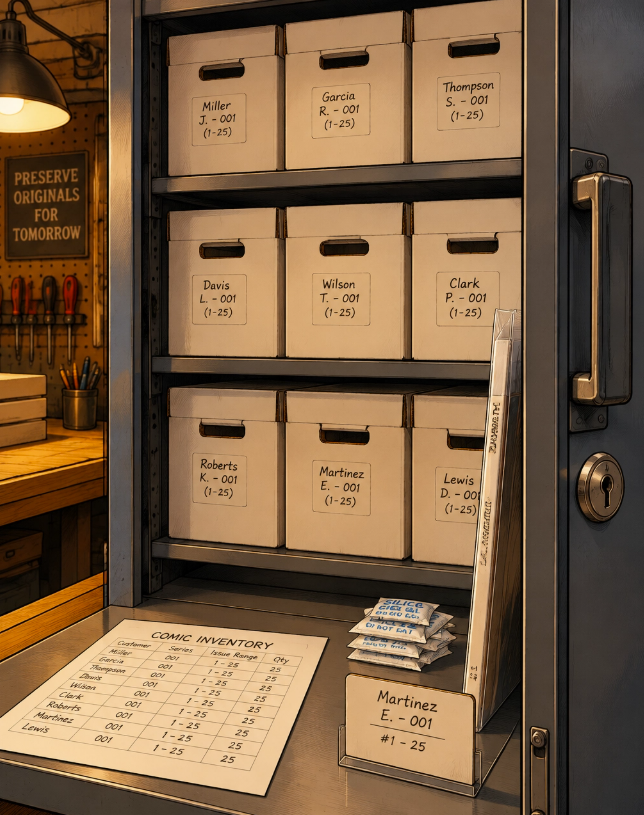
For a comic, chain of custody is an unbroken record of the book’s journey: what arrived, what condition it was in, who handled it, where it was stored, what work was performed, and how it was returned.
This is more than an administrative checklist. It protects the book and gives both sides a reliable record if questions arise.
Questions to ask your presser
Ask these questions before you ship. You can use them verbatim:
How do you identify my book when it arrives?
Do you photograph every book at intake and before and after work?
How is my book stored, where, and separated from other customers’ books?
Who handles my book, and can you tell me every person who touched it?
How do you match books back to the right customer at return?
What happens if my book is damaged while in your care?
Can I see photos of my specific book at every stage?
Do you insure shipments both ways?
What documentation do I receive at the end?
Good answers are specific and process-oriented. A provider should be able to explain how a comic is identified, documented, stored, and returned. “We’re careful” is reassuring, but it is not a chain of custody. “We’ve never had a problem” does not tell you what happens if there is one.
You do not need to demand a perfect system. You do need to understand the one you are trusting.
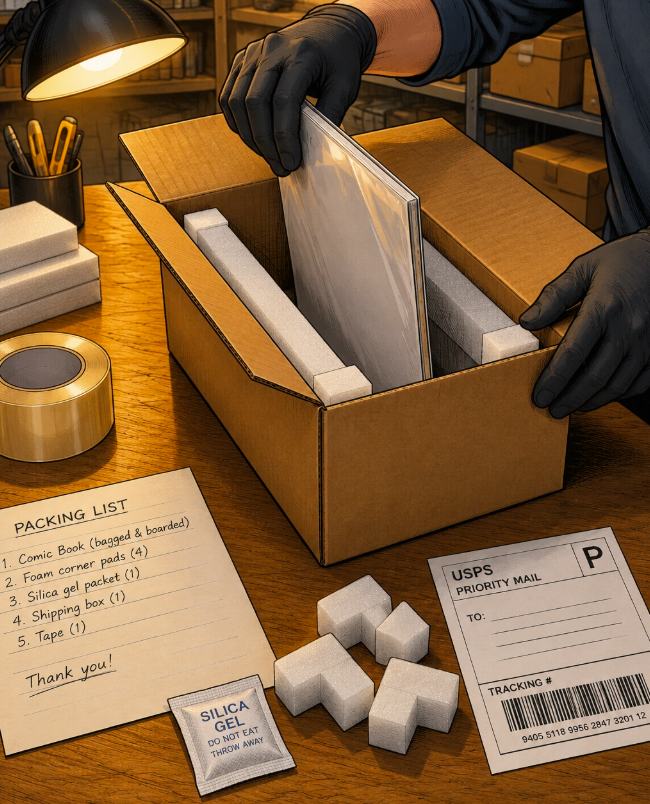
What useful documentation looks like
A photo of “a comic book” is not enough. You should be able to recognize your copy in the record.
That means clear intake photos of the front and back covers, spine, and corners. The images should show unique features: a small crease, a particular spine tick, a tiny stain, a corner bend, or another detail that distinguishes your book from a nearly identical copy. Written condition notes add context. Before-and-after photos show what changed, and what did not.
At the end, a final image of the actual book packed for return, a packing list, and tracking details help close the loop.
This is closely related to Rule Four of the Five Golden Rules of comic book pressing and cleaning: document the work so actions have a demonstrable effect and ineffective steps are not repeated. Documentation is not just proof of improvement. It helps establish that the same book moved through the process.
At Pressing Issues, our process includes a complimentary value analysis with a written estimate and photo updates during work. That is what a documented service should aim to provide: information you can review, not just reassurance you have to take on faith.
Ethics go beyond deliberate swapping
Swapping is theft. There is no softer way to say it.
But ethical responsibility reaches beyond intentional fraud. Mixing customer books without a reliable identification system, having an unclear photo policy, or relying on “trust me” instead of records creates avoidable risk. These practices can make mistakes harder to catch and make accountability harder to establish.
A service provider’s duty is not only to handle a comic carefully. It is also to preserve your ability to verify what happened to it.
You have responsibilities, too. Photograph your comics before shipping them. Make notes about unusual flaws or markings. For a slabbed comic, record the certification number and check it through the grading company’s verification service. Use tracked, insured shipping, and keep the receipt and packing details.
Trust should work in both directions. The provider documents its work; you keep your own record.
What I have learned
Trust is not a feeling. It is a system.
A presser who documents the process is not saying, “I don’t trust you.” They are saying, “Neither of us should have to rely on memory.” That distinction matters. Good documentation protects the collector, the service provider, and the comic itself.
The best providers welcome reasonable questions because their process can answer them. Before you send a book, slow down. Inspect closely. Ask how it will be identified, stored, handled, documented, and returned. If the answers are vague, ask again, or choose another provider.
For more on making careful choices about comic book pressing and cleaning, see The Five Golden Rules. And keep this advice close: if you love something, buy it, but always use caution.
Key takeaways
Chain of custody means a documented record from intake through return shipping.
Intake photos should show the specific book, including flaws that distinguish your copy.
Ask how a provider identifies, separates, handles, and matches books to customers.
Specific procedures are stronger than vague assurances.
Keep your own photos, condition notes, certification numbers, and shipping records.
Trust is earned through verifiability, not demanded through reputation alone.