
A comic book grade estimate can sound reassuring. It gives you a number to picture and a goal to hope for.
But your first question should not be, “What grade might this comic book get?” It should be, “Should I spend money on this comic book at all?”
That is where timing matters. A grade estimate delivered after pressing is a report card. A written defect audit delivered before work begins is a decision tool. Both can be honest. Only one can help you decide whether to commit.
The two deliverables
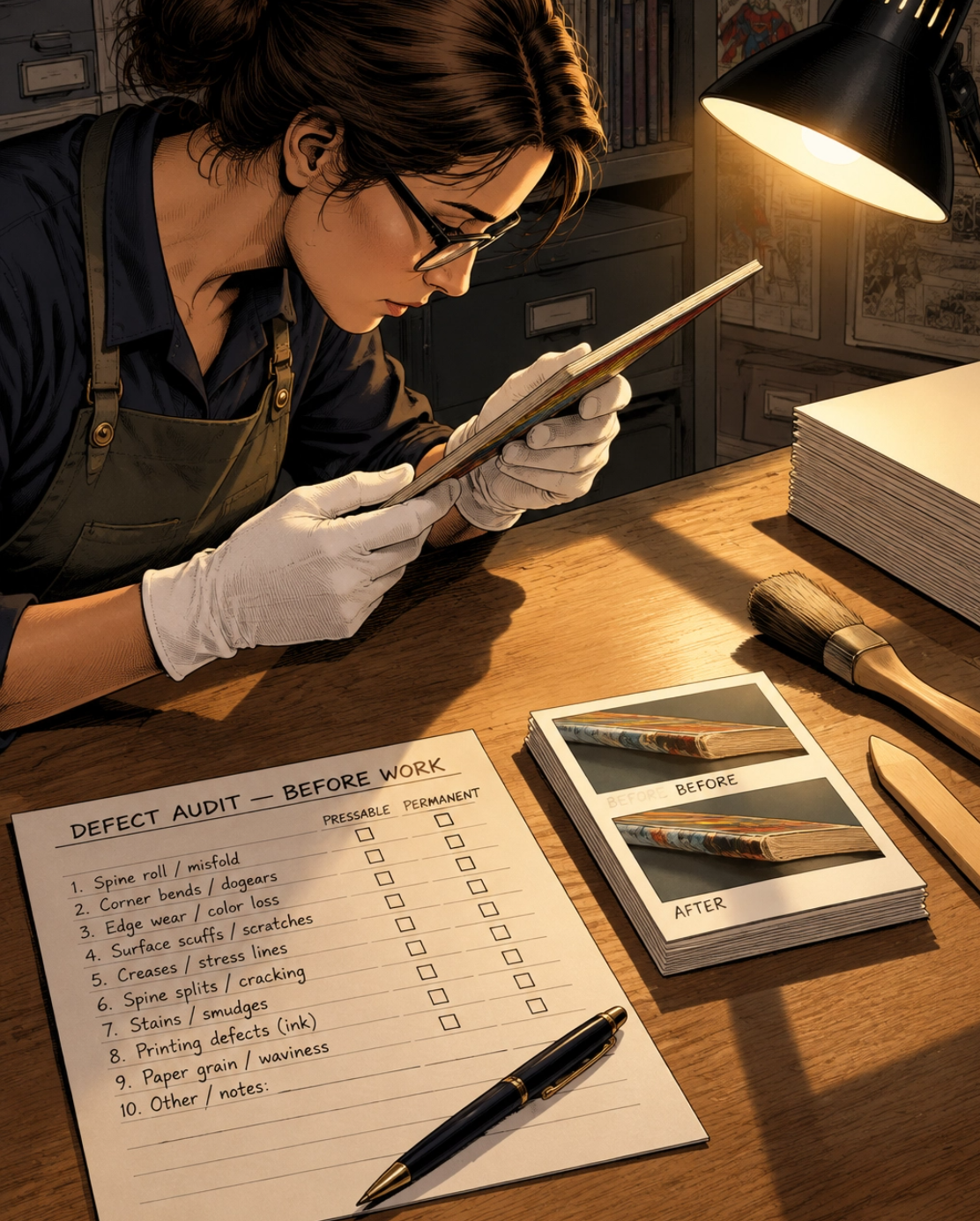
A pre-work defect audit tells you what is wrong with the book, which defects may respond to comic book pressing or comic book cleaning, which are permanent, and whether the likely result makes financial sense.
A post-work grade estimate offers an opinion about the book’s possible grade after treatment. It can be useful context. But by then, you may have already paid for pressing, shipping, grading, and other parts of the pipeline.
The difference is not whether a number is accurate. It is whether the information arrives in time to change your decision.
Why a grade estimate is the weaker tool
A number without the defects behind it is hard to act on.
If someone says “9.6,” you still need to know why. Is the book held back by a non-color-breaking bend that pressing may improve? A color-breaking crease that will remain? A stain, tear, or fragile staple area that limits the result, or makes treatment riskier?
Without that context, you cannot tell whether the proposed work addresses the problem.
A number can also anchor you. Once you hear “9.6,” it is easy to stop inspecting and start hoping. Possibility can make us see what we want to see. A grade is an opinion, not a promise, and the grading decision belongs to the grading service, not the presser.
And if the estimate arrives after the work, it describes a book you have already paid to treat. It may still help you decide whether to submit the book for grading. It cannot help you decide whether the pressing itself was worth authorizing.
What a real defect audit contains
A useful audit is specific enough for you to understand the recommendation and question it. It should include:
Each identified defect and its location. “Front-cover wear” is vague. “Short stress mark near the lower spine” gives you something to inspect.
Whether each mark is color-breaking. A flattened bend may look better; broken color will not be restored by pressing.
Which defects appear pressable and which are permanent. A crease, stain, tear, or missing piece may set limits that pressing cannot change.
A realistic ceiling and the reason for it. This is the part many collectors do not hear until after they have spent. A ceiling is not a guaranteed grade cap. It is an explanation of what remaining defects may limit the result.
Value scenarios at the likely grade and the hoped-for grade. The hopeful case is worth discussing, but it should not replace the realistic case.
The total cost of the pipeline. Consider pressing, cleaning if appropriate, grading, shipping, insurance, and selling costs, not just one service charge.
For a practical look at the difference between defects that may improve and defects you may have to accept, see our companion piece on the defects that decide a book's ceiling.
A ceiling is not pessimism. It is a way to avoid paying for an outcome the book cannot physically reach.
The financial math should come before the work
Slow down before you spend. Compare the book’s current raw value with realistic value scenarios after treatment. Use recent sales for comparable books where possible, and remember that condition, edition, timing, and venue can change what a comic sells for.
Treat grade and value bands as reference points, not rules. Two books with similar grades can have different demand. Two books with similar defects can respond differently to treatment. There is no universal grade bump or guaranteed return.
Your decision is a simple formula:
Likely value after work − current value − total pipeline cost = estimated financial upside or downside.
Do the calculation with the likely outcome first. Then consider the hopeful outcome separately. If the math only works in the best-case scenario, you need to know that before you authorize the work.
And if the honest analysis says “do not press,” you want to hear that before you ship, not after you have paid.
Why documentation also protects the presser
A written assessment gives you and the presser a shared starting point. You can see what was noticed, what the proposed work may address, and what is expected to remain.
That helps prevent “I thought you said 9.8” conversations. It also makes clear that an estimate is not a guarantee. A responsible process documents both the potential benefit and the limits.
Photos can help, too. A clear record of the front, back, spine, and relevant defects gives both sides something concrete to refer to. The goal is not paperwork for its own sake. It is a better decision and fewer surprises.
The questions that get you a real analysis
Before you authorize comic book pressing, ask:
Will you assess the book before I commit to the work?
Will I receive the assessment in writing?
Will it identify specific defects and where they are?
Will it separate pressable defects from permanent ones?
Will it explain what could limit the book’s likely ceiling?
Will it tell me if you think I should not press this book?
What does the analysis cost, and is it separate from the pressing work?
Listen for specifics. “We think it will grade well” is not the same as an explanation of what may improve, what will remain, and why the work makes sense.
For more questions to ask before sending a comic, see Choosing a Comic Book Presser: Why 90% of the Decision Isn’t the Pressing.
The five golden rules
A sound assessment should follow the same basic discipline as the work itself:
Do no harm.
Do not perform an action on a comic book that it does not need.
Handle each comic book with care to avoid causing new damage during any movement.
Document your work with photos to ensure actions have a demonstrable effect and avoid repeating ineffective actions.
Treat every action as having inherent risk, acting strategically rather than on a whim.
This is one reason professionals do not rely on dry cleaning with drafting powder. Powder can abrade a surface, lodge in paper, or affect gloss unevenly. If you are learning a new technique, experiment on inexpensive dollar books, not a valuable key issue or a book you cannot replace.
Our practice, plainly
We provide a complimentary value analysis before any work begins. It includes a defect-focused assessment, realistic value considerations, and a recommendation that may be to proceed, or not to press the book. It is meant to help you make an informed choice, not promise a grade or a return.
What I have learned
Collectors often come in hoping for a number. That is understandable. A grade can feel like a clear answer when a comic matters to you.
But the better conversation starts with the paper, the ink, the surface, and the defects you can actually see. Inspect closely. Ask what can change and what cannot. Then decide whether the likely result justifies the cost and risk.
Cleaning and pressing can support comic book preservation, whether or not you plan to submit a book for CGC pressing or grading. But preservation still calls for restraint. Not every book needs treatment, and not every treatment improves your position.
Key takeaways
A grade estimate tells you what someone thinks the book might grade.
A written defect audit explains why, and what pressing may or may not change.
The audit is most useful before you authorize work.
Calculate the total pipeline cost against the likely outcome, not only the hopeful one.
A sound presser should be willing to recommend no work.
The most valuable thing a presser can sell you is a reason not to spend money.
If you love something, buy it, but always use caution.